





Why Your Sleep Cycle Feels Off (And How to Fix It Without Turning Your Life Into a Wellness Spreadsheet)
If your sleep has been doing that fun little thing where you’re exhausted all day and then suddenly ready to reorganize your spice drawer at 11:47 PM… hi. Welcome. You’re not broken. You’re not “bad at sleeping.” And you probably don’t need a $300 magnesium cocktail that tastes like wet pennies.
A lot of the time, what’s actually off is your circadian rhythm—your body’s internal clock. And when that clock gets confused, it doesn’t just mess with bedtime. It messes with everything: energy, mood, cravings, focus, metabolism… the whole group chat.
The good news: you can usually nudge it back into place with a handful of boring but powerful habits (I know, I know—”go outside” isn’t the exciting answer we wanted).
Your brain has a tiny “master clock” and it’s kind of bossy
Deep in your brain (hypothalamus, if you like trivia) there’s a cluster of neurons called the suprachiasmatic nucleus—the SCN. I think of it as the cranky little manager of your body’s schedule.
It takes its cues mostly from light coming into your eyes. Morning light tells your body, “Rise and shine, it’s go time.” Evening darkness tells it, “Wrap it up, everyone out of the building.”
When those signals get muddy—hello, bright screens at midnight and sleeping until noon on Saturday—your “manager” starts sending mixed memos. And that’s when you get the classic wired and tired combo that makes you feel like a zombie with anxiety.
The two hormones that matter most (and why they keep beefing)
I’m going to keep this simple because nobody needs a hormone dissertation or evening DHEA timing benefits before coffee.
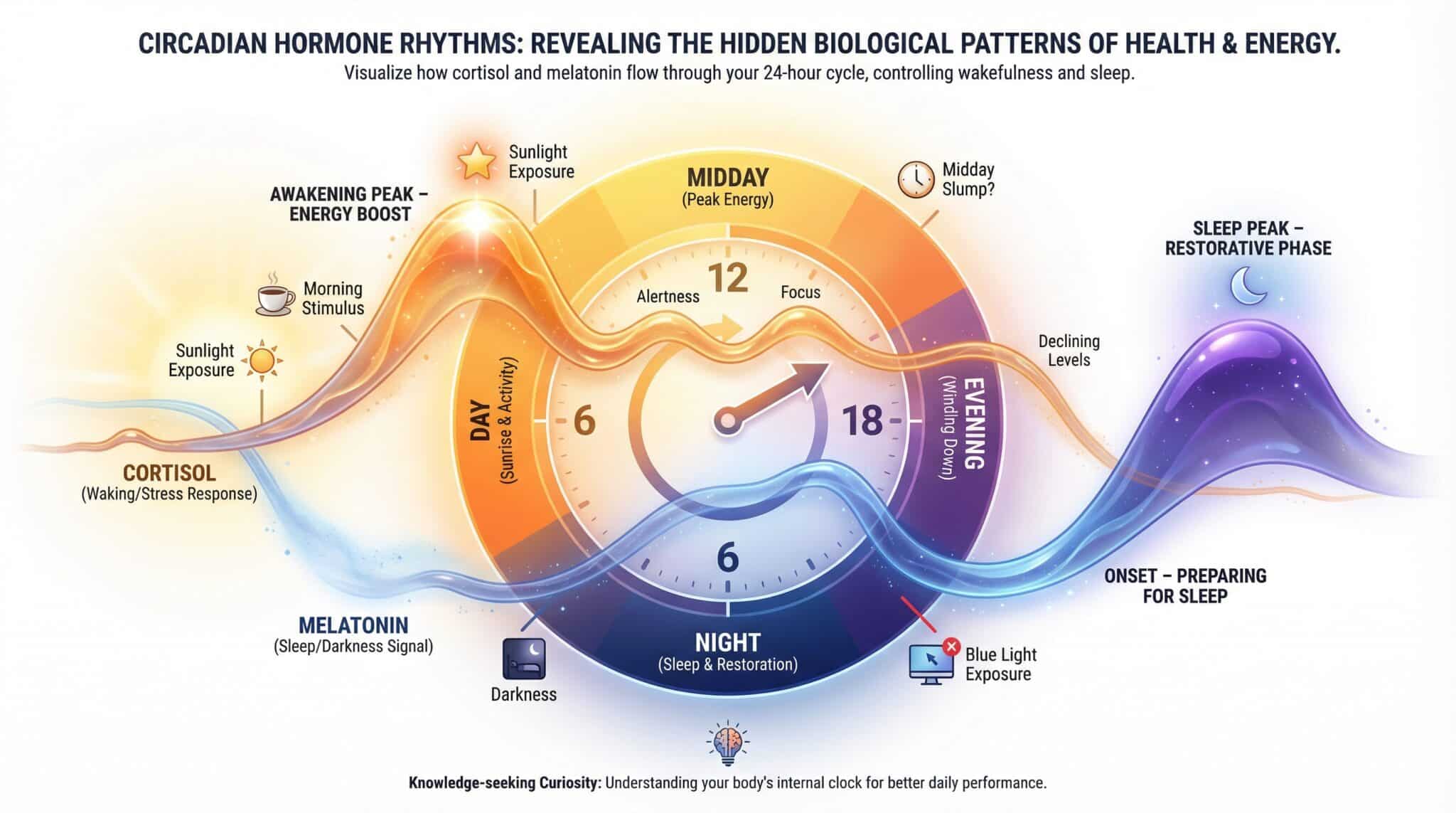
- Cortisol is your “get up and function” hormone. It naturally rises about 30-45 minutes after you wake up (that’s why you can feel foggy at first, then suddenly human). It should taper down by nighttime.
- Melatonin is your “it’s nighttime, please power down” hormone. It starts rising in the evening and peaks overnight.
These two should be doing a nice, polite relay race. When they overlap too much—this cortisol and melatonin clash has cortisol still acting like it’s morning while melatonin is trying to drag you into bed—you feel like you could nap… but also argue with a stranger on the internet. Not ideal.
The everyday habits that quietly wreck your rhythm
This is the part where you might feel lightly attacked. I say that with love. I’ve done all of these.
1) Nighttime screens (a.k.a. your eyeballs getting daytime messages at night)
Blue-ish light from phones, tablets, TVs—especially in the 2-3 hours before bed—can suppress melatonin fast. So you’re tired, you get in bed, and your brain’s like, “Sweet, it’s noon!”
2) The weekend sleep in that feels like “self-care” (but acts like jet lag)
If you wake up at 6:30 all week and then do a 10:30 Saturday “recovery,” your body basically experiences social jet lag. You’re not “catching up,” you’re time traveling twice a week.
3) Late night eating
Your digestion has its own timing. Eating close to bedtime tells parts of your body, “Let’s do daytime stuff,” while your brain clock is trying to run the nighttime program. That mismatch can mess with sleep and make cravings worse the next day. (Ask me how I know. Actually don’t. It involves leftover pasta at 10 PM.)
4) Shift work / weird schedules
If you work nights or rotate shifts, you’re basically running multiple time zones inside one body. That’s not a moral failing—it’s just a tough setup. You’ll need more “damage control” strategies (I’ll get to those).
“Is it my circadian rhythm or am I just tired?” A quick gut check
Here are some classic signs your internal clock is off, not just your sleep quality:
- You get 7+ hours but still wake up feeling unrested (multiple days a week)
- You’re tired…but it takes 30+ minutes to fall asleep
- Morning grogginess lasts 45+ minutes
- Afternoon crashes hit like a truck
- Evening cravings (especially refined carbs) show up on a schedule
- Your mood tanks when your routine changes—even if life is fine otherwise
If it’s predictable and pattern-y, circadian rhythm is a strong suspect.
My “reset your sleep cycle” plan (the stuff that actually moves the needle)
You don’t need to do all of this at once. In fact, please don’t. One habit you keep beats five habits you try for three days and then abandon dramatically on your bathroom floor.
1) Get outdoor light in the morning (yes, even if it’s gloomy)
This is the closest thing I’ve found to a real life reset button.
- Try to get bright light within 30-90 minutes of waking
- Aim for 20-30 minutes outside (longer if it’s very cloudy)
- A window helps, but outdoor light is much stronger
If you want to use a light therapy box, that can help too—just a quick safety note: if you have eye disease, take photosensitizing meds, or have bipolar disorder, talk to a clinician before using bright light therapy.
2) Anchor your wake up time (even on weekends… sorry)
If you only do one thing, do this.
Keep your wake time within about 30 minutes day to day. Bedtime will follow more easily once your mornings are consistent. (I know this is the opposite of how we want it to work. But your body loves morning consistency.)
3) Start “dim mode” 2-3 hours before bed
You’re trying to send a clear message: night is coming.
My personal hierarchy:
- Best: fewer/no screens late
- Next best: blue blocking glasses (true amber lenses work better than clear ones)
- Last resort: night mode settings (helpful, but not magic)
Also, overhead house lighting can be way brighter than you think. If your living room looks like an operating room at 9 PM, your melatonin is going to file a complaint.
4) Stop feeding yourself like it’s a midnight shift (set an eating window)
Your body generally handles food earlier in the day better than late at night. A simple guideline:
- Eat within an 8-10 hour window
- Try to have your first meal within 1-2 hours of waking
- Finish your last meal 2-3 hours before bed
Important note because this matters: if you have a history of eating disorders, you’re pregnant/breastfeeding, you have diabetes, or you take glucose lowering meds, talk with a clinician before tightening food timing. Your safety beats any routine.
5) Time caffeine, alcohol, and exercise like you actually want to sleep later
This is the “small hinges swing big doors” section.
- Caffeine: try cutting it by 2 PM (or noon if you’re sensitive). Also, waiting 30-60 minutes after waking for your first cup can help your natural morning alertness kick in first.
- Alcohol: give it at least a 3 hour buffer before bed. Even 1-2 drinks can fragment sleep (rude, I know).
- Exercise: earlier in the day tends to help your rhythm. Evening workouts can delay sleep for a lot of people—so if you’re lying awake after a late spin class, it’s not in your head.
What if you travel a lot or work nights?
First: you’re not failing. Your schedule is just playing on hard mode.
- Shift work: use bright light during your work hours, then wear dark sunglasses on the way home (yes, even if you look dramatic). Make your sleep space as dark as possible. Try to eat your biggest meal before your sleep period instead of right before bed.
- Jet lag: your body generally shifts about 1-1.5 hours per day with well timed light. Eastbound tends to be harder. If you’re going east, prioritize morning light at your destination; if you’re going west, late afternoon light can help.
Also: your natural chronotype matters. If you’re naturally a 9 AM person, forcing a 5:30 AM “miracle morning” might just make you permanently cranky. (Ask me how I know.)
How fast will you feel better?
In my experience (and backed by what we know about circadian timing), this is a decent expectation:
- 3-7 days: mornings start feeling less brutal
- 1-2 weeks: daytime energy improves
- 2-4 weeks: mood and cravings often calm down
- 4-8 weeks: bigger metabolic changes show up
Start with wake time + morning light for a week. Then layer in the evening dimming or caffeine cutoff. You’re building a rhythm, not cramming for a test.
When you should get professional help (because sometimes it’s not just “habits”)
If you’ve genuinely done the basics for 4+ weeks and nothing improves, it’s worth talking to a clinician. Same if you have loud snoring/gasping, intense daytime sleepiness, or symptoms that suggest something else is going on (sleep apnea, thyroid issues, iron deficiency can all masquerade as “my schedule is off”).
Also get evaluated sooner if you notice red flags like:
- consistently high fasting glucose (around 125 mg/dL or higher)
- missing menstrual cycles for 3+ months
- symptoms worsening significantly when you try to tighten your schedule
No prize for white knuckling it.
If you want the simplest “start tomorrow” version: set one wake up time you’ll honor, then step outside for morning light before you scroll. Give your body a clear signal, and it’ll do a lot of the heavy lifting for you.
And if you slip up? Congratulations, you are a human living in 2026 with electricity and a phone. Just get back to it the next morning. Your internal clock loves consistency—not perfection.