




If you’ve ever punched your stats into a calorie calculator and gotten a number that feels either insultingly low or suspiciously high, welcome. You’re in the club. Your resting metabolism (aka the calories you burn just existing) is doing the heavy lifting—roughly 60-75% of your daily burn, even on days when your only exercise is walking to the fridge like it’s an Olympic event.
And yet, most people obsess over workouts like that’s the whole story. It’s not. Your baseline burn is the quiet background app that’s running all day, draining the battery (in a good way). So let’s talk about the two acronyms that get tossed around like everyone was born knowing them: BMR and RMR.
Spoiler: they’re cousins, not enemies.
BMR vs RMR (aka “Do I Need to Live in a Lab to Get a Real Number?”)
BMR: Basal Metabolic Rate
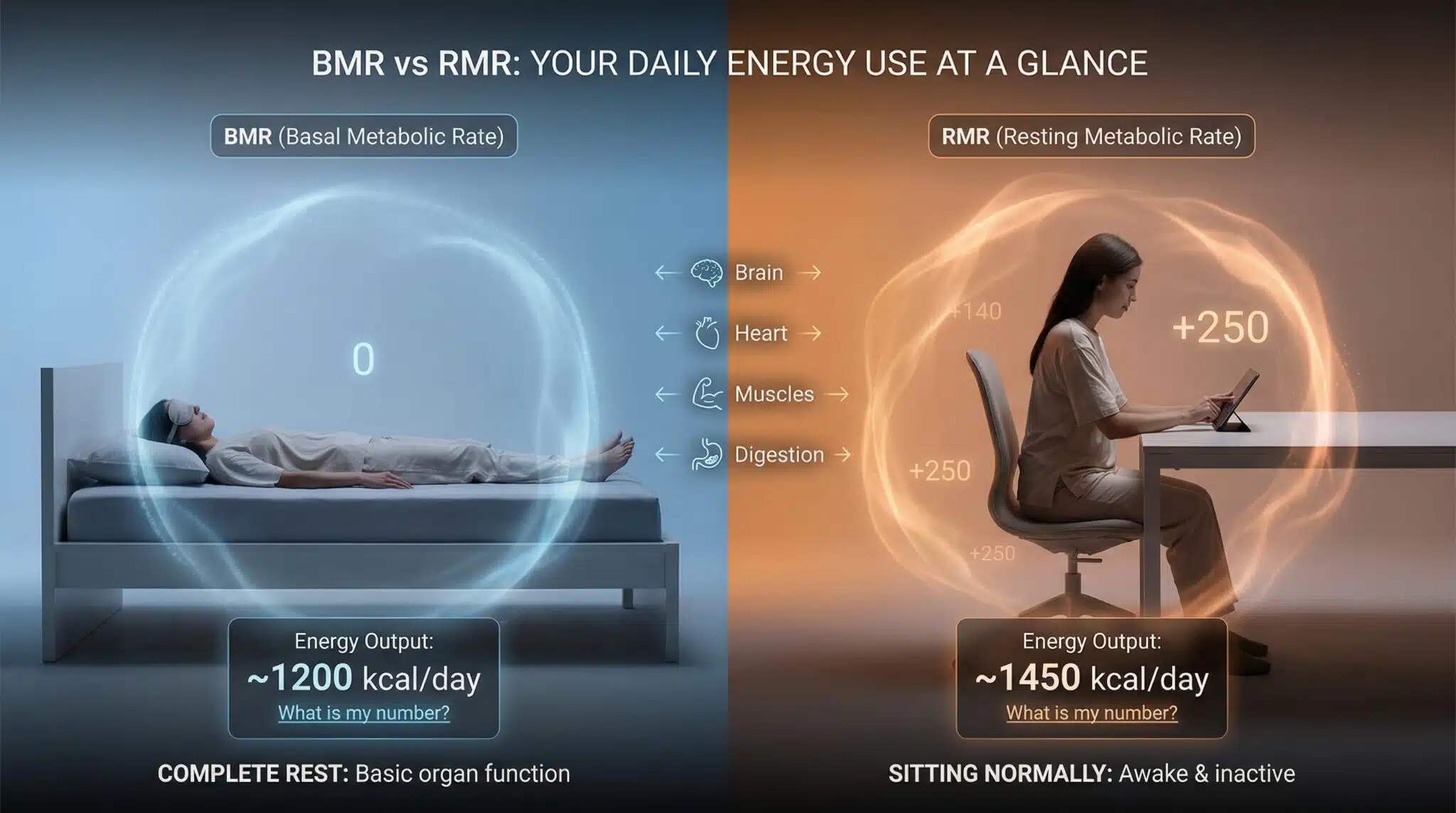
BMR is the most dramatic version of resting metabolism. Measuring true BMR is like auditioning for a very boring sci-fi movie:
- fast for 12 hours
- sleep overnight (usually in a lab)
- wake up in a temperature controlled room
- lie perfectly still while someone measures your oxygen use
It’s accurate, sure. It’s also completely unrealistic for normal life unless you routinely spend your weekends in a “silent medical cave.”
RMR: Resting Metabolic Rate
RMR is the more practical, real world sibling. Same idea—calories burned at rest—but measured under looser conditions:
- fast 2-5 hours
- sit or lie down आरामfully (not “don’t move or the scientists will hiss”)
- no overnight lab sleep required
Because it’s not your body’s absolute lowest setting, RMR is usually about 5-10% higher than BMR.
So… which one should you “trust”?
For everyday goals (fat loss, maintenance, muscle gain), RMR is the one you’ll actually use. And honestly? Most apps and coaches say “BMR” when they really mean “RMR-ish.” The difference is usually small enough that it won’t make or break your results.
If you take nothing else from this post, take this: stop getting hung up on the acronym and start using the number consistently.
Why Your Resting Burn Matters More Than Your Workout Calories (Sorry, Spin Class)
Workout calories are flashy. Resting calories are… not. But resting burn is the huge chunk of your day.
Think of it like this: workouts are the fun little bonus purchases. Your resting metabolism is the mortgage. It’s happening whether you acknowledge it or not.
Here’s how to use it without spiraling:
- If you want fat loss: Your resting number helps you set a realistic intake once you estimate your total daily burn (more on that in a second).
- If you want to build muscle: It reminds you that you still need enough calories to support training. (A lot of people “bulk” like Victorian birds: tragically underfed.)
- If you want to maintain: It gives you a baseline so you can stop guessing and start adjusting like a sane person.
And yes, your needs can change. Retest/recalculate and decide how often to retest if you’ve:
- gained or lost ~15-20 lbs
- dramatically changed activity (new job, training for a race, couch era, etc.)
- stalled for weeks and the math is no longer math-ing
How to Get Your Metabolic Rate (Pick Your Level of Fancy)
1) Indirect calorimetry (the “real test”)
This is the gold standard: you breathe into a device that measures oxygen in / CO₂ out and calculates your resting burn.
- takes about 15-20 minutes
- often costs $75-$150
- offered at some gyms, wellness clinics, dietitian offices
If you love data (or you’ve been stuck forever), it can be worth doing once.
If you do it: skip hard exercise and caffeine for ~24 hours, fast at least 3-4 hours, and show up calm. Don’t sprint in late while chugging an espresso like you’re in an action movie.
2) An online calculator (the “free and good enough” route)
Most calculators use predictive equations (Mifflin-St Jeor is a common one). They’re not psychic—they’re math based on age, sex, height, weight.
Are they perfect? No. Are they usually close enough to start? Yes. Think “within ~10% for many people.”
Pro tip: use real measurements. Not your “I’m basically 5’6″ on a confident day” estimate.
“Normal” RMR: A Reality Check (So You Stop Comparing Yourself to That One Friend)
There’s no single normal, because size and muscle mass matter a lot. But typical adult RMR ranges often look like:
- Women: ~1,200-1,500 calories/day
- Men: ~1,500-2,000 calories/day
A smaller person will usually have a lower RMR than a taller, more muscular person. That’s not “broken metabolism.” That’s physics.
If you get a measured RMR that’s way (like 10-15%+) below what a reputable calculator predicts and you feel genuinely off, it’s worth retesting or checking in with a clinician—especially if you want context on what your metabolic reading means or you suspect thyroid issues or something medical is going on.
What Actually Changes Your Metabolism (No, It’s Not a Magic Tea)
Here’s what moves the needle the most:
- Muscle mass: more muscle generally = higher resting burn. This is why strength training is so powerful long term.
- Age: metabolism can drift down with age, mostly because many people lose muscle over time. Resistance training helps a lot.
- Sex/body composition: men often have higher RMRs on average because they tend to carry more muscle.
- Recovery + nutrition: protein helps support muscle. Poor sleep can mess with hunger and recovery. Crash diets can cost you muscle (and then your resting burn drops, which is rude).
Your metabolism doesn’t need drama. It needs consistency. (Annoying but true.)
Okay, Now What? Use Your Number Without Losing Your Mind
Here’s the simple workflow I use for myself and recommend to basically everyone:
1) Get an RMR estimate (calculator or test)
2) Estimate TDEE (total daily energy expenditure) using an activity multiplier
3) Pick a goal (lose, maintain, gain) and set a starting calorie target
4) Track results for 2-3 weeks, then adjust based on reality
Because reality is the boss, not your spreadsheet.
Activity multipliers (choose your real life, not your “January 2nd” life)
- Sedentary: RMR × 1.2
- Lightly active (1-3 workouts/week): × 1.375
- Moderately active (3-5 workouts/week): × 1.55
- Very active (6-7 hard sessions/week): × 1.725
Example (so you can see the math once, then never do it again)
If your RMR is 1,500 and you’re moderately active:
TDEE ≈ 1,500 × 1.55 = 2,325 calories/day
From there:
- Fat loss: subtract 300-500 (or ~10-15%) → start around 1,800-2,000
- Maintenance: eat around 2,325
- Muscle gain: add 200-300 → around 2,525-2,625
After 2-3 weeks, look at weekly averages, not random Tuesday weigh-ins after salty takeout. If nothing’s moving, adjust by 100-200 calories, rinse and repeat. Small tweaks beat big emotional overhauls.
Quick Safety Note (Because You’re a Person, Not a Science Experiment)
If you’re pregnant, breastfeeding, under 18, have a history of eating disorders, or have metabolic/medical conditions, get medical guidance before using generic calorie targets.
And if you notice stuff like persistent dizziness, extreme fatigue, missed periods, or feeling generally unwell: please don’t “push through.” Get help. Safety first, abs second.
The Bottom Line
BMR is the ultra controlled lab version. RMR is the practical, real life version. Use whichever number you can get, apply it consistently, and adjust based on what your body actually does.
Your metabolism isn’t a mystery novel you solve once and shelve forever—it changes as you change. So grab a starting number, make a plan, and let real world results guide you.
Numbers first. Vibes second.