





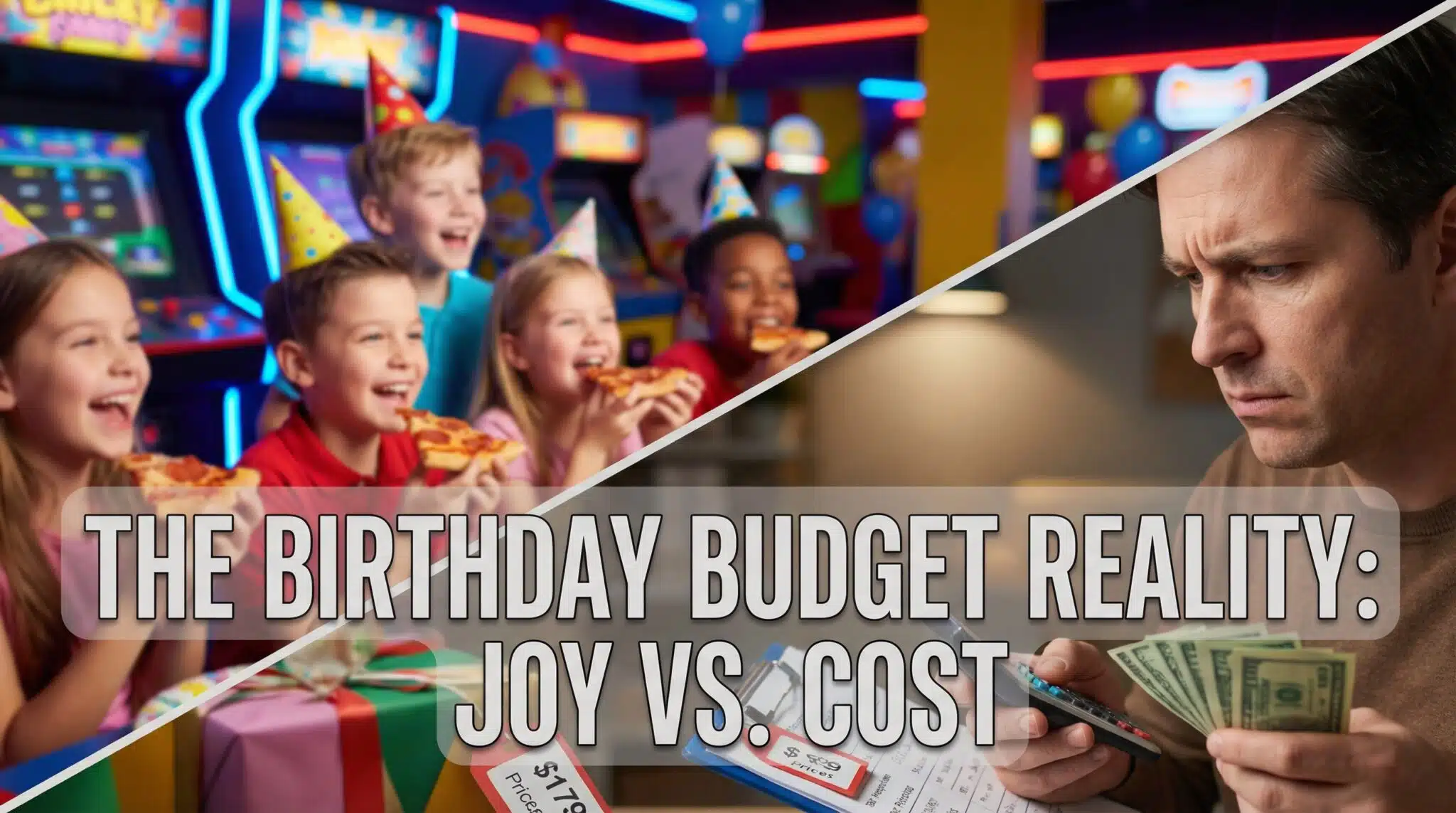








You know that feeling when you see “$19.99 per child” on a fun center website and you’re like, “Oh. That’s… manageable. We can do this.”
Yeah. That price is the party version of “starts at” as in starts at before reality shows up with a clipboard, a lanyard, and a card reader.
I’ve watched so many parents (myself included, and also every parent I’ve ever spoken to in a parking lot after a party) walk in thinking, “This will be like $200-ish,” and walk out like, “How did we just donate $480 to the arcade gods?”
So let’s talk about why that happens, what the pricing models actually mean, and how to keep your kid’s birthday from turning into a surprise bill you have to emotionally process later in the car.
Consider this your “because kids” tax prevention plan.
The “Quick Math” I Use So I Don’t Cry Later
Here’s the simplest way to estimate a fun center party without needing a spreadsheet (or a stress rash):
- Take your guest count and multiply by about $22 for a mid range guess.
- Then add ~30% for the little “oops” charges that magically appear.
So if you’ve got 10 kids, don’t budget $220 and call it a day. Budget closer to $300 and you’ll sleep better.
Because the sticker price isn’t the meal. It’s the appetizer they hand you while they’re quietly preheating the hidden fees.
The 3 Ways These Places Get You to Hand Over Money (Lovingly)
Most venues do one of these pricing setups. None are evil. They’re just… very good at math.
1) Per kid pricing (usually $18-$45 each)
You pay for each kid who shows up.
Best for: smaller parties or if you’re unsure who will actually come (because RSVPs are basically a suggestion now).
Bonus: you usually don’t pay for no-shows. Which is the only upside of no-shows.
2) Flat package pricing (like “up to 10 kids”)
One price covers a set number of kids, and then you pay per extra child.
Best for: predictable headcounts and predictable budgets.
Catch: those extra kid charges can be spicy. Like, “How is one additional second grader $25?” spicy.
3) Room rental + a la carte everything
You pay for the room, and then you pay for food and activities separately.
Best for: control freaks (hi, it’s me) or families who want to customize.
Catch: this model requires you to track every add on like you’re running an event for the Olympics. One “sure, add another pizza” and your budget faceplants.
And no matter which model you pick… you’re not safe yet.
Because we haven’t met the gremlins.
The Hidden Fees That Make Your Total Do Backflips
This is where the “$19.99 per child” turns into “Why is my receipt the length of a CVS coupon?”
1) The arcade credit overage (aka: the big one)
The included game card lasts approximately 12 minutes if your kid is on a mission, and about 7 minutes if another kid keeps swiping their card “just once.”
Most parents end up buying refills to avoid the end of party meltdown where a child dramatically collapses near the skee-ball.
If you want to be realistic, plan on extra game money. Even just $10-$15 per kid adds up fast.
2) Gratuity / tip
Some places include it. Some expect it. Some include it but also have a line where you can tip more (bold).
I’d assume 15-18% unless you’re told otherwise, or budget $20-$50 depending on the party size.
3) Sales tax
Not exciting, but very real. It’s an easy one to forget because nobody daydreams about tax while booking a bounce house.
4) Outside cake fees (yes, really)
Bring your own cake and suddenly you’re paying a “cake cutting fee” that feels like you’re renting their knife and their attitude.
Not every place does this, but enough do that you need to ask.
What It Actually Costs (Realistic Examples)
These numbers vary by location, but also by types of fun centers:
A smaller, “we’re being chill” party (10 kids)
- Package looks like: ~$180-$220
- After tax/tip: ~$220-$280
- If you buy extra game credits: hello $300
A normal, mid range party (15 kids)
- Package looks like: ~$300
- Add tax/tip + game refills: $400-$500 (very common)
A bigger “premium” party (20 kids + upgrades)
- Base package: $600-$800
- Add the layer of extras: $900-$1,000+ without trying that hard
The bigger the package, the bigger the “add on layer” tends to get. It’s like ordering nachos and somehow ending up with guac, queso, brisket, and a side of regret.
How to Cut the Bill Without Becoming the Birthday Grinch
You don’t have to uninvite kids or hand out raisins instead of cupcakes (unless you want to be that person who suggests group yoga poses for teamwork). Try these instead:
Book on a weekday if you can
Tuesday-Thursday time slots are often noticeably cheaper than weekends. Like 20% cheaper in some places.
Yes, it’s inconvenient. But also: money.
Watch for minimums and thresholds
Some venues have weird staffing minimums like “8 kids minimum” or “10 kids minimum,” and if you’re just under, they may charge you anyway.
It can literally be cheaper to book for 10 than to book for 9, which makes zero logical sense and yet.
Understand what “party time” actually means
If you book 2 hours, you might not get 2 hours of actual party. Some places count setup/cleanup in that window, so you’re really getting more like 90 minutes of chaos.
This matters when you’re paying extra for time, or if you’re trying to squeeze in pizza, presents, and play without turning into a party drill sergeant.
Also: read the cancellation/reschedule policy. Refunds get strict real fast once you’re close to the date.
The 5 Questions I’d Ask Before I Hand Over My Card
If you ask nothing else, ask these. Ideally while you’re calm at home not while a gaggle of sugared up kids is chanting “CAKE CAKE CAKE” behind you.
And yes: get the answers in writing. Screenshot it. Save the email. Tattoo it on your soul.
- What’s the total after tax and mandatory fees?
- Is gratuity included, or is tipping expected separately?
- Is there a fee if I bring my own cake?
- Does the reserved time include setup/cleanup, or is that separate?
- What do you charge per child if we go over the package limit?
That’s it. That’s the script.
Go forth, book the party, and make the fine print behave.