



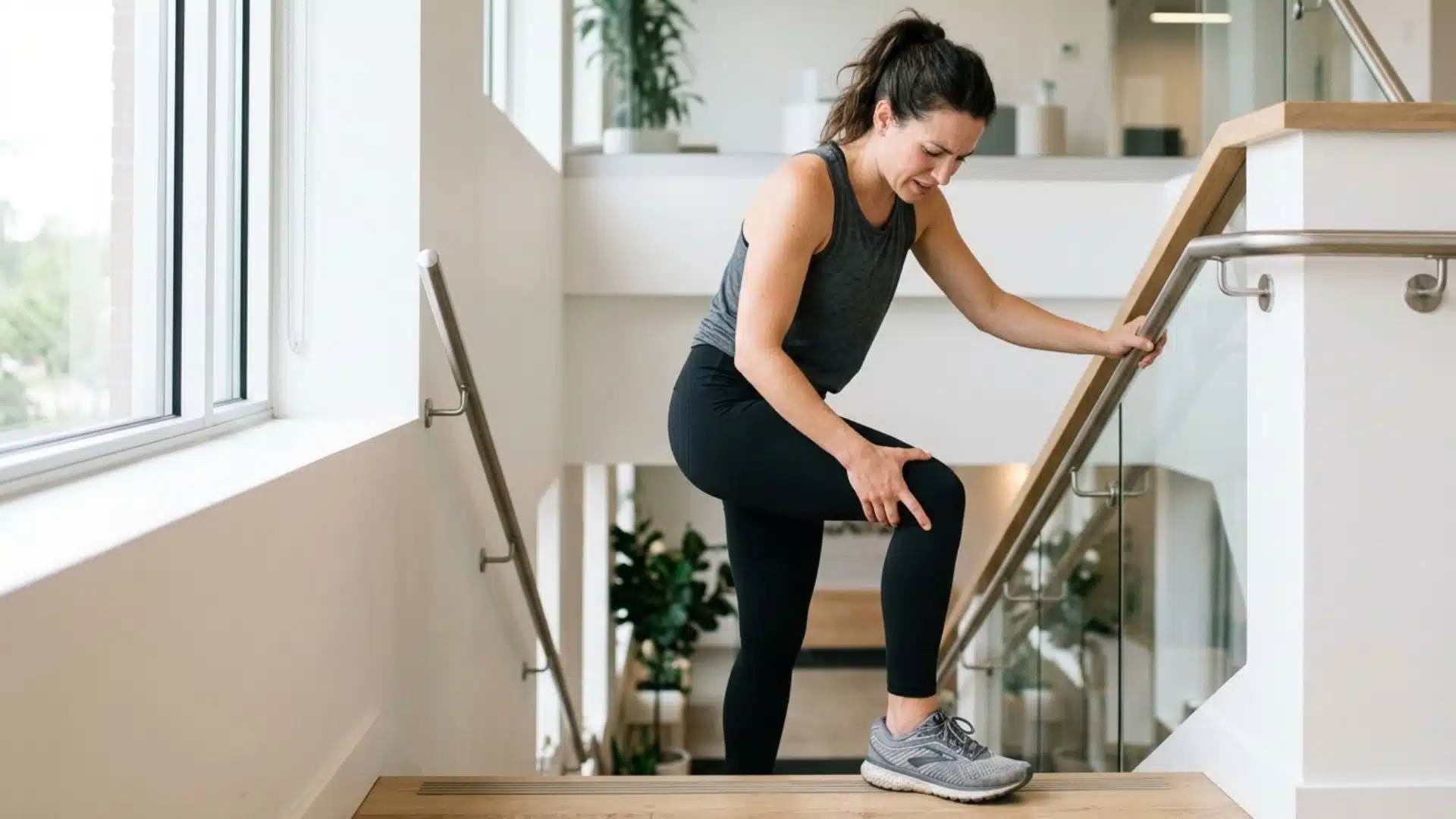






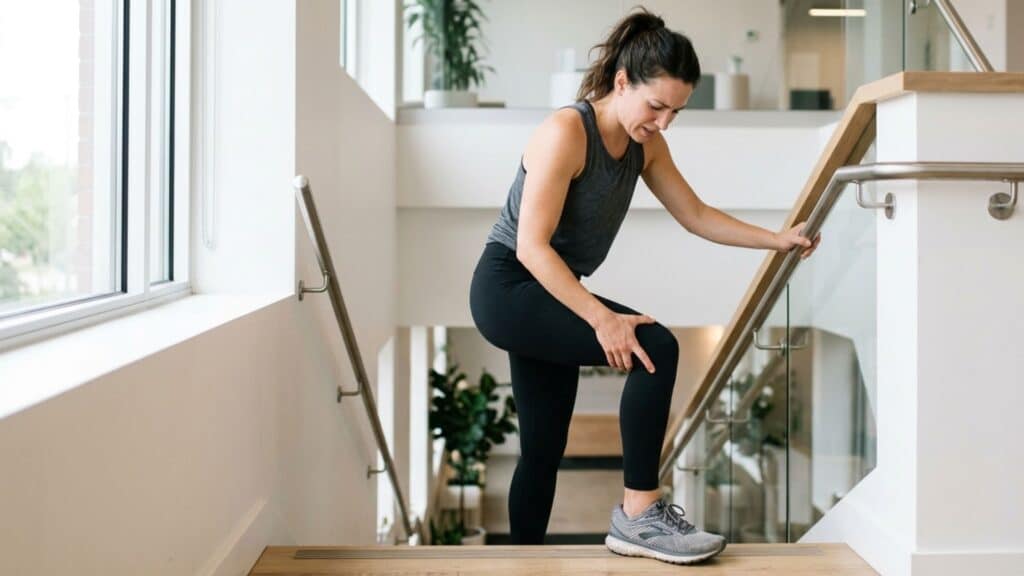

Many people notice knee pain when climbing stairs, even though walking on flat ground feels normal. This often happens because stair climbing places much more pressure on the knee joint than regular walking.
Research shows that going up stairs places roughly 316% of your body weight through the kneecap. For someone weighing 185 pounds, that means nearly 580 pounds of force on the knee joint with every step up. Going down stairs is actually harder on the knee, placing up to 346% of body weight through the same joint. This is why even a minor knee issue that you barely notice on flat ground can become noticeably painful the moment you hit a staircase.
When you step upward, your knee bends deeply while the muscles in your thighs and hips lift your body against gravity. This movement can place three to four times your body weight on the knee joint, making small issues feel more easily.
In my experience helping people improve joint strength and movement patterns, this type of pain often appears when the muscles supporting the knee are weak or the joint becomes irritated.
You’ll learn the common causes, helpful exercises, and simple ways to reduce knee discomfort.
Why You Feel Knee Pain Going Up Stairs
Climbing stairs requires more strength and control than walking on flat ground. During this movement, the knee must perform several tasks simultaneously.
It needs to bend deeply, support your body weight, stabilize the joint, and help lift the body upward with the help of the thigh and hip muscles. Because of this increased demand, the knee joint experiences much more pressure than during normal walking.
When small issues exist in the joint, stair climbing can make them more noticeable. In fitness and rehabilitation settings, knee pain during stair use is commonly linked to weak quadriceps muscles, tight hamstrings or hips, irritation of the cartilage beneath the kneecap, joint inflammation, or previous knee injuries.
When the surrounding muscles are not supporting the joint properly, more pressure shifts directly onto the knee, which can lead to discomfort.
Hip and ankle weakness also plays a role that many people overlook. When the hips or ankles are weak or stiff, the knee is forced to compensate during stair climbing, which increases the strain on an already stressed joint.
Symptoms That Often Come With Knee Pain When Climbing
Knee pain while climbing stairs may be accompanied by other symptoms that help identify the problem. Common signs include:
- pain around or behind the kneecap
- Sharp or dull pain when bending the knee
- swelling or stiffness
- grinding or popping sensations
- weakness or instability in the joint
Recognizing these symptoms early can help you take steps to protect your knee before the problem becomes more serious.
Pain going up vs. pain going down
Some people experience pain only going up stairs, while others find going down more painful. Pain going up is often linked to muscle weakness, patellofemoral syndrome, or early arthritis.
Pain going down stairs tends to place even greater strain on the kneecap, so if descending is worse for you, conditions like chondromalacia or significant cartilage wear are more likely involved.
Knowing which direction hurts more can help a doctor narrow down the cause faster.
Common Causes of Knee Pain Going Up Stairs
Several conditions can lead to knee pain when going up stairs, especially when the joint is under extra pressure. Understanding the possible causes can help you find the right way to manage and reduce the pain.
1. Patellofemoral Pain Syndrome (Runner’s Knee)
One common cause of knee pain when going up stairs is patellofemoral pain syndrome, often called runner’s knee. This condition happens when the kneecap does not move smoothly over the joint beneath it.
I often see people feel a dull ache around or behind the kneecap while climbing stairs, squatting, or sitting for long periods. It can develop from overuse, muscle weakness, or poor alignment of the knee.
Strengthening the thigh muscles and improving movement patterns can help reduce the pressure on the kneecap.
2. Osteoarthritis
Osteoarthritis can also lead to knee pain, especially in older adults. In this condition, the cartilage that cushions the knee slowly wears down over time.
Without enough cartilage, the bones may rub together, causing pain, stiffness, and sometimes swelling. Many people notice the discomfort more during activities that put pressure on the knee, such as climbing stairs or standing up.
Staying active, managing body weight, and strengthening the muscles around the knee may help reduce the stress on the joint.
Note: Knee pain during stair climbing is actually one of the earliest signs of osteoarthritis. If you are over 50 and notice stiffness or aching specifically on stairs, it is worth mentioning to your doctor even if the pain feels manageable right now.
3. Meniscus Tear
A meniscus tear is an injury to the cartilage that cushions and stabilizes the knee joint. This cartilage helps absorb shock during movement.
When it tears, people may feel sharp pain in the knee, especially when climbing stairs or twisting the leg. Some also notice swelling, stiffness, or a catching feeling in the knee.
I’ve seen this injury happen during sports or sudden movements. Proper rest and physical therapy can often help the knee heal and regain strength.
4. Weak Leg Muscles
Weak leg muscles can also cause pain. The muscles in the thighs and hips help support the knee joint and control movement.
When these muscles are weak, the knee has to handle more pressure than it should. I often explain that strong muscles act like helpers for the knee. If they are not doing their job, the joint can become strained.
Strengthening the quadriceps and glute muscles can improve knee support and make stair climbing easier.
5. Ligament Injuries
Ligaments are strong tissues that connect bones and keep the knee stable. If a ligament becomes stretched or torn, the knee may feel painful or unstable.
I’ve noticed that people with ligament injuries often experience discomfort when climbing stairs because the knee has to support body weight as it bends. Sometimes the knee may feel like it might give way.
Swelling and limited movement can also occur. Proper rest, medical care, and rehabilitation exercises are often needed for recovery.
6. Chondromalacia Patella
Chondromalacia patella occurs when the cartilage under the kneecap becomes soft or damaged. This cartilage normally helps the kneecap glide smoothly when the knee bends.
When it is irritated, people may feel pain at the front of the knee, especially during activities like climbing stairs or squatting. I’ve noticed that some people also experience a grinding or rubbing feeling in the joint.
Strengthening the thigh muscles and reducing repeated stress on the knee may help improve this condition.
7. IT Band Syndrome
The iliotibial band is a thick band of tissue that runs along the outside of the thigh from the hip to the knee. When it becomes tight or inflamed, it can cause pain on the outer side of the knee, particularly during activities that involve repeated bending such as stair climbing.
In early IT band syndrome, pain may ease once you warm up, but over time it tends to persist throughout activity. Stretching the hip and outer thigh regularly and strengthening the hip abductors can help reduce the tension on the IT band.
Home Remedies for Knee Pain Going Up Stairs
If knee pain occurs during stair climbing, several simple strategies may help reduce discomfort.
- Resting the knee and limiting excessive stair use
- Applying ice for 15 to 20 minutes to reduce swelling
- Using a supportive knee brace
- Wearing supportive footwear with cushioning and good arch support. Shoes with poor arch support cause the foot to flatten, which pushes the knee inward and adds stress to the joint on every step.
- Maintaining a healthy body weight – every extra pound of body weight adds roughly four pounds of pressure on the knee joint during everyday movement, and more during stair climbing
- Warming up before climbing stairs by bending and straightening the knee for one to two minutes. This gives the joint time to produce the fluid it needs to move comfortably.
These habits can help reduce pressure on the knee joint while it recovers.
How to Climb Stairs With Less Knee Pain Right Now
While you are working on building strength, adjusting your technique on stairs can make a noticeable difference immediately.
- Lead with your stronger leg going up. When climbing, step up with your less painful leg first so it handles the load of lifting your body against gravity.
- Lead with your weaker leg going down. When descending, step down with your more painful leg first so gravity works in your favor and less force goes through it.
- Use the handrail. Holding the handrail transfers some of your body weight to your arms and reduces the load on your knees.
- Place your full foot on each step. Putting only the ball of your foot on a step forces more pressure through the kneecap. A full foot placement lets you push through your heel, which is far more stable.
- Lean slightly forward. A small forward lean when stepping up shifts the load from your knees toward your hips, which are better equipped to handle it.
- Use a bag that leaves your hands free. Carrying heavy bags on one side throws off your balance and increases uneven loading on the knee. A backpack or messenger bag keeps you balanced and lets you use the handrail.
Simple Exercises That May Help Reduce Knee Pain
I’ve found that simple exercises can help support the knee joint, improve stability, and reduce pressure on the kneecap. As the muscles around the knee become stronger and more flexible, everyday movements like climbing stairs can become easier and more comfortable over time.
1. Straight Leg Raises
Straight-leg raises are a gentle exercise that strengthens the quadriceps, improves knee stability, and supports the joint without putting extra pressure on your knees.
Steps to Follow:
- Lie flat on your back with one leg bent and the other leg straight.
- Slowly lift the straight leg about 6–12 inches off the ground.
- Hold the position for 2–3 seconds while keeping the leg extended.
- Lower the leg slowly back to the ground in a controlled motion.
- Repeat the movement for the desired number of repetitions.
Training Note: Perform 10–15 repetitions per leg, 2–3 sets daily, gradually increasing as your strength improves.
2. Wall Sits
Wall sits are an effective exercise that strengthen your thighs, support the knee joint, and improve stability during daily movements like climbing stairs.
Steps to Follow:
- Stand with your back flat against a wall and feet shoulder-width apart.
- Place your feet about two feet away from the wall.
- Slide your back down the wall until your knees reach about a 45–60° bend.
- Keep your core engaged and avoid letting the knees pass your toes.
- Hold the position, then slowly slide back up to standing.
Training Note: Start by holding for 15–30 seconds, gradually increasing to 60 seconds, and do 2–3 sets for optimal thigh strength.
3. Step-Ups
Step-ups strengthen the thighs, hips, and glutes while improving balance, making daily activities like stair climbing easier and reducing strain on the knee joint.
Steps to Follow:
- Stand facing a stable step or platform with feet hip-width apart.
- Step onto the platform with one foot and press through the heel.
- Lift your body upward while keeping your posture upright.
- Slowly lower the same foot back to the ground.
- Repeat on the opposite leg
Training Note: Perform 10–15 repetitions per leg, 2–3 sets, gradually increasing height or duration as strength improves.
4. Hamstring Stretches
Hamstring stretches improve flexibility in the back of your thighs, reducing tension on the knee and promoting smoother movement during activities like climbing stairs.
Steps to Follow:
- Sit on the floor with one leg extended and the other bent.
- Reach forward toward the toes of the extended leg.
- Keep your back straight and avoid rounding the shoulders.
- Hold the stretch for 20–30 seconds.
- Switch legs and repeat.
Training Note: Breathe deeply and avoid bouncing; consistent daily stretches enhance knee comfort and mobility over time.
5. Glute Bridges
Glute bridges strengthen the glutes and hamstrings, which are key muscles that support the knee from above. Stronger glutes mean the knee does not have to compensate during demanding movements like stair climbing.
Steps to Follow:
- Lie on your back with knees bent and feet flat on the floor, hip-width apart.
- Press through your heels and lift your hips toward the ceiling.
- Squeeze your glutes at the top and hold for 2 to 3 seconds.
- Lower your hips slowly back to the floor.
- Repeat for the desired number of repetitions.
Training Note: Perform 12 to 15 repetitions, 2 to 3 sets. This exercise is safe even during active knee pain and can be started earlier in recovery than more loaded movements.
When You Should See a Doctor
If you have knee pain going up stairs that does not improve after a few weeks, it may be a good idea to see a doctor. I always suggest paying attention to warning signs like swelling, redness, or warmth around the knee.
You should also seek medical help if the knee feels unstable, locks during movement, or makes it hard to walk normally. Sudden or severe pain can also signal a deeper problem, such as a ligament injury or cartilage damage.
A healthcare professional can examine the knee, find the cause of the pain, and suggest the right treatment to help you recover safely.
If conservative approaches like exercise and rest have not helped after 4 to 6 weeks, a doctor may recommend imaging, physical therapy, or other treatment options. In cases where nonsurgical treatments are ineffective, knee replacement surgery is an option that has helped many people with severe osteoarthritis regain comfortable movement.
Common Mistakes to Avoid
Certain habits can place additional stress on the knee joint. Common mistakes include:
- avoiding strengthening exercises
- skipping warm-ups before activity
- leaning too far forward while climbing stairs
- ignoring proper movement form
- increasing activity levels too quickly
- Relying on a knee brace long-term without doing strengthening work. A brace can reduce discomfort in the short term, but wearing one without building muscle strength can lead to further weakness over time.
- Trimming stairs out of your day completely. While rest is sometimes necessary, avoiding stairs entirely can reduce muscle strength further, making the problem worse when you do have to use them.
Correcting these habits can help protect the knee joint and improve movement.
Final Stretch
Knee pain while climbing stairs can feel frustrating, especially when it makes simple daily activities harder. In many cases, the pain is caused by muscle weakness, joint stress, or conditions such as runner’s knee or arthritis.
The good news is that small changes like strengthening exercises, proper rest, and supportive habits can often make a big difference. I believe it is important to pay attention to early signs of knee discomfort.
Taking action sooner may help prevent the problem from getting worse and keep your knees stronger over time. If the pain continues or becomes severe, it’s always a good idea to talk with a healthcare professional for proper guidance.
If you found this guide helpful, consider sharing it with someone who might also be dealing with knee pain.