




Ever step on one of those fancy gym scales and it basically says, “Hello, I’ve assessed your soul and it appears to be 12 years older than your driver’s license”? Rude.
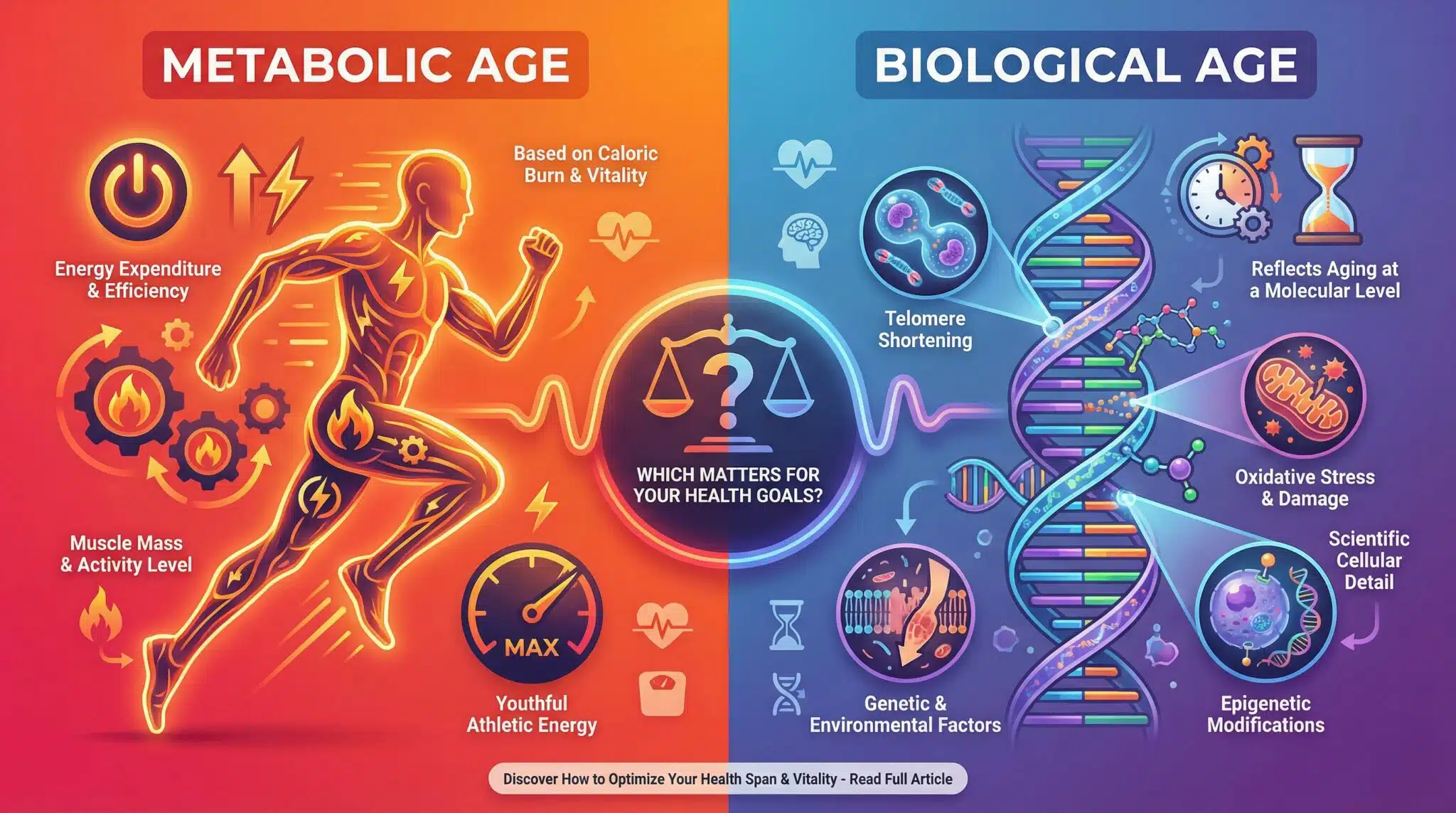
Here’s the thing: metabolic age and biological age get tossed around like they’re the same number in different fonts, but they’re measuring totally different stuff. It’s like comparing your home’s curb appeal to what’s happening inside your walls. (Aka: the “pretty porch” does not guarantee the plumbing isn’t plotting against you.)
So let’s make this simple, practical, and non-spiral inducing: what each one means, when it’s actually useful, and how to track it without turning your mornings into a reality show called Keeping Up With My Metrics.
Metabolic age: the “curb appeal” metric
Metabolic age is basically your metabolism getting compared to the average metabolism of people at different ages.
It usually comes from your BMR (basal metabolic rate) the calories your body burns at rest then gets translated into a little age label.
So if you’re 45 and your BMR looks like the average 35 year old’s BMR, the scale may report a “metabolic age” of 35.
Why it changes (and why people like it)
Metabolic age is heavily influenced by body composition:
- More muscle tends to make your BMR higher (muscle is “expensive” tissue)
- More body fat tends to make it lower
And this is why people get attached to it: it can change relatively fast, especially if you’re strength training, eating differently, and your body composition is shifting.
It’s the “Am I moving in the right direction?” number. Not the “Tell me my destiny” number.
Where you’ll see it
Most often, metabolic age comes from BIA devices (bioelectrical impedance analysis), like:
- bathroom “smart” scales
- gym body comp machines
- calculators that estimate BMR (less direct, more guessy)
The big limitation (read this before you get emotionally attached)
Metabolic age is mostly about calorie burn at rest. That’s it. It does not tell you:
- how your heart is doing
- inflammation levels
- organ function
- long term disease risk in any meaningful way
Metabolic age is like painting your front door and assuming your whole house is now “renovated.” (If only. I’d be unstoppable.)
My opinion: It’s a fine little motivational metric if you treat it like a trend, not a performance review.
Biological age: the “what’s happening inside the walls” metric
Biological age is trying to estimate how “old” your body is internally—regardless of what the calendar says.
This is the one that feels more like: “Okay, but how’s the actual system holding up?” Less beach body, more long game.
How it’s usually measured
The most common method you’ll hear about right now is epigenetic testing, based on DNA methylation patterns.
In normal human terms: there are chemical “tags” on your DNA that tend to change in predictable ways as you age. Some labs use a blood or saliva sample to estimate biological age from those patterns. Research suggests this kind of testing can correlate with disease risk and mortality risk.
Other approaches you might see:
- Telomere length testing (telomeres shorten with age, though interpretation can be tricky)
- Blood biomarker panels (things like CRP, A1C, cholesterol/lipids—more like a “how are the major systems doing?” snapshot)
The part nobody loves: it moves slowly
Biological age usually doesn’t budge dramatically in eight weeks. You’re often looking at six months to a year to see meaningful change.
Annoying? Yes.
Also kind of the point. This metric is more about pace over time than quick feedback.
My opinion: If you’re the type who wants immediate gold stars, biological age will test your patience like trying to watch paint dry in humidity.
Metabolic vs. biological age: same word, different jobs
These aren’t competing numbers. They’re like two different departments:
- Metabolic age: “How much energy do you burn at rest compared to averages?”
- Biological age: “How is your body aging internally?”
One is closer to fitness/body composition feedback. The other is closer to longevity/health risk context.
Also, quick reality check: neither is perfectly standardized. Different devices and companies and online calculators can give different results, so you’re not looking for “truth,” you’re looking for trend.
Repeat after me: track the trend, not the tantrum.
When metabolic age is actually worth paying attention to
Metabolic age is most useful if you’re in an active fitness phase and want simple feedback without turning your life into a science fair.
It can be helpful for:
- tracking progress during a training plan (often you’ll see shifts in ~8-12 weeks)
- noticing stalls (like “why is nothing changing even though I’m trying?”)
- motivation, if numbers keep you consistent
My “stop sabotaging your data” tip
If you’re going to measure it, measure it the same way each time. Ideally:
- morning
- after bathroom
- before food
- similar hydration
- don’t do it right after a hard workout
Because if you weigh in one day dehydrated and the next day after a salty dinner and three waters, your scale will act like it’s auditioning for a drama series.
When biological age matters more
Biological age is for when you’re thinking beyond the next 10 pounds and into the “How am I doing long term?” questions.
Consider it if you:
- are making major lifestyle changes and can wait to retest
- want a deeper health snapshot than “I feel fine, I guess”
- are evaluating big claims (supplements, fasting protocols, anti-aging everything)
If you’re 50 and a test estimates biological age at 58, I wouldn’t take it as a tattooed label on your forehead. I’d take it as a prompt for better questions, especially around cardiovascular risk and inflammation.
At home kits exist (you’ll see brands like TruDiagnostic and Elysium), but getting testing through a clinician can make follow up easier if you want to dig into what to do with the info.
Gentle but firm note: I’m not your doctor, and no test result should replace actual medical advice—especially if something looks off. Use this stuff to start conversations, not to diagnose yourself at 1 a.m. on the internet.
Do you have to pick one? Nope.
Honestly, using both can make a lot of sense:
- Metabolic age = short term feedback loop (training + body composition)
- Biological age = long term trend line (overall aging/internal wear and tear)
Think of them like dashboard lights. Helpful, not holy. They don’t drive the car for you.
The unglamorous limitations (aka: don’t hand a scale the keys to your self-worth)
I love data. I’m also the kind of person who has re-measured a room three times because the first number “felt wrong.” So I get it.
But here’s what can trip you up:
Metabolic age limitations
- BIA scales are estimates and can vary a lot by device
- hydration, time of day, and recent exercise can skew results
- it’s not validated as a longevity predictor
Biological age limitations
- different companies use different “clocks,” so results can disagree
- there’s no universally accepted “best” test yet
- cost can make frequent retesting unrealistic
Translation: use these tools. Don’t worship them.
A simple “age tracking plan” you’ll actually stick to
No spreadsheets required. No color coded binder. (Unless you love that. In which case, live your truth.)
If you’re actively changing your body (training, nutrition, recomposition):
- Track metabolic age about monthly (or even quarterly if monthly makes you obsessive)
If you’re focused on long term health/longevity:
- Consider biological age about once a year (because meaningful changes take time)
And whichever number you’re tracking: consistency beats intensity. One weird reading doesn’t mean you’re doomed. It means… you had a weird reading.
Keep it steady. Watch the trend. Adjust based on patterns, not panic.
Because your health isn’t a single number—it’s a whole house. And you deserve more than a moody scale acting like it knows you.