













If you’re sleeping less than seven hours and telling yourself you’ll “catch up later,” I need you to know something: your body is not hearing “busy season.” Your body is hearing “stress… danger… famine… store the carbs.” (Very dramatic. Very unhelpful.)
And if you’ve been proudly announcing you’re “running on fumes,” just know your metabolism is sitting in the corner like, cool story, bro, while quietly sabotaging your plans.
Sleep isn’t just “rest.” It’s maintenance mode. It’s your body taking out the trash, running software updates, and doing those little repair jobs you ignore until something breaks. And yep—sleep has a surprisingly big say in how hungry you feel, how many calories you burn, and where your body decides to store fat.
Let’s talk about why deep sleep is basically the unsung night shift employee of your fat loss efforts.
Your Body Burns Calories All Night (Even When You’re a Burrito in Bed)
Even when you’re doing absolutely nothing—no steps, no sweating, no “recovery walk” that’s really just you scrolling—your body is still burning calories.
At rest, most people burn roughly 40-80 calories per hour, just keeping the lights on: heart beating, lungs lung-ing, cells repairing, brain doing brain stuff. Over a normal night, that can add up to a few hundred calories.
That baseline burn is your basal metabolic rate (BMR), metabolism shifts with age and it’s a big deal because it makes up the majority of what you burn in a day. Which means the stuff that messes with your BMR (hi, chronic bad sleep) matters more than the extra ten minutes you hate on the treadmill.
Translation: sleep isn’t “lost time.” It’s your body doing important, calorie burning admin work.
Not All Sleep Is Equal (AKA: Broken Sleep Is a Scam)
I used to think sleep was sleep. Like, if I was in bed for seven hours, I’d “done it.” Gold star. Wellness queen.
Then I had a season of waking up a bunch—nothing dramatic, just that annoying half awake flipping the pillow lifestyle—and I noticed two things:
- I was hungrier.
- I was crankier.
- Okay fine, three things. I was also more snacky in a very specific “I deserve a treat because I’m alive” way.
Because your body has different jobs in different sleep stages:
REM sleep (dreamy brain hours)
REM is when your brain is busy—processing, storing memories, doing emotional housekeeping. Your brain uses a ton of energy, and REM is tied to better metabolic markers in a lot of research.
Deep sleep (the “repair and burn” shift)
Deep sleep (slow wave sleep) is where the real physical renovation happens—tissue repair, muscle maintenance, and a big rise in growth hormone. When deep sleep gets cut short, your body doesn’t repair as well… and when you’re trying to lose weight, that can mean losing more muscle and less fat than you’d like.
And no, seven hours of light, fractured sleep is not the same as seven hours of solid cycles. Your body knows. Your appetite knows. Your jeans definitely know.
If you steal one line from this post, let it be this:
Deep sleep is your body’s “repair and burn” shift. Don’t clock out early.
Why You’re Starving After a Bad Night (It’s Hormones, Not “Willpower”)
If you’ve ever woken up after a trash night of sleep and immediately wanted a bagel the size of a throw pillow, you’re not broken. You’re not “undisciplined.” You’re just running on a hormonal situation.
When you don’t sleep enough:
- Ghrelin (the “feed me now” hormone) goes up
- Leptin (the “I’m full” hormone) goes down
So you feel hungrier than you should, and it takes more food to feel satisfied. A lot of studies show sleep deprived people eat hundreds of extra calories without even trying—usually in the form of high carb, high fat comfort food, because your tired brain is basically a toddler in a gas station.
Sleep loss turns “reasonable hunger” into “snack emergency.”
And your pantry becomes the crisis center.
Cortisol: The Tiny Alarm Bell That Loves Belly Fat
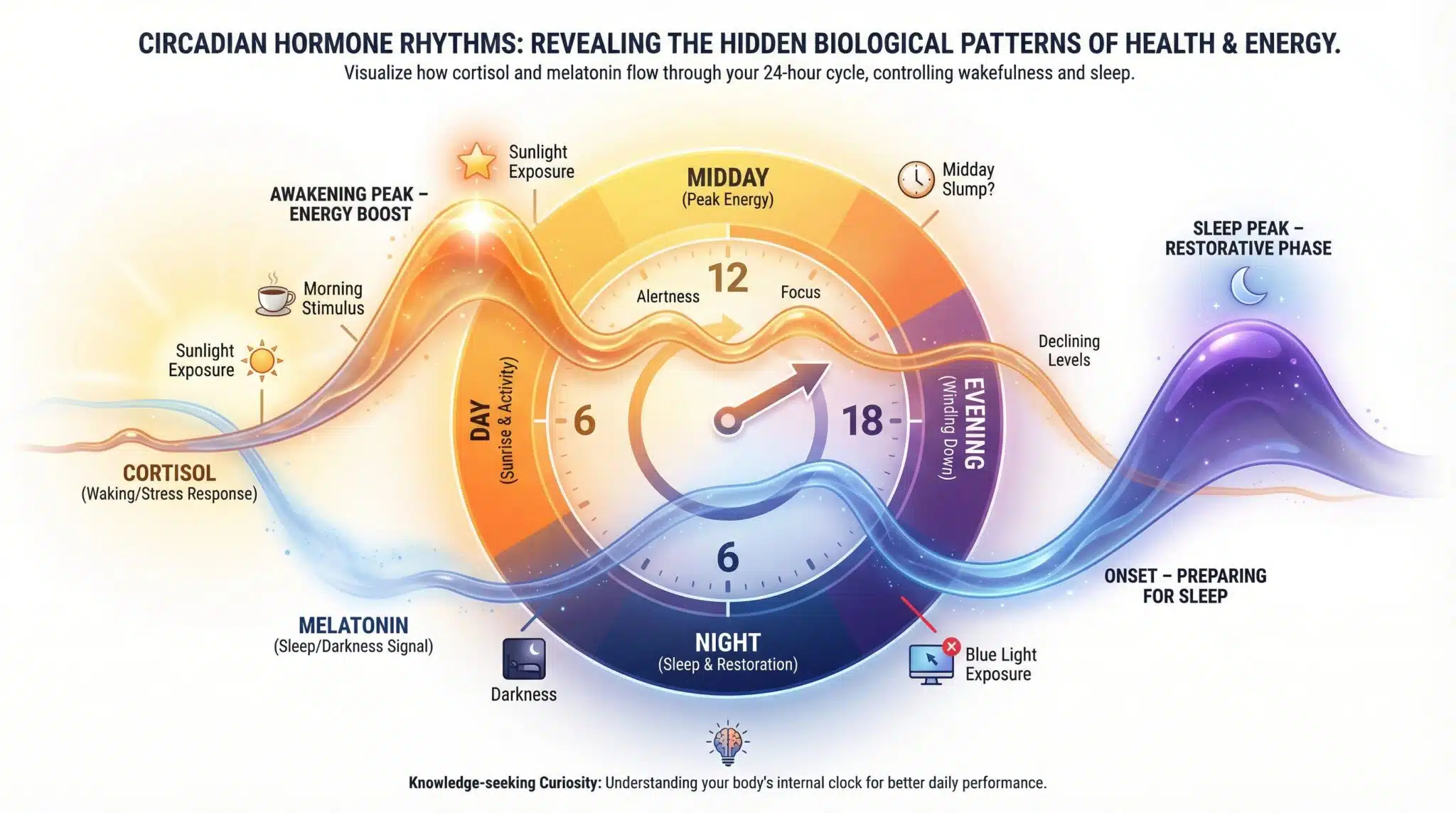
Your body doesn’t interpret “I stayed up watching one more episode” as a cute personality trait. It reads it as stress.
When you’re sleep deprived, cortisol (your stress hormone) tends to stay elevated. That can:
- encourage fat storage (especially around the midsection)
- mess with insulin sensitivity (so your body handles carbs worse)
- leave you tired and hungry (the rudest combo)
There’s also research showing that even a few nights of very short sleep can temporarily make your body act more insulin resistant—basically a “pre-diabetic-ish” moment. The good news is that this can improve when you get back to consistent, quality sleep and your metabolism based age score can improve too.
So if you’ve been doing “everything right” and still feel puffy, hungry, and stuck… I’m not saying sleep is the only answer. I am saying it’s a loud suspect.
Meal Timing Matters (Please Stop Feeding Yourself Like a Midnight Raccoon)
Your body loves rhythm. It’s like a house with a smart thermostat—if the schedule is chaos, everything gets glitchy.
Eating late at night doesn’t just matter because of calories. Your body can handle the same meal differently at 10 a.m. vs. 10 p.m. Late meals can mess with your circadian rhythm and blood sugar handling, and it may nudge your body toward storing more and burning less.
You don’t need a strict rule like “never eat after 6 p.m.” (relax). But if you’re doing big, heavy meals right before bed and your sleep is lousy? That’s a lever worth pulling.
Okay, So How Much Sleep Do You Actually Need?
I wish I could hand you a magical number like “7.3 hours exactly or your metabolism calls the police.” But humans are irritatingly individual.
That said:
- Most adults do best at 7-9 hours
- Under 6 hours consistently is where risks really start stacking up (weight gain, insulin issues, appetite chaos, etc.)
- More than 9 hours regularly can be totally fine for some people, but it can also be a flag to check in on health issues if you’re still exhausted
A simple test I love (because it’s not complicated):
For two weeks, track your sleep and jot down hunger, cravings, and energy. If you’re under seven hours and you’re having afternoon crashes + evening snack attacks… you don’t necessarily need a new diet. You might need a bedtime.
Your body is resilient. It’s not keeping a grudge… but it is keeping receipts.
Can You “Catch Up” on Sleep? Kinda. Not Instantly. (Sorry.)
Yes, you can recover from sleep debt—just not with one heroic 11-hour hibernation on Saturday.
In my experience, when I clean up my sleep, I notice changes fast… but the deeper stuff takes longer. A rough timeline is often something like:
- 24-48 hours: cravings ease a bit, energy steadies
- About a week: appetite hormones start settling down
- 2-3 weeks: measurable improvements in overall metabolic markers
If you’ve been short sleeping for months or years, it’ll take longer. But it still matters. Sleep is never a wasted investment.
Quick Reality Check: Could It Be Sleep Apnea?
Some people can’t “sleep hygiene” their way out of a real medical issue (no matter how many lavender sprays they buy—ask my past self).
If you:
- snore loudly (especially if your partner mentions it… or moves bedrooms)
- wake up gasping or choking
- wake with headaches or a dry mouth
- feel exhausted even after 8 hours
- struggle to lose weight despite consistent habits
…please talk to a doctor. Sleep apnea is common and treatable, and treating it can seriously improve energy, hunger regulation, and weight management.
(Also, if you checked multiple boxes and you’re like “it’s probably just stress,” consider this your gentle nudge. Future you would like you to investigate.)
Five Changes That Actually Help (No 47-Step Bedtime Ritual Required)
If you do nothing else, do these. They’re the biggest bang for your buck moves:
- Keep your bedtime/wake time consistent-ish Within 30-45 minutes, even on weekends. Otherwise your body feels like it’s living in mild jet lag.
- Cool your room down Somewhere around 65-68°F tends to help people get deeper sleep. Cheaper than most wellness fads, honestly.
- Stop eating heavy meals right before bed Try to finish big meals 2-3 hours before sleep. You don’t need to be hungry—just don’t go to bed in “food coma” mode.
- Exercise earlier if you can Morning/afternoon workouts often help sleep. If evenings are your only option, aim to finish 2-3 hours before bed.
- Set a caffeine curfew That “harmless” 2 p.m. coffee? It can still be hanging around at bedtime. If you’re struggling, try cutting caffeine off by noon for two weeks and see what changes.
The Part Where I Tell You What to Do Tonight
If weight loss feels harder than it should—like you’re doing all the things and nothing’s moving—sleep might be the missing piece you’ve been treating like optional bonus content.
Pick one change from the list above and do it tonight. Not because you “should,” but because your body runs better when it’s not exhausted.
Now go to bed like it’s your job.