






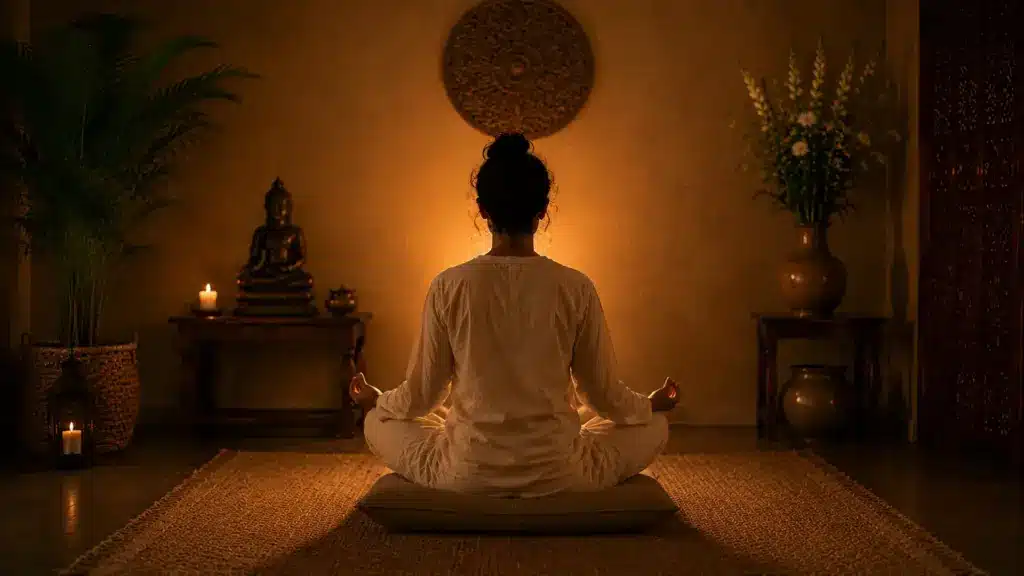

Your breath catches for a second when a stranger holds eye contact half a beat too long.
That flicker, that tiny jolt of aliveness, is closer to tantric meditation than any cross-legged pose ever taught you.
This practice doesn’t ask you to escape your body or quiet it down. It asks you to live inside every sensation, breath, sound, and touch, and let that be enough. No guru on standby, no years of training before you start.
Just breath, presence, and a willingness to feel more than usual.
What is Tantric Meditation?
Tantra comes from Sanskrit and roughly means to expand or to stretch beyond limits.
The phrase refers to practical experience rather than theoretical concepts.
It treats the senses as doorways, not distractions.
Sound, touch, sight, even taste can become entry points into presence. Nothing gets pushed aside to find stillness.
The body leads here, and the mind follows close behind. Practitioners say the practice is felt, not just thought, making tantric meditation feel different from sitting quietly with a closed mind.
It encourages you to remain receptive to whatever happens, moment by moment.
Where Tantric Meditation Comes From?
Tantric meditation techniques trace back to ancient Tantra texts from the Indian subcontinent.
It has roots in the Kashmir Shaivism tradition. One key source is the Vigyana Bhairava Tantra.
This Sanskrit text is often dated between the 8th and 10th centuries CE.
The text takes the form of a dialogue. Shiva speaks to his consort, Devi. In it, he offers what tradition holds as 112 methods for reaching expanded awareness. These methods use breath, sound, and sensory focus.
Many techniques practiced today come from this lineage.
Breath awareness and mantra repetition are two examples. Knowing this origin explains a lot.
It demonstrates why the practice considers the body and breath as primary tools rather than mere side effects.
Core Principles Behind Tantric Meditation
It rests on a few foundational ideas that shape how the entire practice works.
Understanding these principles first makes every technique that follows easier to grasp:
- Union of Opposites: Balances masculine and feminine energy as one whole.
- The Body as Sacred: Treated as a direct gateway to awareness, not something to transcend.
- Presence Over Perfection: Stay fully present with whatever arises, rather than chasing a correct experience.
- Energy as the Foundation: Works with life force, not just thought, setting tantra apart from typical meditation.
These principles aren’t rules to memorize. They’re the lens that makes every tantric technique actually make sense.
How it Affects the Mind and Body
Slow, controlled breathing shifts the nervous system out of fight-or-flight mode.
Heart rate drops. Muscles loosen their grip.
The mind follows the body’s lead. Racing thoughts start to settle as breath steadies. Focus sharpens without force.
Sustained attention practices, like gazing or mantra work, train the brain to hold steady on one point. This builds mental endurance over time. Physical stillness also lets buried tension surface.
Many practitioners notice tight shoulders or a clenched jaw easing after a session.
Here, body and mind react as a whole, not independently. This is the true transformation this practice fosters.
Benefits of Tantric Meditation: Practice and Emerging Research
This provides more than spiritual insight; it impacts the body, emotions, and relationships tangibly.
These benefits explain its appeal beyond just spiritual seekers.
- Regular breathwork trains slower, deeper breathing and may ease stress-related tension like a tight jaw.
- Staying present with difficult feelings builds emotional regulation and reduces everyday anxiety.
- Consistent practice sharpens focus and quiets mental noise.
- Deeper self-awareness and a stronger sense of connection develop with time.
- Techniques like eye-gazing and synchronized breathing build trust and intimacy with a partner.
Before You Begin: Preparing for a Meditation Session
Pick a time when you won’t be rushed. Even ten free minutes work.
Wear loose, comfortable clothing since tight waistbands can draw attention away from the body.
Skip a heavy meal beforehand. A full stomach makes stillness harder.
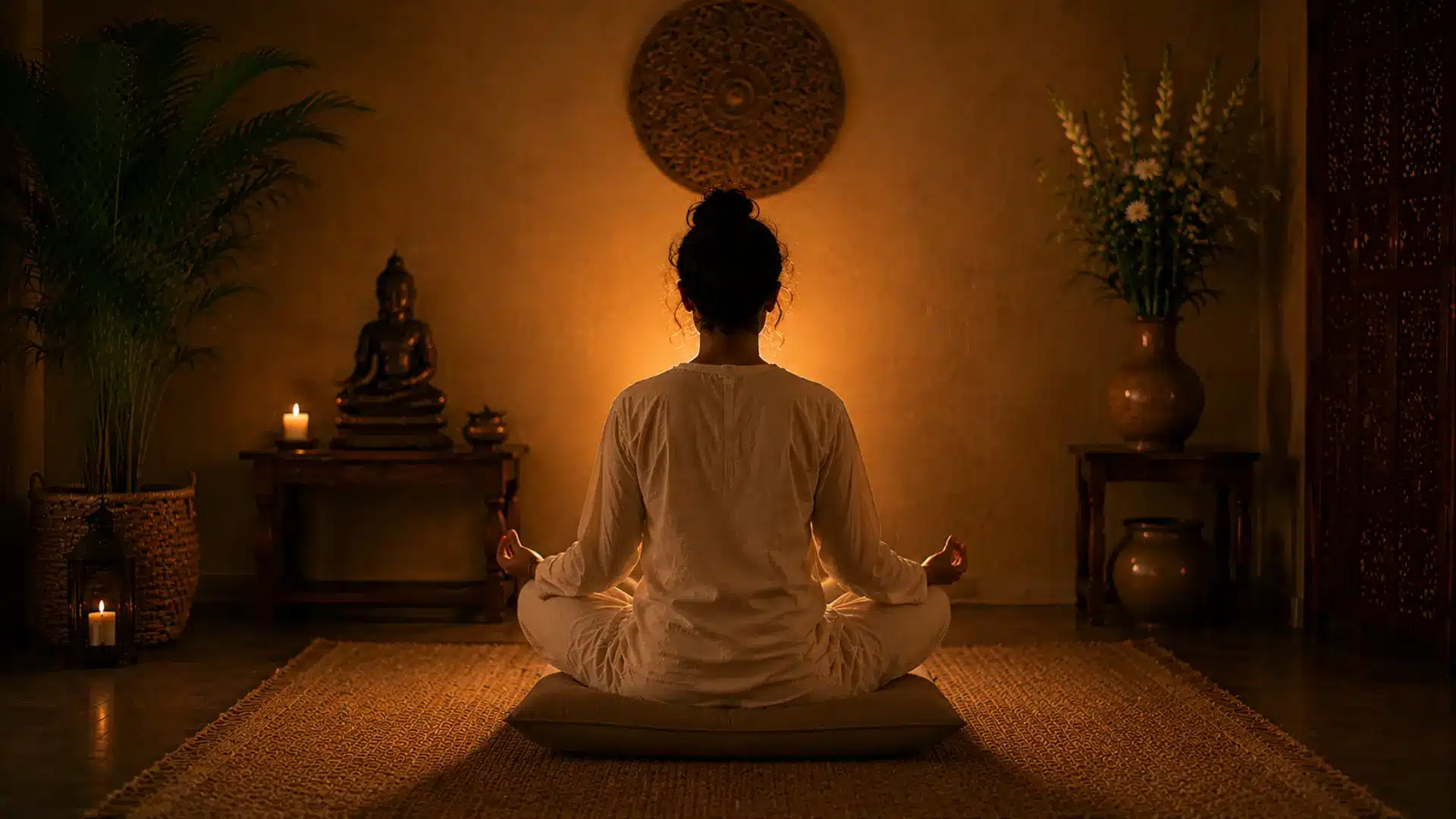
Dim harsh lighting if you can. Soft light supports a calmer state. Set no fixed goal for the session. Expectation creates pressure, and pressure blocks presence. Keep water nearby; a clear space also clears the mind.
Minor configuration options like these influence the entire session’s progression.
Essential Tantric Meditation Techniques for Beginners
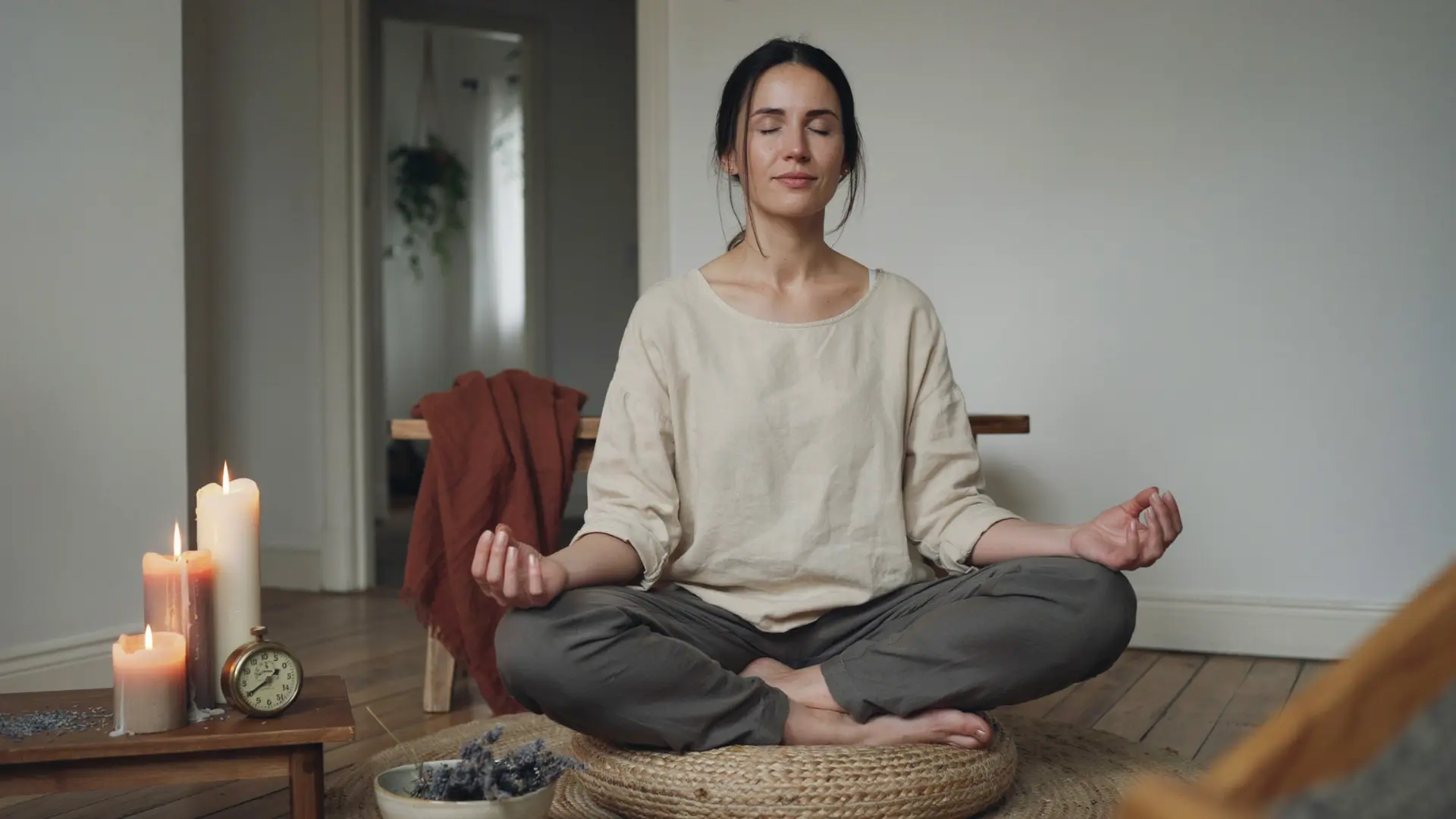
This includes a range of techniques, each offering a different entry point into the practice.
1. Breath Awareness and Energy Circulation
This technique uses the breath as a vehicle for energy movement through the body.
It’s often the first practice beginners learn, since it requires no props or prior training. Drawing energy up on the inhale and releasing it on the exhale forms the foundation for other tantric techniques.
How to Practice:
- Sit comfortably with your spine straight and eyes closed.
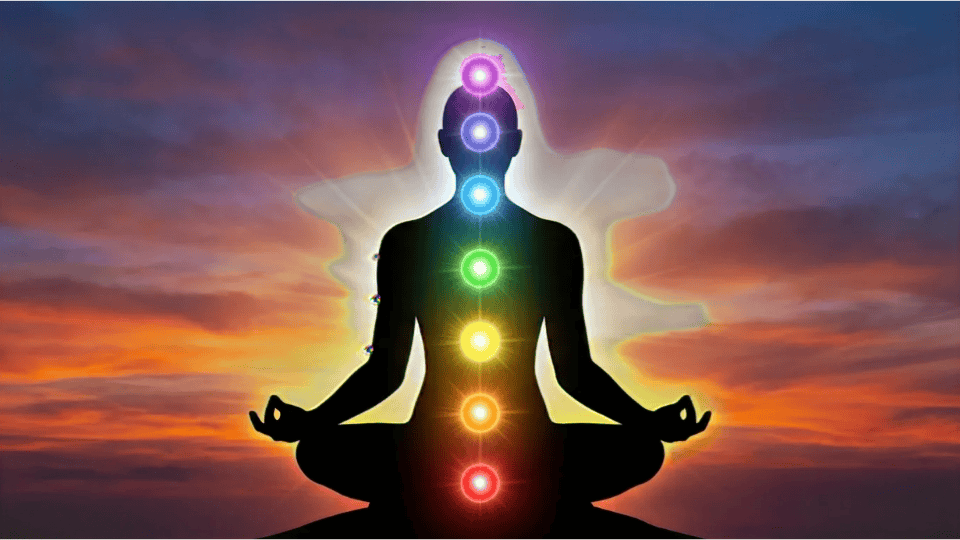
- Inhale slowly, imagining energy rising from the base of your spine.
- Hold the breath gently for one to two seconds.
- Exhale slowly, imagining that energy spreading through your entire body.
- Repeat for five to ten minutes, staying relaxed throughout.
2. Mantra Repetition
Mantra repetition uses sound to anchor a wandering mind and elevate awareness.
The chosen sound or phrase acts as a focal point, pulling attention away from distracting thoughts.
Traditional mantras like “Om” work well, though a personal phrase can have the same effect when repeated with intention and a steady rhythm.
How to Practice:
- Choose a mantra, either traditional (“Om”) or personal (“I am love”).
- Sit quietly and take a few deep breaths to settle in.
- Begin repeating the mantra slowly, either aloud or silently.
- Notice the vibration or feeling the sound creates as you repeat it.
- Gradually increase your pace if it feels natural.
- Continue for five to ten minutes, then sit in silence briefly.
3. Yantra Meditation
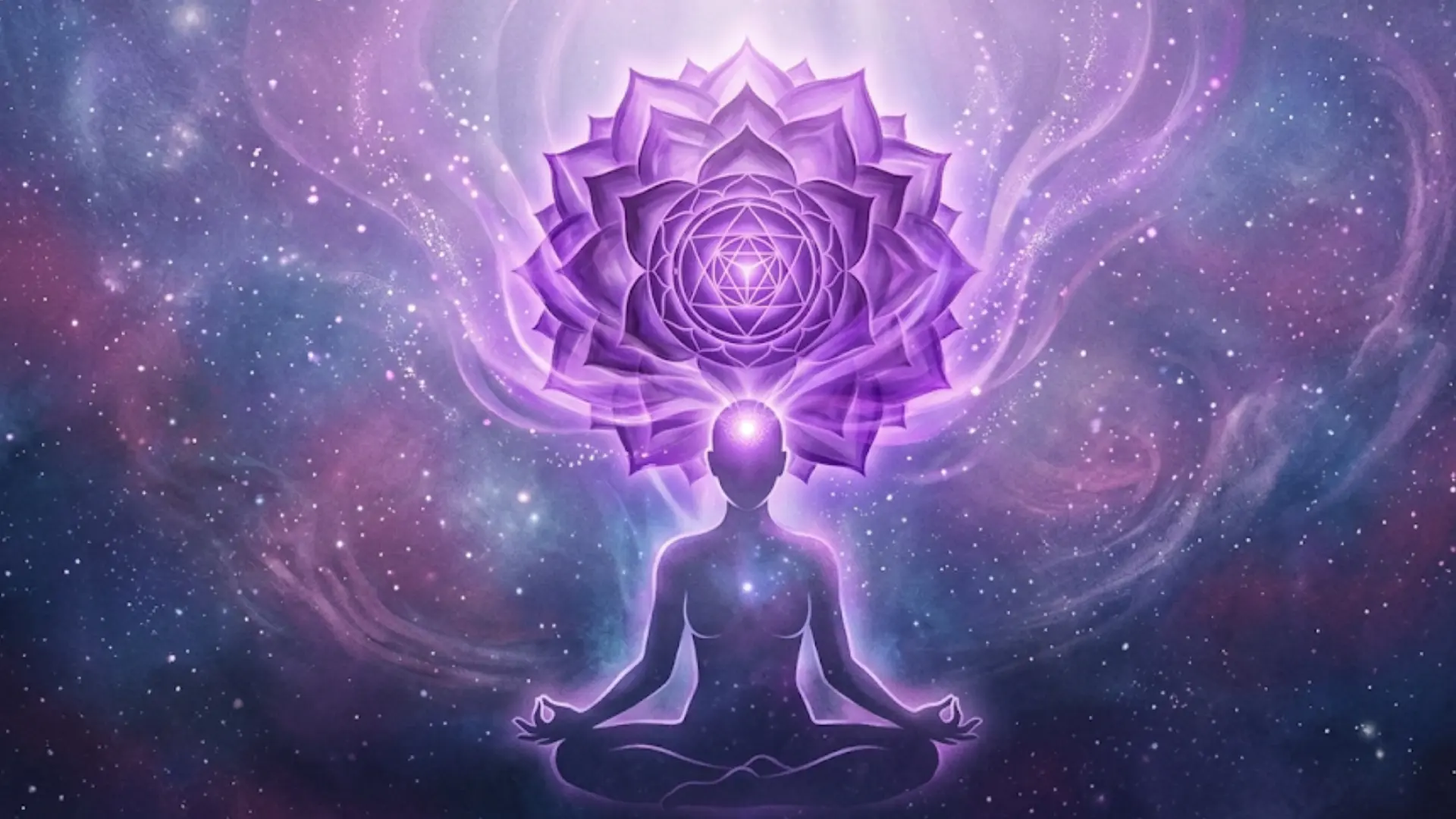
Yantra meditation uses a geometric symbol as a visual anchor for the mind.
Staring at a fixed image trains attention and quiets mental chatter, complementing breath and mantra practices for beginners exploring entry points.
How to Practice:
- Choose a simple yantra image or geometric pattern.
- Place it at eye level, about arm’s length away.
- Gaze softly at the center point without straining your eyes.
- When your mind wanders, gently return focus to the image.
- Continue for five minutes, then close your eyes and notice any afterimage.
4. Body Scanning
Body scanning builds subtle awareness by moving attention systematically through the body. This practice helps beginners notice sensations, tension, and energy shifts they might otherwise overlook.
It’s useful before other techniques since it calms the mind and grounds awareness in the present.
How to Practice:
- Lie down comfortably and close your eyes.
- Bring attention to your feet, noticing any sensation there.
- Slowly move attention upward through your legs, torso, and arms.
- Pause briefly at each area, observing without judgment.
- Finish at the crown of your head, noticing your whole body at once.
5. Heart-Center Meditation
This practice directs attention to the chest, cultivating warmth and emotional openness.
It’s suitable for beginners, linking meditation with gratitude or love instead of pure energy work. Regular practice softens emotional resistance and fosters inner calm.
How to Practice:
- Sit comfortably and place both hands over your chest.
- Take a few slow, deep breaths into that space.
- With each inhale, imagine drawing in warmth or love.
- With each exhale, release any tension or negativity.
- Continue for ten minutes, staying with whatever feelings arise.
6. Free-Form Movement
Free-form movement connects breath and body through unstructured, rhythmic motion.
Unlike seated practices, this technique releases physical tension stored in the body while building awareness of how emotion shows up physically.
It works well for beginners who feel restless during still meditation and need a more active starting point.
How to Practice:
- Choose music that feels rhythmic but calming.
- Stand in an open space with enough room to move freely.
- Close your eyes and let your body move without choreography.
- Notice how different movements feel in relation to your breath.
- Continue for five to ten minutes, then stand still and breathe.
7. Candle-Gazing (Trataka)
Trataka is a traditional solo practice using a candle flame as a point of visual focus.
It sharpens concentration while calming the nervous system, making it a popular entry point for beginners new to visual meditation.
The flickering flame also introduces a gentle, meditative rhythm that’s easy to follow.
How to Practice:
- Light a candle and place it at eye level, a few feet away.
- Sit comfortably and gaze steadily at the flame.
- Blink as needed, but keep returning focus to the flame.
- After one to two minutes, close your eyes and visualize the flame.
- Repeat two to three times, then sit quietly for a moment.
Practicing Tantric Meditation Alone vs With a Partner
Both options are effective; the best choice depends on your specific needs.
| Factor | Solo | With a Partner |
|---|---|---|
| Pacing | Set entirely by you | Requires matching someone else’s rhythm |
| Focus | Turns inward on your own energy | Splits between self and the other person |
| Feedback | None, just personal observation | Verbal check-ins after the session |
| Scheduling | Fits any free moment | Needs two calendars to align |
| Learning Curve | Quicker to settle into | Takes a few sessions to sync well |
Partner Tantric Practices
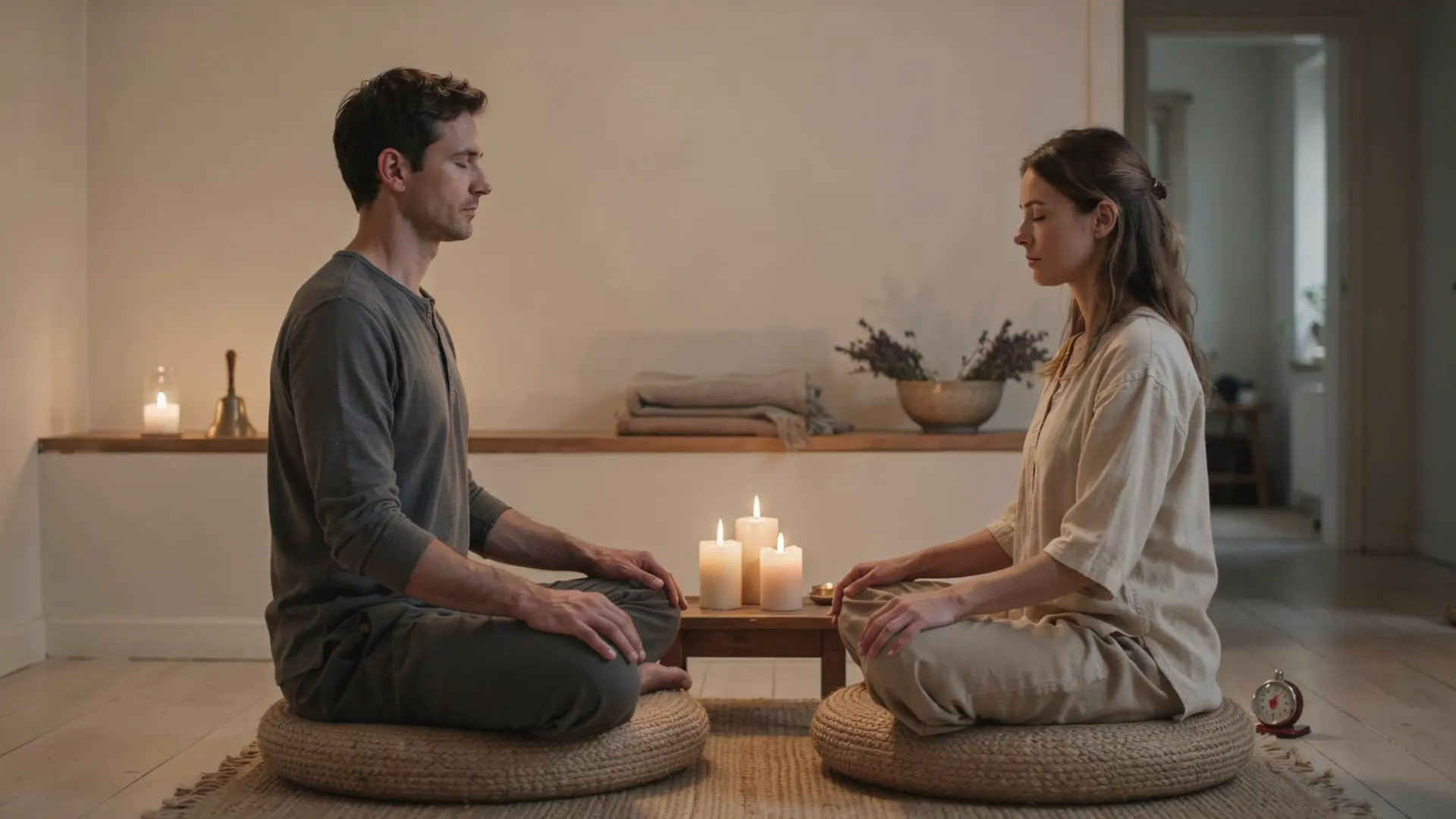
Partner practices involve a second person to enhance trust and connection, building on solo practice awareness.
Beginners are advised to perform these exercises together from the start.
1. Eye-Gazing
Eye-gazing builds trust and shared presence through sustained, soft eye contact.
Unlike casual eye contact, this practice asks both partners to stay present without looking away, which can feel vulnerable at first.
Over time, it becomes a powerful way to deepen connection without words.
How to Practice:
- Sit facing your partner at a comfortable distance.
- Take a few deep breaths together to settle in.
- Maintain soft eye contact for one to two minutes.
- Avoid forcing focus; let your gaze stay relaxed rather than intense.
- Afterward, share what came up for each of you, if comfortable.
2. Synchronized Breathing
Synchronized breathing creates a felt sense of connection by matching breath rhythms between partners.
This practice works well before intimacy or simply as a way to feel more attuned to each other. It requires no talking, just shared attention to the rise and fall of each breath.
How to Practice:
- Sit close to your partner, touching if comfortable.
- Close your eyes and breathe naturally for a moment.
- Gradually adjust your breath to match your partner’s rhythm.
- Continue breathing together for five to ten minutes.
- Notice any shift in connection or calm by the end.
3. Heart-to-Heart Energy Exchange
This practice uses touch and breath to consciously exchange warmth and attention between partners.
Placing hands over each other’s heart center creates a physical anchor for the emotional connection being built. It’s often used as a closing practice after other partner techniques, deepening whatever connection has already formed.
How to Practice:
- Sit or stand facing your partner, close enough to reach each other comfortably.
- Place one hand over your own heart and one hand over your partner’s heart.
- Breathe slowly and deeply together for a few moments.
- With each breath, imagine warmth passing between you both.
- Continue for five to ten minutes, then sit quietly together.
How to Deepen Your Practice Over Time
Progress in meditation isn’t about adding more minutes. It’s about adding more attention.
Start by holding stillness a little longer each week. Notice where the mind wanders, then return without frustration. Small shifts compound faster than big leaps. Journaling after each session builds awareness of patterns.
What felt easy? What pulled focus? Those notes become a map over time.
Consider working with a teacher once the basics feel steady. Guidance catches habits solo practice misses.
Consistency beats intensity here. Five focused minutes daily outweigh one long session done occasionally.
A Complete 15-Minute Tantric Meditation Routine
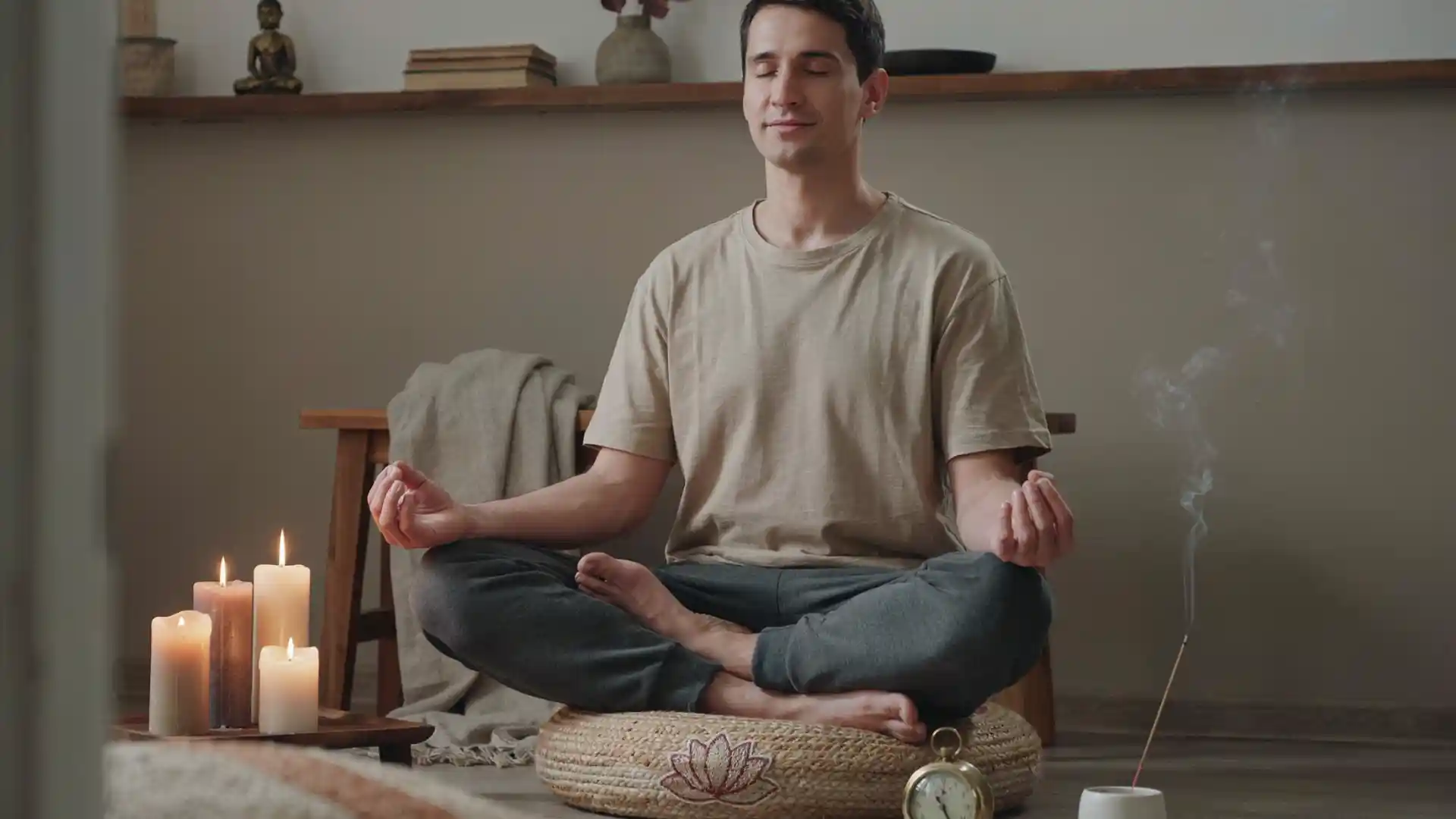
Fifteen minutes is enough time to slow a racing mind and settle back into the body, one breath at a time.
- Minute 1-3: Seated grounding, spine tall, eyes soft or closed.
- Minute 3-6: Deep belly breathing, extending each exhale.
- Minute 6-9: Body awareness scan, noticing sensation without judgment.
- Minute 9-12: Mantra or sound repetition to anchor focus.
- Minute 12-14: Stillness, letting thoughts pass without chasing them.
- Minute 14-15: Slow return, gentle movement before opening the eyes.
Common Myths About Tantric Meditation and the Truth
A few additional misconceptions need a brief, straightforward correction.
| Myth | Truth |
|---|---|
| It’s a New Age trend | It draws from centuries-old Tantra texts, not a modern invention. |
| It requires special equipment | A quiet room and a few minutes are enough to start. |
| It’s only for advanced meditators | Beginners can practice it from day one. |
| It always happens in a group setting | Most sessions are solo, done alone at home. |
Signs Your Practice is Progressing
Progress rarely announces itself loudly. It shows up in small, quiet shifts.
Daily irritations start losing their grip faster. A delayed train or a curt email bothers you less than it used to.
Sleep may deepen, since a calmer nervous system rests more easily. Sensations become sharper, too. A warm cup of tea or a breeze on skin registers with more clarity. Emotions surface without the usual spiral attached to them.
Time also feels different mid-session. Fifteen minutes can pass without the urge to check a clock.
Common Challenges Beginners Face: How to Handle Them
Every new practice comes with friction, and this is no exception.
1. Restlessness in stillness: Sitting still for fifteen minutes can feel unbearable at first.
Start with five minutes instead. Let the body adjust gradually rather than forcing endurance it hasn’t built yet.
2. Wandering mind: Thoughts will interrupt constantly, especially early on. This is normal, not failure. Gently return attention to breath each time, without judging the drift.
3. Self-consciousness during sound or mantra work: Chanting aloud can feel awkward, even alone.
Start quietly, almost a whisper. Volume matters less than consistency and genuine intention behind the sound.
4. Skipping sessions when busy: Motivation dips once novelty fades. Shrink the practice to three minutes on hard days. Something small keeps the habit alive better than nothing at all.
5. Misreading sensation as distraction: Physical feelings often get dismissed as noise to push past.
Sensation is the practice itself here. Curiosity toward it builds the skill faster than avoidance
Tantric Meditation vs Other Popular Meditation Styles
Meditation styles share a goal but differ sharply in method.
Here’s how tantric practice stacks up against three well-known approaches.
| Style | Main Focus | Best For |
|---|---|---|
| Tantric | Sensation, breath, and energy | Deepening body awareness |
| Mindfulness | Present-moment observation | Reducing daily stress |
| Transcendental | Silent mantra repetition | Quieting mental chatter |
| Loving-kindness | Directed compassion toward self and others | Softening emotional reactivity |
Is Tantric Meditation Safe for Everyone?
Check with a doctor or therapist first if you have a history of trauma, psychosis, or severe anxiety.
It is generally considered low-risk for most healthy adults. Still, it isn’t automatically right for everyone.
People with unresolved trauma may find body-focused awareness brings up intense emotions unexpectedly. Those with certain mental health conditions should approach slowly, ideally with professional support nearby.
Pregnant individuals can usually practice safely, though certain postures may need adjusting.
Beginners with no red flags can start solo without concern.
Bottom Line
Tantric meditation is a consciousness and energy practice at its core, not a sexual one.
Once that misconception falls away, what remains is a simple, approachable path toward presence and awareness.
Mastering all techniques isn’t the goal.
Starting small and staying consistent with one matters more than doing everything at once. Breath awareness, mantra repetition, or heart-center meditation choose one and practice daily to build depth.
Ready to begin? Choose one technique from this resource and try it tonight for ten minutes to notice changes.
Frequently Asked Questions (FAQ’s)
Is Tantric Meditation the Same as Tantric Sex?
No, they’re different. Meditation focuses on breath, energy, and awareness. Tantric sex is just one small, optional application within the broader Tantra system, not its foundation.
Do I Need a Partner to Practice Tantric Meditation?
No. Solo practice is complete on its own and covers most beginner techniques. Partner practices exist too, but they’re optional additions, not requirements to start.
How Long Does It Take to See the Benefits?
Benefits build gradually with consistency, usually over several weeks of daily practice. Like most meditation styles, results come from regular repetition, not a single session.
Is Tantric Meditation Safe For Beginners?
Yes, simple techniques like breath awareness and mantra repetition are safe to practice alone. More intense energy work is best learned later with guidance.
What’s the Difference Between Tantric And Regular Meditation?
Regular meditation often focuses on observing thoughts. Tantric meditation works directly with energy, breath, and the body to reach similar states of awareness.