










Celtic vs. Himalayan Salt: The Hidden Difference (It’s Not the Minerals)
If you’ve ever stood in the salt aisle holding a bag of Celtic sea salt in one hand and Himalayan pink salt in the other like you’re choosing a wand at Ollivanders… hi, same.
And I’m going to save you from the most boring argument on the internet: the trace minerals debate.
Yes, both salts have minerals. Yes, the labels make it sound like you’re basically licking a magical rock that will fix your life. No, that’s not the part that actually changes how your food turns out.
The real, sneaky difference the one that actually matters in your kitchen is moisture.
Celtic salt is damp. Himalayan salt is dry as a bad chicken breast. And that one detail affects everything: how it melts, how it crunches, how it stores, and whether it turns your grinder into a rage hobby.
The main thing: Celtic is wet. Himalayan is dry.
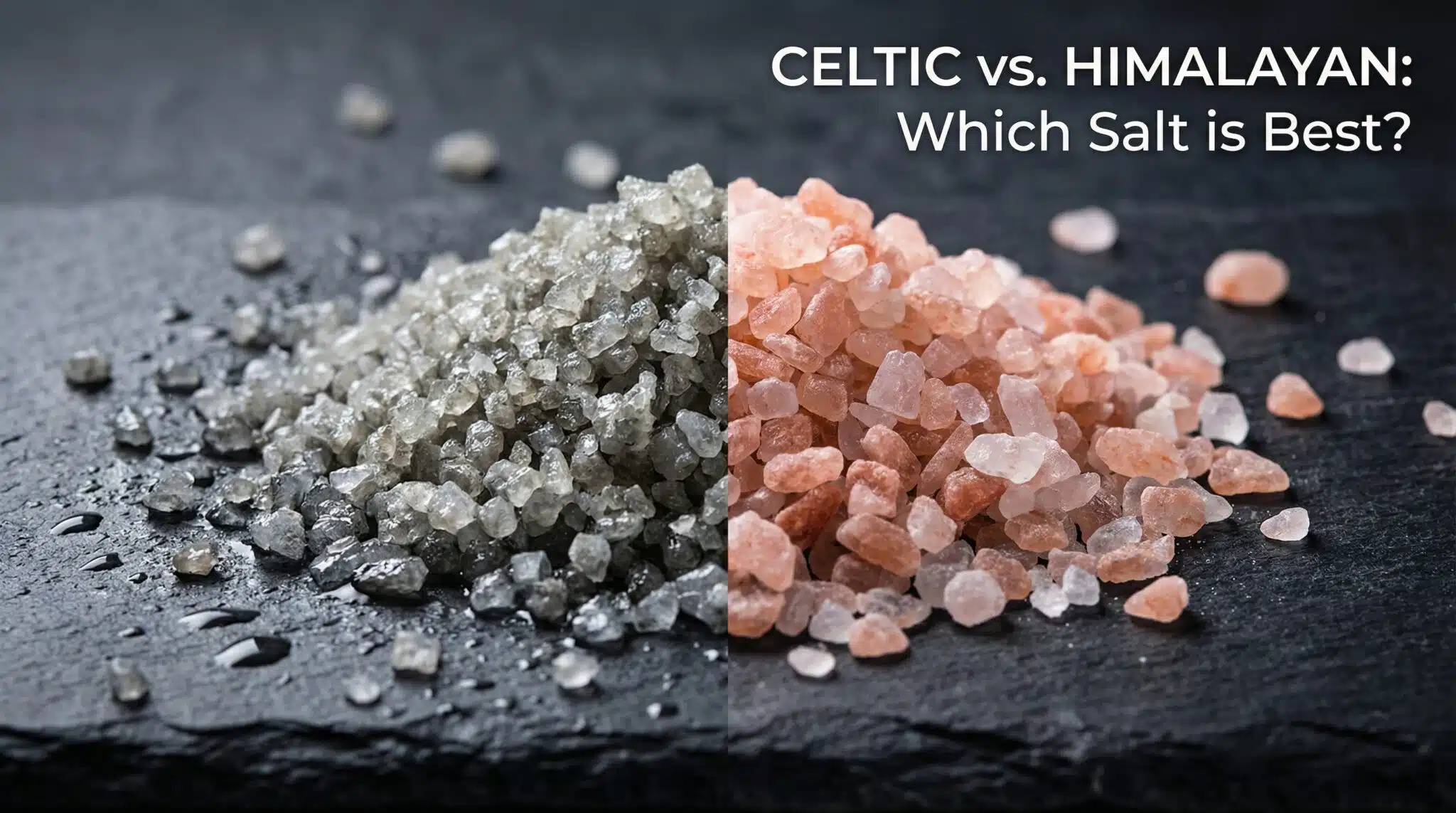
Celtic sea salt usually sits around 10-15% moisture (depending on brand and where you live humidity is not here to support your dreams). It’s a little grey, it clumps, and it feels like salt that’s been to the beach and brought back souvenirs.
Himalayan pink salt has basically zero moisture. It’s dry, more uniform, and it’ll sit in your pantry for years like, “I’m fine. I don’t need anything from you.”
And here’s why you should care:
- Wet salt dissolves faster (great for hot food).
- Dry salt stays crunchy longer (great for finishing and baking).
- Wet salt clumps (annoying, but not fatal).
- Dry salt behaves predictably (a.k.a. the love language of bakers).
Once you know this, the question stops being “Which salt is better?” and becomes “What am I actually cooking?”
Where they come from (aka: why they act so different)
Celtic sea salt is made from modern ocean water evaporated in clay lined ponds along the French Atlantic coast. It’s traditionally harvested, and that clay contact is part of why it’s grey and a little more… ocean-y.
Himalayan salt is mined from ancient deposits in Pakistan. It’s old. Like, “formed before dinosaurs were a glimmer in the universe’s eye” old. The pink color comes from iron oxide.
Different origins, different textures, different behavior on your food.
About the mineral claims (let’s not get scammed by vibes)
Do these salts have trace minerals? Yep.
Do those trace minerals matter at the amount of salt a normal human should be eating? Not really.
You’d have to eat an amount of salt that would make your doctor gently remove you from society before those minerals claims like the 84 minerals marketing myth added up to meaningful nutrition.
Also: sodium is sodium. Both are roughly the same sodium per gram. Celtic can seem “lower sodium” on paper mostly because… it has water in it. (Congrats, it’s damp.)
One important, unsexy truth: neither is a good iodine source. If you ditch iodized table salt entirely, make sure you’re getting iodine elsewhere (seafood, dairy, eggs ask your doctor if you’re unsure). Iodine is one of those “boring” nutrients you don’t think about until it becomes a problem.
What they taste like (my very opinionated take)
- Celtic salt tastes more briny and mineral-y. It can make food taste deeper… or it can stomp in like an ocean pirate and take over the whole bite.
- Himalayan salt tastes cleaner and more neutral. Mostly just… salt. (Sometimes there’s a faint earthy note, but it’s subtle.)
But honestly? Texture is where you’ll notice the biggest difference.
My favorite lazy test
Sprinkle both on something warm (like eggs or roasted potatoes). Celtic will melt in fast. Himalayan will hang out longer.
Then try them on something cool/room temp (like sliced tomatoes or a salad). Himalayan stays crunchy and visible. Celtic can disappear faster.
It’s like the difference between a salt that wants to blend in and a salt that wants to be perceived.
When I reach for Celtic salt (the damp one)
I love Celtic salt when I want salt to melt and spread quickly, especially on hot food.
Use it for:
- Finishing hot stuff: eggs, roasted veggies, soups, steak anything steaming.
- Sauces, stews, warm liquids: it dissolves quickly and doesn’t leave crunchy pockets.
- Anything that likes an ocean-y boost: seafood, tomatoes, vinaigrettes, salted caramel (yes, salted caramel can handle it just don’t go full pirate).
Basically: if the food is warm and you want the salt to disappear into it like it pays rent there, Celtic is great.
When Himalayan salt is the better choice (dry, dependable, low drama)
Himalayan is my pick when I need predictability or I want crunch that lasts.
Use it for:
- Baking: moisture can mess with dough and batter, especially in delicate recipes. Dry salt is the safer friend here.
- Brining/curing: consistent texture helps it dissolve and distribute more evenly.
- Salt grinders: Himalayan plays nice. Celtic will clump and jam and then you’ll be standing there aggressively shaking a grinder like it owes you money.
- Cold finishing: salads, avocado, sliced tomatoes, cheese boards, cocktail rims Himalayan stays crunchy and pretty.
If you want salt that behaves the same way every time, Himalayan is your coworker who color codes spreadsheets.
A quick word on measuring (because salt can be sneaky)
This is where people get accidentally salty (and not in the fun way):
A “teaspoon” of salt can vary wildly depending on crystal size, shape, and how it packs down especially with damp Celtic salt.
If you’re baking, brining, or doing anything where ratios matter:
- Weigh your salt if you can.
- If you can’t, start with less and adjust.
Your taste buds are smart. Let them drive.
Storage: one of these salts is high maintenance
- Himalayan salt: toss it in basically any container. It won’t clump. It’ll be fine forever.
- Celtic salt: put it in an airtight glass or ceramic container (metal can corrode). If you live somewhere humid, it may clump because it’s damp and it’s not sorry.
If Celtic clumps: mash it with a fork and move on with your life. (If it really bugs you, you can spread it out to dry, but personally? I’m not giving salt a spa day.)
So… which one should you buy?
If you mostly cook savory meals and want a salt that melts fast and adds a little ocean-y personality: Celtic.
If you bake, use a grinder, or want reliable crunch and no clumping drama: Himalayan.
If you’re like me and you bounce between “I made cookies!” and “I threw an egg on toast and called it dinner!” then honestly? Keeping both is nice. One for melting, one for crunching. Like having sneakers and boots could you survive with one pair? Sure. But why?
The best salt isn’t the one with the most mystical marketing or any mineral rich salt comparison. It’s the one that does what you need it to do in the moment.