




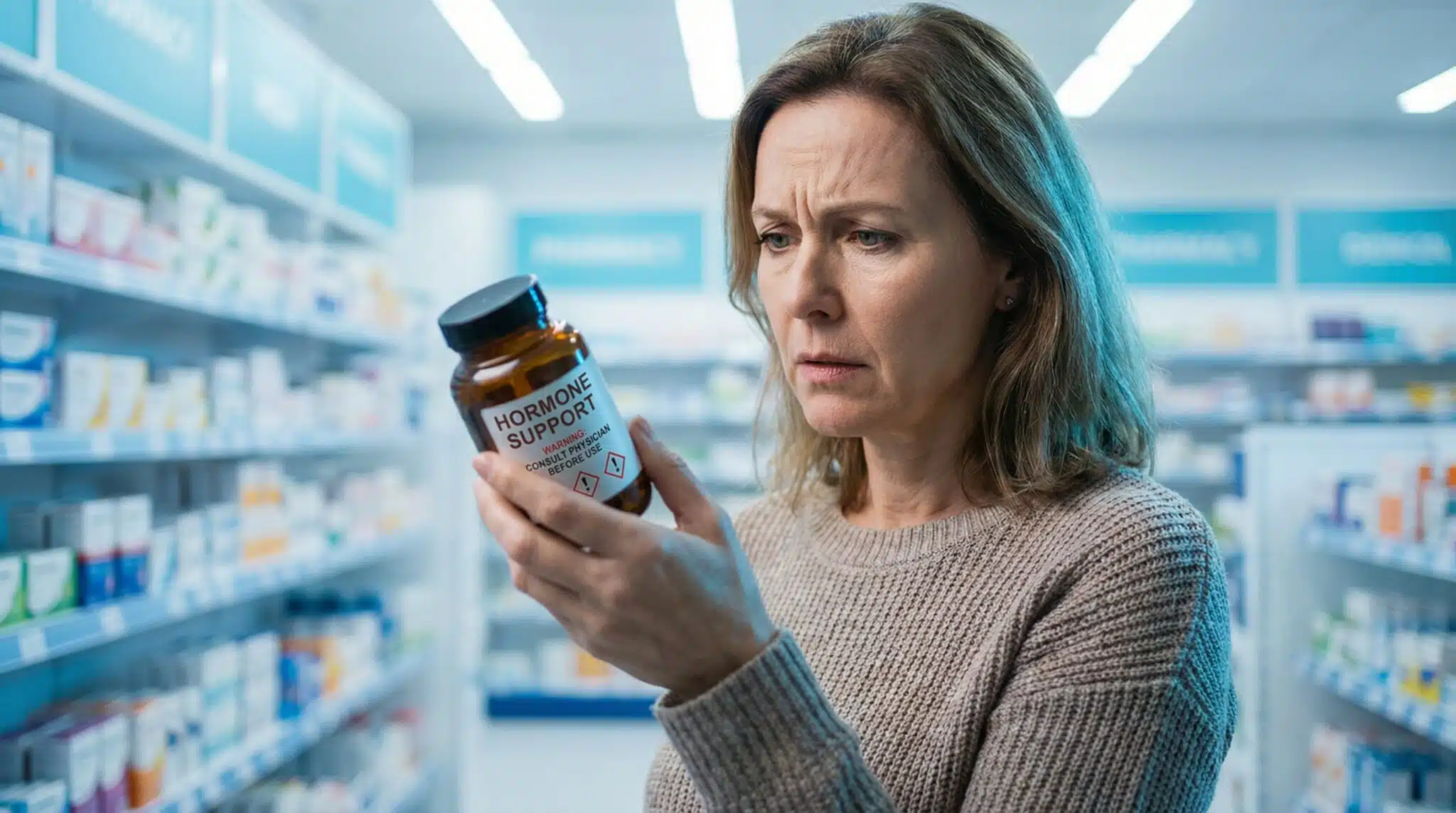









Hormone Therapy: Are You at Risk? (Let’s Talk About the Stuff Nobody Puts on the Pretty Instagram Graphic)
If you’ve been even thinking about hormone therapy whether that’s prescription estrogen/progesterone from your doctor, or you’ve been side-eyeing a bottle of DHEA next to the collagen gummies at Target there’s one unsexy truth you deserve upfront:
Some hormone products are like buying “white paint” online and discovering it’s actually… beige. With glitter. And no label.
One quality check I read about tested a handful of over the counter hormone supplements and only two out of eleven matched the label. One bottle claimed 100 mg and contained 6 mg. Six. That’s not “a little off,” that’s “did the ingredient take a wrong exit on the highway?” off.
So today I’m walking you through:
- who should not use systemic hormone therapy (the hard no’s),
- who needs extra caution (the “slow down, let’s read the fine print” group),
- and why the way you take hormones (pill vs patch vs vaginal) changes risk a lot.
And yes, I’m going to say this like your slightly over caffeinated friend who went down a research rabbit hole not like a medical textbook. (Also: I’m not your clinician. Please don’t use this post as a permission slip. Use it as a “what should I ask at my appointment?” list.)
First: Prescription hormones and supplement aisle hormones are not the same animal
Prescription hormone therapy (the regulated stuff)
If your doctor prescribes estrogen, progesterone/progestin, or testosterone in an FDA-approved form, you’re getting:
- standardized dosing,
- known ingredients,
- safety data that’s been studied for years,
- and a pharmacist who can tell you exactly what’s in it.
Not “perfect,” but it’s not a mystery bag.
OTC “hormone boosters” (the mystery bag)
DHEA, “testosterone support,” and herbal hormone blends are regulated like supplements, which basically means:
- labels can be… optimistic,
- doses may not match what’s printed,
- and you can end up taking things you didn’t intend to.
So when we talk about screening, risks, and “who should avoid hormones,” prescription therapy has clearer guardrails. OTC products can be a gamble.
Two terms that make everything else make sense (promise I’ll keep it painless)
- Systemic vs. local: Systemic hormones circulate through your whole body (think pills, patches). Local hormones mostly act where you put them (like low dose vaginal estrogen).
- Oral vs. transdermal vs. vaginal: Oral = swallow it. Transdermal = absorbs through skin (patch/gel/spray). Vaginal = cream/tablet/ring used vaginally.
That’s it. You now speak enough “hormone” to keep going.
The “red light” list: when systemic hormone therapy is usually off limits
If any of these apply to you, don’t DIY this (and yes, that includes “natural” hormone products that are still biologically active).
1) Unexplained vaginal bleeding
This is a full stop. Bleeding needs to be evaluated first to rule out serious causes (including cancer) before you even talk hormones.
2) A history of estrogen sensitive cancer (often)
Especially breast cancer and endometrial cancer systemic hormone therapy is often a no go or at least a “specialist only decision.” (More nuance on cancer history below, because it’s not one size fits all.)
3) Blood clots / clotting disorders / certain cardiovascular events
If you’ve had:
- DVT (deep vein thrombosis),
- PE (pulmonary embolism),
- certain inherited clotting disorders (like Factor V Leiden),
- or a history of stroke/heart attack/arterial clotting issues,
…systemic hormones can seriously raise risk. This is “do not pass go without a clinician and likely a specialist” territory.
4) Severe active liver disease
Your liver helps process hormones especially oral forms so active severe liver disease can make levels unpredictable and unsafe.
Quick PSA: “Bioidentical” isn’t a magic force field
This drives me a little bonkers because the marketing is so soothing.
Compounded “bioidentical” hormones
Compounded hormones can be appropriate in specific situations, but they’re not automatically safer, and they don’t have the same FDA oversight for consistency. “Bioidentical” describes structure, not safety.
Salivary hormone testing
Saliva testing gets pushed a lot in hormone marketing land. The problem: it’s not considered reliable enough to guide dosing in the way some clinics claim.
If someone’s trying to sell you a pricey testing package and a compounded custom blend in the same appointment… please, at minimum, get a second opinion.
The “yellow light” list: things that don’t automatically rule you out but change the plan
These are the “you might still be eligible, but let’s not be casual about it” factors.
- Uncontrolled high blood pressure (like 180/110 or higher): get it controlled first.
- High triglycerides: delivery method matters (more on that in a second).
- Migraines with aura: not always a hard no, but risk and route matter.
- Lupus: especially important if you have antiphospholipid antibodies (anticardiolipin antibodies / lupus anticoagulant), because clot risk changes the whole equation.
- Smoking: raises clot risk quitting is one of the best “risk reducers” you can do.
- Gallbladder disease history: oral options can be riskier.
- Endometriosis or fibroids: estrogen can aggravate symptoms for some people.
- Strong family history of breast cancer or clotting disorders: may warrant extra screening/genetic counseling before decisions.
Basically: none of this means “you’re doomed,” it means “you deserve an individualized plan.”
Timing matters more than most people realize (no, 60 isn’t a magical cliff)
A lot of clinicians talk about a generally lower risk window for starting systemic hormone therapy:
- under age 60, or
- within ~10 years of menopause
Starting later (after 60 or more than 10 years post menopause) tends to come with higher baseline cardiovascular and clot risk and changes in when hormone effects show up.
Also important: starting hormones later isn’t the same thing as continuing hormones you’ve already been on. Those are different conversations.
And if you had premature menopause (often before ~40-45), the math can flip hormone therapy may be recommended until the typical age of menopause (around 51-52) to support bone and overall health. Again: very personal, very “talk to your clinician,” but worth knowing.
If you have a cancer history, you need a specialist conversation (but there can be nuance)
This is where internet advice gets especially messy, so I’m going to keep this clear:
- Breast cancer (especially hormone receptor positive): systemic hormone therapy is often avoided. That said, low dose vaginal estrogen is sometimes considered because systemic absorption is typically very low. This decision should be made with your oncology/gynecology team.
- Endometrial cancer: in certain early stage cases after hysterectomy, some studies have not shown increased recurrence risk with hormone therapy but this is absolutely not a “decide from a blog post” situation.
- Other cancers (non-breast, non-gynecologic): often don’t follow the same rules as estrogen sensitive cancers, but still deserve a clinician’s review.
If you hear “never, ever, ever” from someone who hasn’t looked at your specifics… I’d get another set of eyes on it.
The delivery method is not a tiny detail. It’s a big deal.
If hormones were paint (stay with me), oral estrogen is like using a product that has strong fumes and needs extra ventilation. Transdermal estrogen is like low VOC. Same end goal, different impact getting there.
Oral estrogen (pills)
Oral estrogen goes through the liver first. That “first pass” effect can increase certain clotting factors and can affect triglycerides.
In general, studies suggest higher clot risk with oral estrogen compared with transdermal forms (often described as about 2-3x higher, depending on the population and study).
Transdermal estrogen (patch/gel/spray)
Transdermal estrogen bypasses that first liver pass. For many people especially if there are clot risk concerns this route is often preferred.
Vaginal estrogen (cream/tablet/ring)
Low dose vaginal estrogen is its own category. It’s primarily local, and blood levels usually remain very low, which is why it’s often considered even for people who can’t use systemic hormones.
(You may still see boxed warnings on class labeling this is one of those “labeling hasn’t caught up to nuance” situations so it’s worth discussing with a clinician who understands the difference between local vs systemic dosing.)
If you still have a uterus: here’s the non-negotiable rule
If you take systemic estrogen and you still have a uterus, you generally need progestogen (progesterone or a progestin) to protect the uterine lining.
Why? Because estrogen alone can overstimulate the endometrium and significantly increase endometrial cancer risk over time.
If you’ve had a hysterectomy, estrogen only therapy is often appropriate (since there’s no lining to protect). But don’t wing this this is one of those “the details matter” moments.
Side effects: what’s annoying but common vs what needs a call
Often temporary (especially in the first few months)
- breast tenderness
- mild bloating/fluid retention
- nausea (more common with oral forms)
- breakthrough bleeding as your body adjusts
- mild mood changes
Also: hormone therapy isn’t proven to cause meaningful weight gain in the way people fear. Midlife bodies change for a million reasons. Hormones get blamed for all of them like they’re the designated villain at Thanksgiving.
Call your clinician if you notice:
- persistent bleeding (especially after the adjustment period your clinician told you to expect)
- a new breast lump
- mood changes that feel intense or don’t improve
- headaches that are new, severe, or clearly different for you
Emergency warning signs (don’t “wait and see”)
Possible blood clot:
- sudden one sided leg swelling/pain/warmth/redness
- chest pain
- sudden shortness of breath
- coughing up blood
Possible stroke:
- sudden severe headache
- vision or speech changes
- facial droop
- weakness/numbness on one side
If those show up, it’s urgent. No toughing it out.
About those OTC hormone boosters… please don’t let the label seduce you
I get it. Supplements are sold like they’re gentle little helpers. But “available without a prescription” doesn’t mean “risk free.”
Here’s what worries me most about OTC DHEA/testosterone boosters:
- Quality control issues: you can’t dose safely if you don’t actually know what’s in the capsule.
- “Proprietary blends”: translation = “we’re hiding the doses.”
- Potentially risky ingredients: some herbs have been linked to liver injury (for example, Bulbine natalensis has raised concerns). Others can interact with meds.
And yes, side effects can happen mood changes, acne, and liver/kidney strain aren’t just theoretical.
If you take antidepressants, cancer meds, blood thinners, or any hormone related medication, a pharmacist medication review before adding DHEA for DHEA timing benefits is genuinely a smart move (and usually faster to access than a full specialist visit).
The safest path forward (aka: your action plan so you’re not spiraling at 1 a.m.)
If you’re considering hormones prescription or supplement here’s what I’d do in your shoes:
- Get clear on what you’re actually considering. Systemic prescription therapy? Low dose vaginal estrogen? A supplement “booster”? Those are not interchangeable.
- Scan the red light list. Unexplained bleeding, clot history, estrogen sensitive cancer history, severe liver disease those need clinician involvement before anything.
- If you’re in the yellow light group, ask about route. For a lot of people, transdermal vs oral is the difference between “reasonable” and “why would we choose that?”
- If you still have a uterus, ask about uterine protection. Please don’t let anyone casually hand you estrogen without addressing this. Your endometrium is not a hobby.
- Bring your actual questions to an appointment. Not “is HRT good or bad?” but:
- “Given my migraine history/smoking history/triglycerides, what route is safest?”
- “Am I in that under 60/within 10 years window?”
- “If systemic is a no, what local options exist?”
You deserve symptom relief and safety. The goal isn’t to be scared of hormones it’s to stop treating them like a cute little wellness add on you toss in your cart next to the shampoo.