











I’ve seen thoracic stiffness in clients of almost every age and fitness level, from desk workers and athletes to new parents and retirees. It’s one of the most consistently overlooked areas of the body, and one that responds remarkably well once you actually address it.
A stiff upper back and tight shoulders affect how you move, how you breathe, and how you feel in your own body, and it’s clear how frustrating that can be. That’s why thoracic mobility exercises are so important; they can be a game-changer for many.
These exercises help improve flexibility, reduce neck and shoulder pain, and make daily movements much easier. Here, I will walk you through some of the most effective exercises that target the mid and upper back.
I’ll also share tips on performing them safely and effectively, whether you’re at home, at the gym, or at your desk, along with guidance on sets, reps, and how to build this into a realistic routine.
A Closer Look at Thoracic Mobility
Your thoracic spine is the middle part of your back, located between your shoulders and ribs. It consists of 12 vertebrae, T1 through T12, running from just below the base of the neck to the bottom of the ribcage.
Together with the ribs, it forms the protective cage around the heart and lungs, which means thoracic mobility directly affects breathing capacity that most people don’t expect.
When this area becomes stiff or tight, simple movements like reaching overhead, twisting, or sitting straight can become uncomfortable. It can also lead to upper back pain, tight shoulders, and a slouched posture over time.
The kyphosis connection: Prolonged stiffness in the thoracic spine commonly leads to kyphosis, an exaggerated forward rounding of the upper back. Beyond aesthetics, kyphosis alters the position of the shoulder blades on the ribcage, directly restricting shoulder range of motion and contributing to shoulder impingement syndrome.
In plain terms, a stiff thoracic spine is often the root cause of shoulder pain that gets misdiagnosed as a shoulder problem.
Research has also found an association between prolonged sitting, particularly more than eight hours per day, and increased neck, shoulder, and lower back pain. This makes thoracic mobility one of the more relevant areas of the body for anyone working a desk job.
Improving thoracic mobility helps your back feel more relaxed and flexible. It allows you to move more easily, sit and stand straighter, and breathe more comfortably, making everyday activities feel smoother and less tiring.
Signs You Need Thoracic Mobility Exercises
Sometimes it’s hard to know if your thoracic spine needs attention. These signs can help you figure out if it’s time to add some thoracic mobility exercises to your routine:
- Stiffness when twisting your upper body: You feel tight or limited when turning side to side.
- Pain or tension in the mid-back: You notice discomfort between your shoulder blades after sitting or working.
- Difficulty lifting arms overhead: Raising your arms feels hard or uncomfortable.
- Poor posture while sitting or working: Your shoulders round forward, or you slouch frequently.
- Shallow breathing or reduced breath capacity: Tightness in the thoracic spine limits rib cage expansion, which can make breathing feel slightly restricted, particularly during exercise.
- Recurring shoulder or neck pain without a clear cause: When shoulder mobility is restricted, and the thoracic spine is stiff, the neck and shoulders compensate, generating pain that seems to come from those joints rather than from the mid-back where the restriction actually lives.
If you notice one or more of these, don’t worry, it’s common. Doing some simple mobility exercises regularly can make a big difference in your comfort and movement.
What You’ll Need
Most of these thoracic mobility exercises require no equipment. The one exception is exercise #3 (Foam Roller Extensions), which requires a standard foam roller.
If you don’t have one, a tightly rolled yoga mat or a rolled towel can substitute, though a firm foam roller delivers better contact and feedback along the thoracic vertebrae.
A yoga mat or soft surface is recommended for any floor-based exercises. That’s it, no gym required.
The Most Common Error Before You Start
In my experience, the single most common mistake I see clients make, and the one that quietly undermines almost every thoracic mobility exercise, is letting the lumbar spine do the work instead of the thoracic spine.
The lower back is naturally oriented toward extension, so when you attempt to extend or rotate through your mid-back, your body will default to arching the lumbar spine instead.
The thoracic spine barely moves. You feel like you’re working the right area, but you’re not.
The fix is consistent: keep your pelvis still and your core gently engaged throughout every exercise on this list. A stable pelvis forces the thoracic spine to do its own work.
It may feel awkward at first, and your range may seem smaller than expected, that’s normal. That reduced range is the honest range your thoracic spine actually has, and it will grow with practice.
Common Thoracic Mobility Exercises
Improving your thoracic spine mobility can reduce stiffness, improve posture, and make daily movements easier. These exercises target your mid-back, shoulders, and chest for better flexibility. Unless a specific rep range is noted, aim for 8–10 repetitions per side and 2–3 sets.
1. Thread the Needle
Thread the Needle is a gentle thoracic mobility exercise that improves spinal rotation, relieves upper-back tension, and helps counter stiffness caused by long periods of sitting.
Steps to follow:
- Start with your hands under your shoulders and your knees under your hips, keeping your spine neutral.
- Slowly slide your right arm underneath your left, rotating your torso as you lower your shoulder and ear toward the floor.
- Reach the threading arm across your body as far as comfortable, allowing the upper back and shoulders to twist.
- Pause briefly at the end range, then slowly return to the starting position and repeat on the opposite side.
Progression Tip: Gradually increase the reach and pause longer in the rotated position while maintaining slow, controlled breathing and stable hips.
Sets/Reps: 8–10 reps per side, 2–3 sets. This is one of the most underused exercises in this list, in my experience. People who add it consistently are the ones who notice the fastest improvement in upper-back rotation.
2. Thoracic Rotation (Lumbar Lock)
Thoracic Rotation, also known as the Lumbar Lock, targets upper-back rotation while keeping the lower spine stable. It helps improve posture, spinal mobility, and shoulder movement.
Steps to follow:
- Begin in a quadrupod position, then sit your hips slightly back toward your heels to reduce lower-back movement.
- Place one hand behind your head with the elbow pointing down, while the other arm supports your body on the floor.
- Slowly rotate your upper body and lift the elbow toward the ceiling, focusing on controlled movement from the thoracic spine.
- Pause briefly at the top of the rotation, then return the elbow toward the floor and repeat the movement slowly.
Progression Tip: Increase the pause at the top of the rotation and focus on deeper thoracic movement while keeping the hips stable and the lower back relaxed.
Sets/Reps: 8–10 reps per side, 2–3 sets. The hip-back position is what makes this exercise work; it mechanically locks the lumbar spine, so the thoracic has no choice but to rotate on its own.
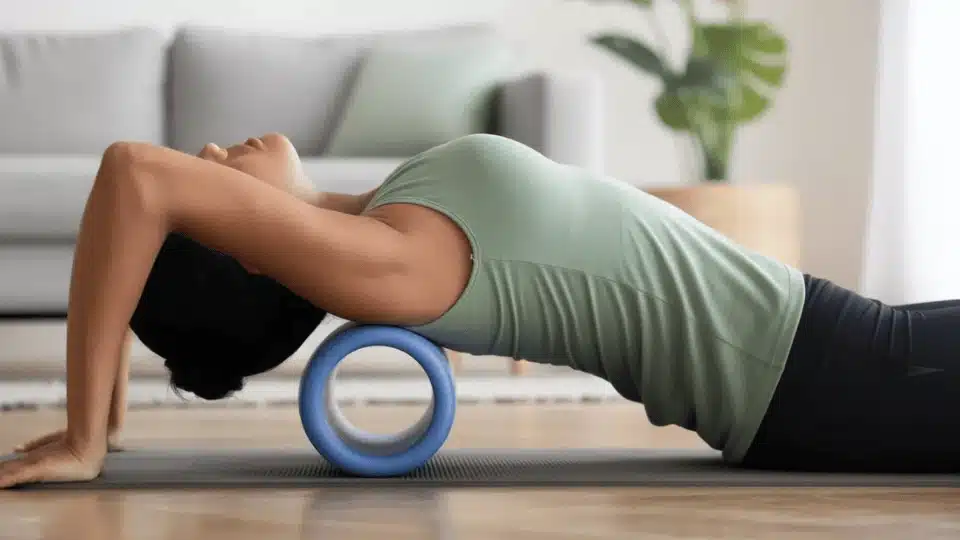
3. Foam Roller Extensions
Foam Roller Extensions are a simple thoracic mobility exercise that helps open the chest, improve posture, and reduce upper-back stiffness caused by prolonged sitting.
Steps to follow:
- Lie on your back with a foam roller placed horizontally under your mid-back, keeping your knees bent.
- Interlock your hands behind your neck to support your head while keeping your elbows relaxed and slightly open.
- Slowly lean back and extend your upper spine over the foam roller, allowing your chest to open comfortably.
- Hold the extended position briefly, then return to neutral and gently repeat the movement without forcing the stretch.
Progression Tip: Gradually move the foam roller slightly higher or lower along the thoracic spine to target different stiff areas safely.
Important placement note: Position the roller between your shoulder blades and the bottom of your ribcage; do not roll it below the lowest rib. Placing it in the lumbar region shifts stress onto the lower back, leaving it unprotected. I’ve seen this mistake cause more discomfort than the original stiffness in new clients. When in doubt, start higher and work down incrementally.Sets/Reps: 2 sets of 8–10 reps. Exhale as you extend over the roller. The exhalation releases tension in the ribcage and allows the thoracic spine to extend further than you’d achieve by holding your breath.
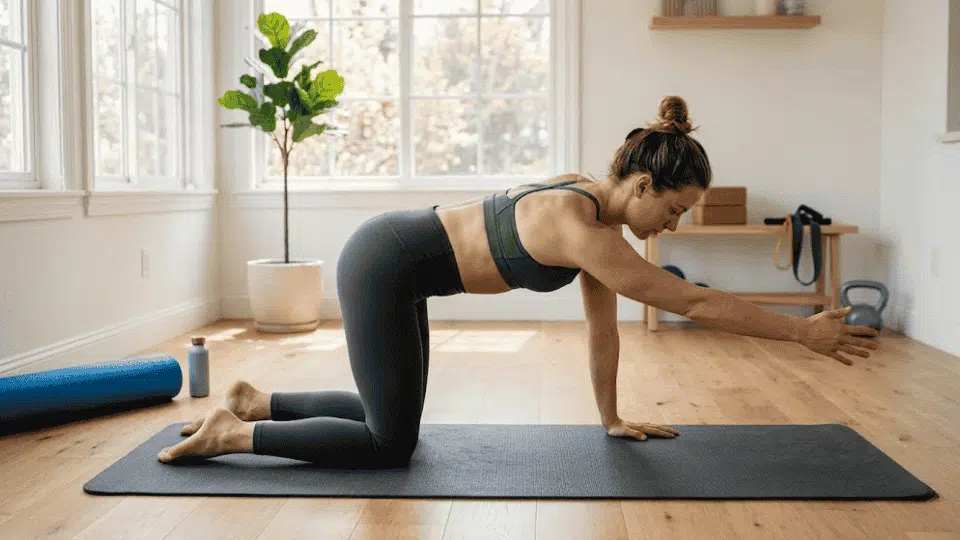
4. Cat-Cow Stretch
The Cat-Cow Stretch is a gentle spinal mobility exercise that improves flexibility, encourages smooth thoracic movement, and helps relieve stiffness after long periods of sitting or inactivity.
Steps to follow:
- Start on all fours, with your hands under your shoulders and your knees under your hips.
- Inhale as you slowly drop your belly toward the floor, lift your chest, and allow your upper back to gently extend.
- Exhale as you round your spine upward, drawing your chin toward your chest and spreading your shoulder blades.
- Continue alternating between these positions slowly, focusing on controlled breathing and smooth movement through the entire spine.
Progression Tip: Increase the range of motion gradually and coordinate deeper breathing with each movement to improve spinal control and thoracic flexibility.
Sets/Reps: 10–12 slow breath-coordinated cycles, 2 sets. Focus on segmental movement. Try to feel each section of the spine move in sequence rather than just the areas that already move freely. Most people find their thoracic spine barely participates at first; that will change with consistent practice.
5. Side-Lying Rotations (Book Openers)
Side-Lying Rotations, also called Book Openers, are excellent for improving thoracic rotation while gently stretching the chest and shoulders.
Steps to follow:
- Lie on your side with your knees bent and stacked, keeping your hips stable as you extend both arms straight in front.
- Slowly lift your top arm and rotate it across your body toward the opposite side while following the hand with your eyes.
- Allow your chest and upper back to rotate comfortably while keeping your knees grounded and lower body stable.
- Pause briefly when your arm reaches the floor behind you, then slowly return to the starting position.
Progression Tip: Gradually extend the pause in the open position and focus on deeper thoracic rotation while keeping the hips steady.
Sets/Reps: 8–10 reps per side, 2–3 sets. Following the moving hand with your eyes is not incidental. It drives cervical rotation that feeds into and deepens thoracic rotation. Don’t skip that cue.
6. Wall Slides / Windmills
Wall Angels are one of the most comprehensive upper-body mobility exercises available, and in 15 years of working with clients, they have consistently been one of the hardest to do correctly.
They address thoracic extension, scapular muscle activation, shoulder mobility, and deep neck alignment simultaneously, which is precisely why they’re so challenging.
Steps to follow:
- Stand with your back flat against a wall, feet a few inches out. Your head, upper back, and hips should all contact the surface.
- Press your lower back gently toward the wall by engaging your core — do not let it arch away.
- Raise your arms to a goalpost position (elbows at 90°, wrists aligned with elbows) against the wall.
- Slowly slide your arms upward toward full overhead extension while maintaining contact at elbows and wrists throughout.
- Lower back to the goalpost position and repeat.
Progression Tip: If your wrists lose contact with the wall before reaching overhead, stop at the point where contact breaks. That is your current end range. Work from there rather than forcing past it.
Sets/Reps: 2–3 sets of 8–10 reps. Most people find this exercise humbling at first. Wrists leaving the wall, lower back arching forward. These are the thoracic extension and shoulder flexibility restrictions revealing themselves. Use those limitations as your baseline and track progress weekly.
7. Kneeling Lat Stretch
The Kneeling Lat Stretch helps lengthen the lat muscles while improving thoracic mobility and shoulder flexibility, making it easier to maintain better posture and deeper breathing.
Steps to follow:
- Kneel comfortably on the floor with your hips over your knees and keep your spine tall and core gently engaged.
- Raise one arm overhead and slowly lean your torso toward the opposite side to stretch your side body.
- Allow the stretch to reach through your ribs, lats, and shoulders while keeping your hips stable and facing forward.
- Hold the position for 20–30 seconds, breathing deeply, then slowly return to the starting position before switching sides.
Progression Tip: Gradually deepen the side bend and extend the reaching arm further overhead to increase the stretch through the lats and ribcage.
Sets/Reps: Hold 20–30 seconds per side, 2–3 rounds. The latissimus dorsi attaches to the thoracic vertebrae and the lower back, meaning tight lats actively restrict thoracic mobility. This stretch targets the root cause rather than just the symptom, which is why it belongs in this list even though it does not look like a spinal mobility drill at first glance.
8. Child’s Pose with Side Stretch
Child’s Pose with Side Stretch is a relaxing mobility exercise that gently stretches the thoracic spine, shoulders, and side body while helping release tension built up from daily activities.
Steps to follow:
- Start in a kneeling position and sit your hips back toward your heels while extending your arms forward on the floor.
- Lower your chest toward the ground, relaxing your shoulders and allowing your spine to lengthen comfortably.
- Slowly walk both hands toward one side to create a stretch along the opposite side of your thoracic spine.
- Hold the stretch while breathing deeply, then walk your hands to the opposite side to repeat on the other side.
Progression Tip: Gradually walk your hands farther to each side while keeping your hips grounded to deepen the stretch safely.
Sets/Reps: Hold 20–30 seconds per side, 2–3 rounds. This works well as a closing exercise at the end of the routine. The passive nature of the hold allows accumulated tension from the more active drills above to release, and deep breathing from this position noticeably reinforces the thoracic extension achieved through the session.
9. Seated Thoracic Rotations
Seated Thoracic Rotations are a simple mobility exercise that improves upper-back rotation, reduces stiffness from sitting, and helps maintain better posture throughout the day.
Steps to follow:
- Sit upright on a chair with feet flat on the floor, keeping your spine tall and core gently engaged.
- Place both hands behind your head, elbows open, while keeping your lower body stable and relaxed.
- Slowly rotate your upper body toward one side, focusing on controlled movement through the thoracic spine.
- Return to the center and repeat the rotation toward the opposite side while maintaining a steady posture.
Progression Tip: Gradually increase the rotation range and pause briefly at the end of each twist while keeping hips stable and spine tall.
Sets/Reps: 8–10 reps per side, 2–3 sets. This is the most practical exercise on this list for anyone who works at a desk, because it requires no floor space, equipment, or change of clothes. I often recommend it to people as a 2-minute movement break every 90 minutes during a seated workday. It takes less time than a coffee run and addresses the cumulative loading that leads to mid-back stiffness by the end of the day.
Quick Desk-Worker Routine (No Floor Required)
For anyone who cannot get on the floor at work, this three-exercise subset requires only a chair and two minutes:
- Seated Thoracic Rotations — 8 reps per side
- Wall Angels — 8 reps against any wall
- Kneeling Lat Stretch — substitute with a standing version: reach one arm overhead and side-bend away from a doorframe for 20–30 seconds per side
Done every 90 minutes during a desk workday, this takes less than three minutes and meaningfully offsets the postural loading that accumulates with prolonged sitting.
It is not a replacement for the full routine, but it is far better than doing nothing until the evening.
How Often to Practice Thoracic Mobility
For best results, it’s recommended to practice thoracic mobility exercises daily, or at least three to five times a week. The key is to move slowly and only within a pain-free range; never push through discomfort.
Breathing deeply during each movement can help you relax your muscles and deepen the stretch.
There is a mechanical reason for this: inhalation expands the ribcage and creates tension around the thoracic vertebrae; exhalation releases that tension, allowing the spine to move further into its available range.
Timing your movement to the exhale, particularly in rotation and extension exercises, is not just a relaxation cue; it is the most effective way to access the full range each session offers.
Even a few minutes each day can make a noticeable difference in your posture, upper back comfort, and overall mobility over time.
Common Mistakes to Avoid
Even when doing thoracic mobility exercises, it’s easy to make mistakes that reduce effectiveness or cause discomfort. Here are some common ones to watch out for:
- Holding your breath: Forgetting to breathe can make muscles tense and limit the stretch. Always exhale during movements.
- Moving too fast: Rushing through exercises reduces effectiveness and increases the risk of injury. Slow, controlled motions work best.
- Forcing the range of motion: Trying to twist or extend beyond your comfort zone can strain the spine. Only move through a pain-free range.
- Ignoring posture: Slouching or letting your lower back take over can limit thoracic engagement. Keep your core stable and spine aligned.
- Skipping consistency: Doing exercises sporadically won’t improve mobility. Regular practice is key.
- Placing the foam roller too low: Positioning the roller in the lumbar region during extensions loads the lower back in a vulnerable position. Keep it between the shoulder blades and the bottom rib only.
Avoiding these mistakes will help you safely get the most from your thoracic mobility routine.
When to See a Professional
Thoracic mobility exercises are appropriate for most people experiencing general stiffness, postural tightness, or mild discomfort between the shoulder blades. They are not a substitute for professional evaluation when symptoms are more significant.
Consult a physiotherapist, sports medicine physician, or rehabilitation specialist if you experience:
- Sharp, shooting, or radiating pain during or after any of these exercises
- Pain that worsens over time rather than improving with consistent practice
- Numbness or tingling in the arms, hands, or chest
- Difficulty breathing that is not related to fitness level
- A history of spinal fracture, osteoporosis, or recent spinal surgery
Mobility work is most effective when done on a spine that has been properly assessed. If any of the above apply, get that assessment first; the exercises will still be here.
Final Stretch
Your posture will feel better, you will move more freely, and even your shoulders and neck will feel less tense.
In practice, the clients who see the most consistent improvement are those who attach this routine to something they already do: morning coffee, a lunch break, or directly before a workout as a warm-up.
Thoracic spine mobility responds well to frequency and poorly to infrequency; short sessions five days a week will outperform long sessions twice a week almost every time.
Remember, the key is consistencydoing them regularly, even if only for 5–10 minutes, is better than doing a long session occasionally. Start slowly, focus on your breath, and only go through a comfortable range of motion.
Give these exercises a try, and if you enjoyed this, don’t forget to share it and start your journey to a healthier, more mobile upper back today!