



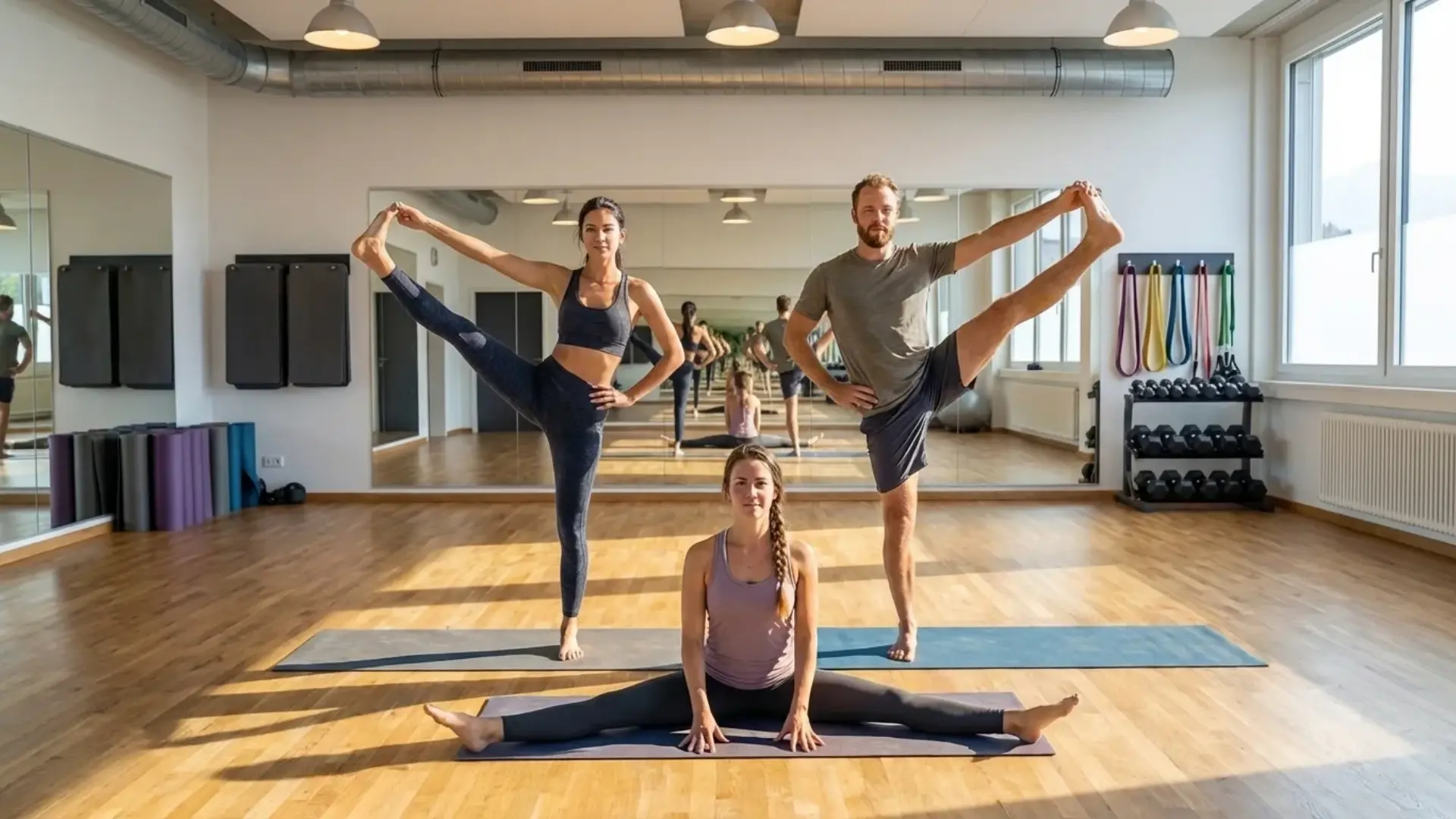





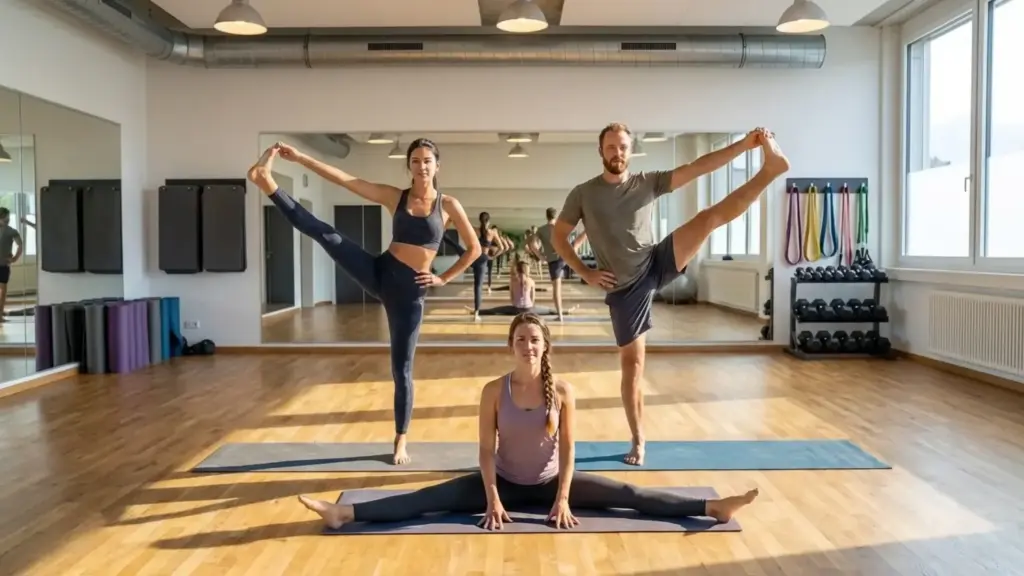

Yoga gets a whole lot more interesting with three people on the mat. Three-person yoga poses are one of the most fun and exciting ways to practice yoga.
Instead of rolling out your mat alone, you get to connect, laugh, and balance with two other people. It sounds tricky, but trust me, there are plenty of poses that even total beginners can try.
Everything you need to know about trio yoga poses is right here: easy poses for beginners, medium-level challenges, and even some hard poses for those who want to push themselves. Let’s get started!
Safety Note: Never attempt advanced poses without prior experience in the individual or partner version first. Listen to your body and communicate openly with your trio partners throughout.
What are Trio Yoga Poses?
These yoga poses are performed by three people working together at the same time. Instead of practicing alone or with just one partner, a group of three uses shared balance, body weight, and teamwork to create shapes that no single person could make on their own.
Think of it as a mix of traditional yoga, trust exercises, and a whole lot of fun. Some trio poses are simply three people doing the same pose side by side.
Others involve one person supporting or balancing on the others in creative ways; this style is often called Acro Yoga. You don’t need to be flexible or experienced; you just need two willing partners and a little bit of patience.
Benefits of Three-Poses Yoga Poses
Trio yoga isn’t just fun, it transforms your body, mind, and friendships all at once. Here’s why you should start today.
- Builds Trust and Communication: When three people move together, they must talk, listen, and respond constantly, building deep trust beyond the yoga mat.
- Improves Balance and Core Strength: Trio poses challenge your stability more than solo yoga, as your core works harder to adjust to the weight and movement of two other people.
- A Fun Social and Bonding Experience: Trio yoga promotes laughter and shared achievement, fostering strong bonds.
- Mental Health and Mindfulness Benefits: Trio yoga’s focus keeps your mind present, serving as a mindfulness practice that reduces stress and anxiety.
- Great for Team-Building: Many workplaces and retreats use trio yoga to foster cooperation, communication, and support more effectively than traditional exercises.
Now that you know the benefits, let’s look into the poses and start building strength, balance, and connection with your trio today!
Beginner Trio Yoga Poses
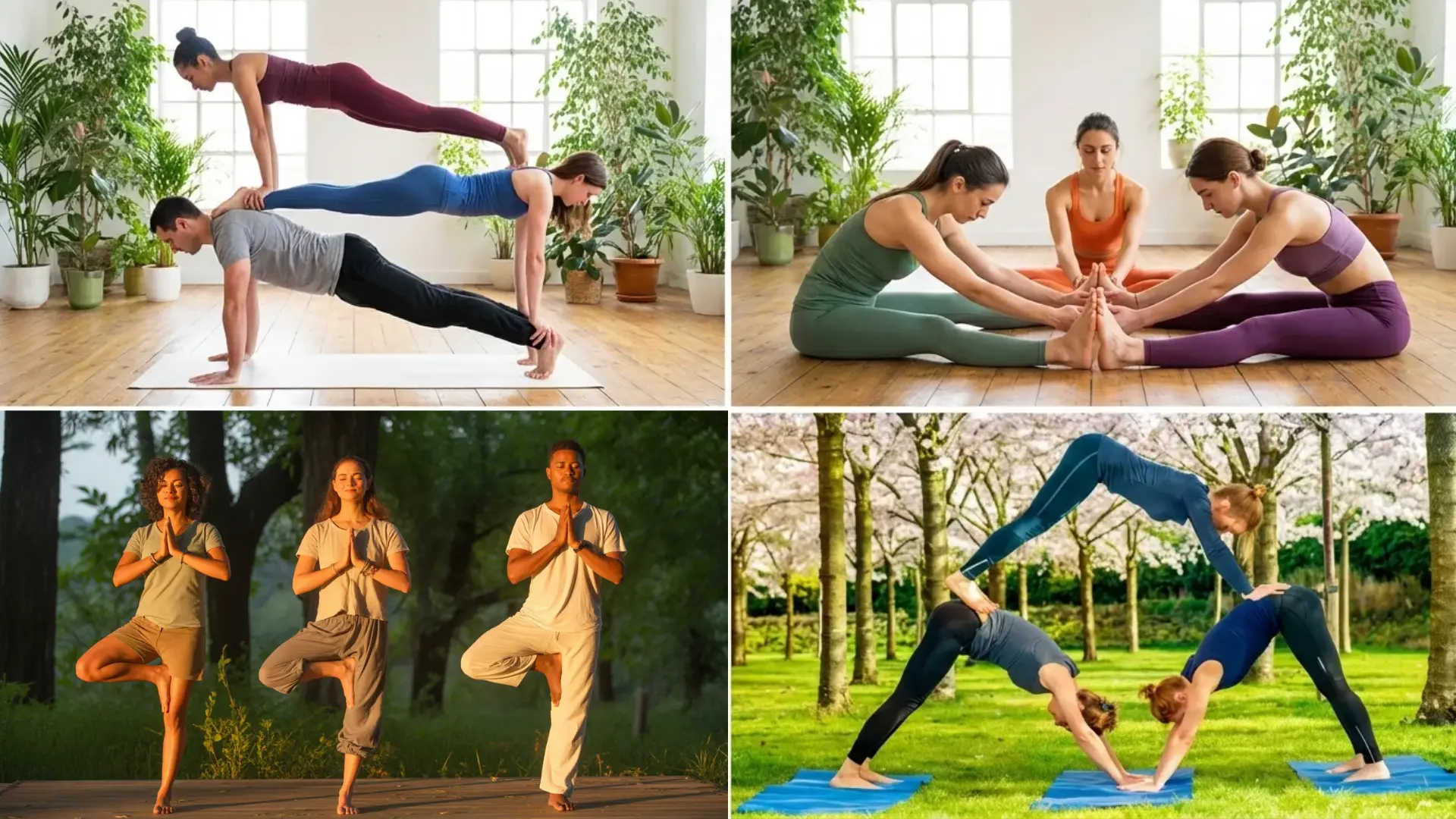
These beginner poses are simple, safe, and perfect for building confidence and connection with your two partners from day one.
1. Triple Mountain Pose (Tadasana Trio)
This is the simplest and most grounding starting point for any trio yoga session, building awareness, sync, and calm between all three partners.
Steps:
- Stand side by side with feet hip-width apart, making sure all three of you have enough space to stand comfortably without touching.
- Let your arms relax fully at your sides, or gently join hands with the people on each side to create a physical connection.
- Stand tall, lengthen your spine, soften your shoulders, and close your eyes together.
- Begin breathing in unison: inhale slowly for 4 counts, exhale slowly for 4 counts, and hold for 5–8 breaths.
Progression: Once comfortable standing still, try synchronizing a slow arm raise overhead on the inhale and a slow lowering on the exhale.
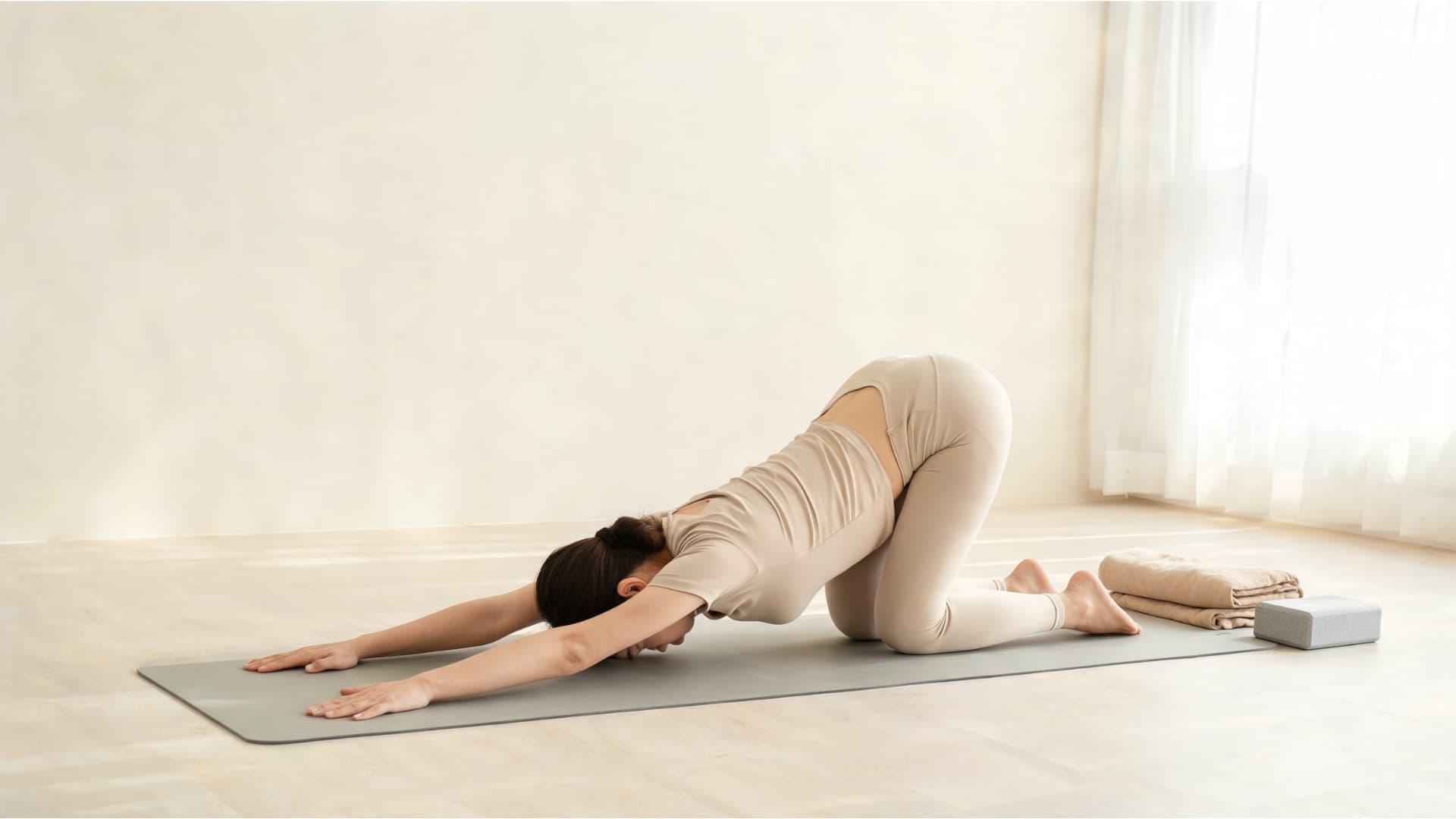
2. Triple Child’s Pose Circle
One of the most calming trio poses you can do, this is ideal for warm-ups and cool-downs, and works beautifully for kids and beginners alike.
Steps:
- All three kneel on the floor and form a triangle, each facing the center of the group.
- Slowly fold forward from the hips, bringing your forehead down toward the floor in Child’s Pose.
- Stretch both arms forward toward the center of the triangle until your fingertips are close to or touching those of your partners.
- Close your eyes, breathe deeply, and hold for 5–10 slow breaths before gently pressing back up together.
Progression: Once settled, try reaching one arm under your body to hold the hand of the partner diagonally across from you for a deeper shoulder stretch.
3. Triple Seated Forward Fold
A gentle and deeply satisfying stretch where the connected hand-hold between all three partners naturally deepens everyone’s fold without any forcing.
Steps:
- All three sit in a loose triangle formation with your legs stretched out straight in front of you and your feet pointing toward the center.
- Sit up tall first, taking a deep inhale to lengthen your spine before you begin to fold.
- On the exhale, hinge forward at the hips, not the waist, and reach your hands toward your feet or shins.
- Extend your arms toward your partners and hold each other’s wrists or hands, using the shared grip to gently ease deeper into the fold with each exhale.
Progression: Hold for 5 breaths, then on each exhale, lightly pull each other a little deeper, never forcing, just inviting the stretch.
4. Three-Way Tree Pose (Vrikshasana Trio)
A classic balancing pose made far more achievable for all three people thanks to the mutual support and stability that each partner provides.
Steps:
- Stand in a line or triangle formation, close enough to comfortably place an arm around the person beside you.
- Each person shifts their weight onto one foot, pressing it firmly into the floor, then lifts the other foot.
- Place the sole of the lifted foot against the inner thigh or calf of the standing leg; never press it against the knee joint.
- Wrap your inner arm around the shoulder or waist of the person next to you, raise your outer arm overhead, and hold for 5–8 breaths before switching sides.
Progression: Once balanced, try lifting your outer arms to meet overhead in a connected arch, with all three outer hands touching at the top.
5. Triple Downward-Facing Dog
A foundational yoga pose that lengthens the spine and hamstrings for all three people, with an optional stacked version for a deeper challenge.
Steps:
- All three start in a hands-and-knees position in a row, one behind the other, with about a leg’s length of space between each person.
- Tuck your toes, press firmly through your palms, and lift your hips up and back into Downward Dog, forming an inverted V shape.
- Hold the individual version for 5 breaths to make sure everyone is comfortable and stable before progressing.
- For the stacked version, the second person carefully lifts their feet one at a time onto the lower back of the first person, and the third person does the same on the second.
Progression: Master the side-by-side version across several sessions before attempting the stacked version for the first time.
6. Trio Butterfly Pose
A wonderfully social and relaxing hip-opening pose that feels even better when shared, making it a perfect choice for kids and first-time trio yogis.
Steps:
- All three sit in a triangle facing inward, close enough to reach your partners comfortably without straining.
- Bring the soles of your feet together in front of you in Butterfly Pose, letting your knees fall open to the sides.
- Extend both arms out toward the people on each side and hold the wrists or forearms of your partners.
- Breathe deeply, relax your inner thighs toward the floor, and hold for 8–10 breaths while maintaining a light, steady grip.
Progression: Try gently flapping your knees up and down in sync with your partner’s, like butterfly wings. This adds a gentle dynamic stretch to the hips.
7. Three-Person Boat Pose (Navasana Trio)
A core-strengthening classic that becomes far more fun and rewarding when three people press their feet together to create a beautiful shared star shape.
Steps:
- All three sit facing the center of the group in a triangle formation, close enough so your feet can reach your partners.
- Lean back slightly, engage your core firmly, and lift your feet off the floor. Start with bent knees if needed.
- Extend your legs toward the center and press the soles of your feet against the feet of both partners, creating a six-pointed star shape.
- Keep your spine long, chest lifted, and core engaged, hold for 5 breaths, then slowly lower your feet together.
Progression: Once comfortable with bent knees, work toward straightening your legs fully for the complete Navasana shape.
Intermediate Yoga Poses
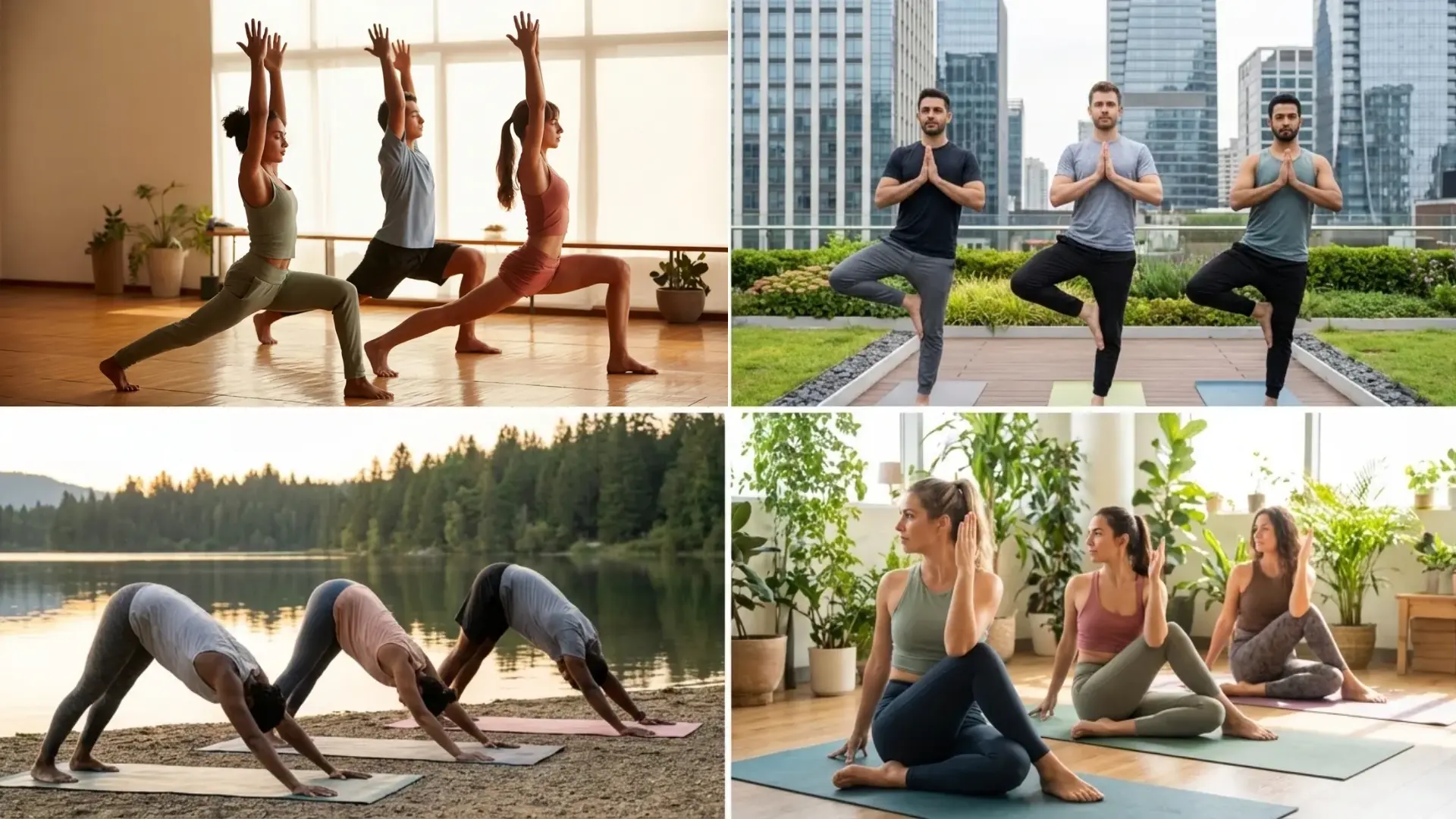
Ready to level up? These intermediate yoga poses will challenge your balance, strength, and teamwork in ways the beginner poses simply couldn’t.
8. Trio Warrior III
A powerful single-leg balance pose that becomes much more achievable and rewarding when the two supporting partners offer steady hands on each side.
Steps:
- Stand in a line of three, with the middle person positioned between the other two, all facing the same direction.
- The middle person shifts their weight onto one foot, engages their core, and begins to hinge their torso forward while simultaneously lifting the back leg.
- Continue until the torso and lifted leg are both parallel to the floor, forming a straight horizontal line from head to heel.
- Each side person extends a forearm or hand at hip height for the middle person to lightly rest their hands on for balance, hold for 5 breaths, then switch.
Progression: As the middle person gets stronger, encourage them to take their hands off the supporters’ arms for 2–3 breaths at a time to build independent balance.
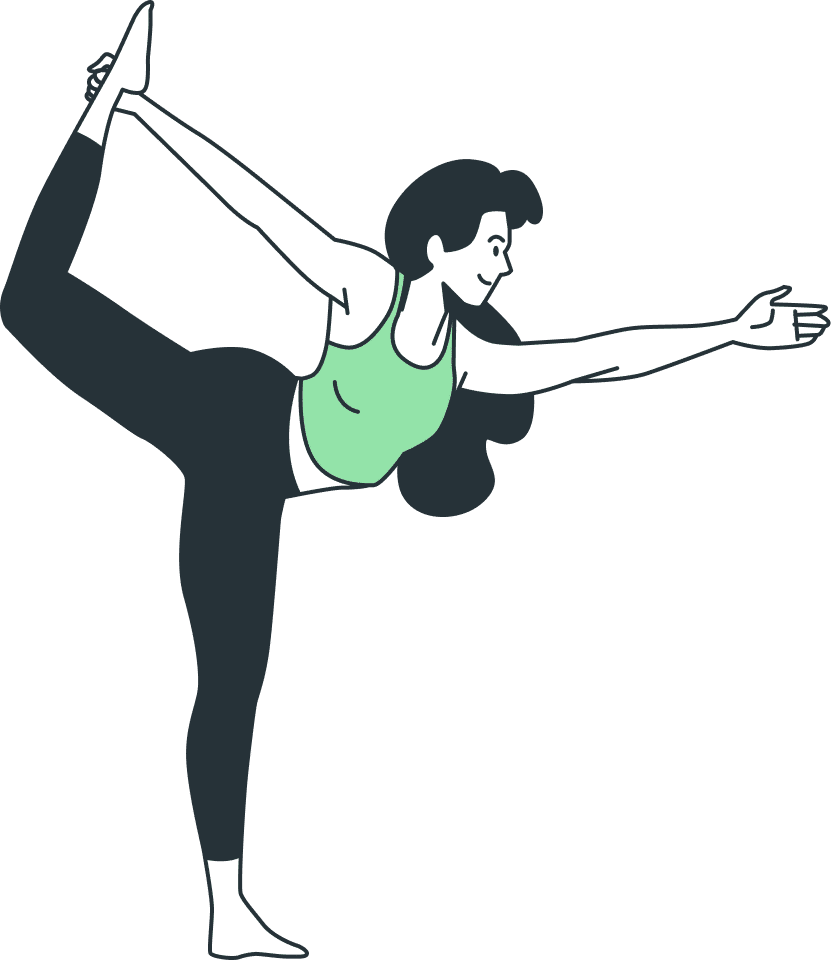
9. Trio Dancer Pose (Natarajasana Trio)
A graceful, visually stunning backbend where the symmetry of three people in Dancer Pose, side by side, creates an unforgettable shared moment.
Steps:
- Stand in a line of three, all facing the same direction, with enough space to extend your arms without touching.
- Each person shifts weight onto one foot, bends the back knee, and reaches the same-side hand back to hold the inner ankle or foot.
- Begin to lean the torso forward while pressing the foot into the hand and kicking the leg upward and back, move slowly and with control.
- The outer two people extend their free hand toward the middle person, who holds on lightly for balance support, holding for 5 breaths on each side.
Progression: Once steady, try releasing the middle person’s hands for a few breaths so all three are holding the pose independently in unison.
10. Leaning Double Side Bend
A beautiful and connected lateral stretch where all three people lean together to create a flowing, fan-like shape that opens the whole side body.
Steps:
- Stand in a line of three, shoulder to shoulder, with feet hip-width apart and arms relaxed at your sides.
- The two outer people raise their outer arms up and overhead, then begin to lean away from the centre in a long, sweeping side bend.
- The middle person raises both arms overhead and simultaneously leans gently toward each outer person, connecting the movement of the whole group.
- Hold the full shape for 5–8 breaths, breathing into the sides of the body, then slowly return to standing and repeat on the other side.
Progression: Try holding the outer hands of the people next to you overhead at the peak of the lean to deepen the stretch and create a more connected shape.
11. Three-Person Bridge Pose
A glute and spine-strengthening pose where the connected hand-hold between all three people creates a stable, grounded chain of lifted bridges.
Steps:
- All three lie on your backs in a row with your feet pointing toward the center and knees bent, feet flat on the floor.
- Place your feet hip-width apart, press your arms into the floor beside your body, and take a breath to prepare.
- On an exhale, press firmly through your feet, squeeze your glutes, and lift your hips as high as comfortably possible into Bridge Pose.
- Reach your arms toward the people on each side, hold their wrists firmly, and hold the lifted position for 5–8 breaths before slowly lowering together.
Progression: Try lifting onto the balls of your feet while in the Bridge to add a calf and ankle strengthening challenge for all three people.
12. Triple Camel Pose (Ustrasana Trio)
A deep and opening backbend for the chest and hip flexors that feels even more supported and confident when done side by side with two partners.
Steps:
- All three kneel side by side on your mats with hips stacked directly over knees and the tops of your feet flat on the floor.
- Place your hands on your lower back, fingers pointing down, and begin to lift your chest toward the ceiling while drawing your shoulder blades together.
- If comfortable, reach both hands back, one at a time, toward your heels, keeping your hips pushed forward to protect your lower back.
- The outer two people place their free hands gently on the middle person’s upper back, offering light support. Hold for 5 breaths, then slowly come up together.
Progression: Work toward reaching your hands all the way to your heels with straight arms before adding the partner support element.
13. Trio Star Pose
A feel-good and confidence-building shape where all three people press back to back and extend outward, creating a striking six-pointed star together.
Steps:
- All three stand back-to-back in a tight triangle, close enough that your upper backs are lightly touching.
- Step your feet out wide to the sides, roughly 3 to 4 feet apart, while keeping your backs pressed firmly together.
- Extend both arms out to the sides at shoulder height and reach toward your partners until you can grip each other’s wrists or hands.
- Press your backs into each other, breathe deeply, and hold the star shape for 8–10 breaths. The shared back pressure is what keeps everyone steady.
Progression: Once stable, try lifting onto your tiptoes together as a group while holding the star shape to add a balance and calf challenge.
14. Three-Person Seated Spinal Twist
A deeply satisfying spinal rotation where the resistance of three backs pressing together naturally helps everyone twist further than they could alone.
Steps:
- All three sit cross-legged on the floor in a tight back-to-back-to-back triangle, pressing your backs firmly into each other.
- Take a deep inhale and sit up as tall as possible, lengthening through the crown of your head before beginning any rotation.
- On the exhale, everyone twists to the right. Place your right hand on your own right knee and your left hand on the left knee of the person to your left.
- Use each other’s backs as resistance to twist deeper with every exhale, hold for 5–8 breaths, then unwind and twist to the left.
Progression: To deepen the twist, try gazing over your right shoulder and holding for 2 extra breaths before switching direction.
15. Trio Half-Moon Pose (Ardha Chandrasana Trio)
One of yoga’s trickiest balance poses becomes far more accessible and enjoyable when two supportive partners stand ready to steady the middle person.
Steps:
- Stand in a line of three, the middle person between the two supporters, all facing the same direction.
- The middle person steps their right foot forward, places their right hand on the floor or a block about 12 inches ahead, and begins to shift weight onto the right foot.
- Lift the left leg up until it is parallel to the floor, stack the hips, and reach the top arm toward the ceiling; the body should form a long, open T-shape.
- Each outer person places a steady hand on the middle person’s waist or hip to help them stabilize, hold for 5 breaths, then switch sides and roles.
Progression: Once the middle person feels stable with support, have the outer people slowly reduce their grip to just a fingertip touch before removing contact entirely.
16. Triple Wide-Legged Forward Fold
A spacious, releasing forward fold, where the shared wrist grip among all three partners gently draws everyone deeper into the stretch together.
Steps:
- All three stand in a triangle facing inward, stepping feet wide apart, roughly 3 to 4 feet, toes pointing slightly inward.
- Place your hands on your hips, take a deep inhale to lengthen the spine, then hinge forward from the hips on the exhale.
- Once your torso is parallel to the floor or lower, extend your arms toward the center and find your partner’s wrists, gripping firmly.
- With each exhale, use the shared grip to gently draw each other a little deeper into the fold, hold for 8 breaths, then slowly rise together.
Progression: Once comfortable, try walking your hands further along your partner’s forearms to increase the forward pull and deepen the stretch.
Fun & Creative Yoga Poses

These fun and creative yoga poses are perfect for adding laughter, energy, and a whole new level of excitement to your practice.
17. Three-Person Seated Meditation Circle
A deeply calming, connected mindfulness pose in which three people breathe in perfect unison, creating a powerful sense of shared peace and presence.
Steps:
- All three sit cross-legged in a tight triangle, positioning yourselves so that your knees lightly touch your partners’ knees.
- Rest both hands on the knees of the people on either side of you, palms facing upward in a receiving gesture.
- Close your eyes together, soften your faces, and begin breathing slowly and in unison, try to match the rhythm of each other’s breath.
- Hold this connected meditation for 2–5 minutes, letting the shared silence and breathing create a deep sense of calm and presence.
Progression: Try humming a single sustained note together on your exhale; the shared vibration adds a powerful grounding dimension to the meditation.
18. Trio Reverse Plank
A strong and energizing chest and shoulder opener that feels even more powerful when all three people press up into the pose at exactly the same time.
Steps:
- All three sit side by side with legs extended straight, hands placed on the floor directly behind your hips, fingers pointing forward toward your feet.
- Press your palms firmly into the floor, engage your core and glutes, and prepare to lift on a shared count.
- On the count of three, all press up simultaneously into Reverse Plank, hips rising, chest opening toward the ceiling, arms straight and strong.
- Point your toes, press your hips as high as comfortable, hold for 5 breaths, then lower together slowly and with control.
Progression: Try turning your head gently back to look behind you at the top of the pose for a deeper throat and chest stretch.
19. Three-Person Lizard Tower
A playful, trust-building, and visually impressive pose where one person stands elevated on another’s thighs while the third partner provides essential safety support.
Steps:
- Person A takes a wide-straddle stance, with feet about 3 feet apart, knees slightly bent, and hands ready to grasp Person B’s ankles.
- Person B carefully steps one foot at a time onto Person A’s thighs, facing the same direction, while Person A grips B’s ankles firmly for security.
- Person B stands tall and finds their balance while Person A keeps a firm, stable hold; both communicate openly throughout the process.
- Person C stands directly behind Person A with both hands raised and ready at Person B’s waist level to catch them if needed at any point.
Progression: Once Person B feels stable, try having them raise both arms overhead for a more impressive and balanced shape.
20. Trio Plank Stack
A thrilling and challenging pose where one person planks on top of another, building impressive core and arm strength for both the base and the flyer.
Steps:
- Person A comes into a strong, solid Plank Pose, hands under shoulders, core tight, hips level, and body forming a straight line from head to heel.
- Person B kneels beside Person A, places their hands firmly on A’s ankles, then carefully steps their feet up one at a time onto A’s shoulders.
- Person B adjusts until they are in a full Plank Pose on top of A. Both people maintain tight cores and flat backs throughout.
- Person C kneels beside the stack, hands ready to assist Person B’s hips or catch them if they begin to lose balance, hold for 3–5 breaths, then dismount carefully.
Progression: Person A must be able to hold a solid solo plank for at least 60 seconds before attempting this pose as a base.
21. Three-Person Wheel Pose
An advanced and exhilarating backbend that becomes more motivating and connected when all three people rise into Full Wheel and link hands together.
Steps:
- All three lie on your backs in a row, heads pointing toward the center of the group, with bent knees and feet flat on the floor near your hips.
- Place both hands flat on the floor beside your ears, fingers pointing toward your shoulders, and take a preparatory breath.
- On a shared count, all three press strongly through hands and feet, lifting the hips and chest up into Full Wheel, straighten your arms fully.
- Once all three are stable in the pose, the outer two people each reach across with one hand and hold the center person’s wrist for 3–5 breaths, then lower together.
Progression: Only attempt the wrist connection once all three are fully stable in their individual Wheel Poses; never rush this step.
Advanced & Acro Yoga Poses

These advanced and Acro yoga poses are not for the faint-hearted; they demand strength, trust, and serious practice before attempting them.
22. Trio Acro Pyramid
The most iconic structure in trio Acro Yoga, this progressive three-person pyramid is a true benchmark pose that looks as incredible as it feels to achieve.
Steps:
- Person A (base) lies flat on their back, bends their knees, and places their feet flat on the floor hip-width apart before extending arms straight up.
- Person B (middle) stands at A’s feet, places their hips over A’s feet, and leans their body forward while A slowly presses B up into a horizontal plank position.
- Person B extends their body fully, arms at sides, core tight, body forming a straight plank in the air, while A stabilizes by keeping legs perfectly vertical.
- Person C (top) carefully and slowly steps onto B’s back, starting with a kneeling position before attempting to stand, while the whole group communicates every movement.
Progression: Master the two-person base-and-flyer plank shape fully before adding Person C to the structure.
23. Flying Two Egyptian Goddess
A breathtaking and iconic Acro Yoga pose where two flyers rise simultaneously on the base’s feet with arms spread wide like the wings of a goddess.
Steps:
- Person A (base) lies flat on their back, draws their knees to their chest, and raises both feet to the ceiling with legs hip-width apart and soles facing up.
- Person B carefully steps one foot at a time onto A’s right foot, finding their balance with A’s help before fully transferring their weight.
- Person C mirrors Person B on A’s left foot; both flyers stand tall, core engaged, weight directly over A’s feet.
- Once all three are stable, everyone extends their arms wide to the sides like wings, hold for 3–5 breaths then dismount one flyer at a time.
Progression: Each flyer should practice standing on the base’s feet individually and hold for 10 seconds before attempting the full two-flyer version.
24. Three-Person L-Basing Star
A graceful and visually striking Acro shape where one person floats horizontally in the air while a third partner anchors the entire formation from below.
Steps:
- Person A lies on their back with arms extended alongside their body for stability, then draws both knees to the chest and extends both legs straight up toward the ceiling.
- Person B stands facing Person A, places their hips over A’s feet, and slowly leans forward, transferring their weight until A is supporting B in a horizontal L-shape.
- Person B extends their arms out to the sides, finding balance in the floating position while A maintains strong, vertical legs.
- Person C stands beside Person A and reaches up to firmly grasp both of Person B’s extended hands, acting as the stabilizing anchor for the whole shape.
Progression: Person C should practice holding Person B’s hands from a standing position on the ground before Person B is lifted, so the grip is established before the full shape is formed.
25. Trio Throne Pose
A bold and trust-demanding pose where one person literally sits on another’s thighs while a third partner provides the critical support from behind.
Steps:
- Person A (base) stands with feet hip-width apart and lowers into a deep Chair Pose, thighs as close to parallel with the floor as possible, back straight, arms forward.
- Person B stands in front of Person A, facing away, then carefully and slowly sits back onto A’s thighs, evenly distributing their weight across both of A’s legs.
- Person B sits up tall, engages their core, and raises their arms overhead, keeping their weight centered and still, which is critical for A’s comfort and stability.
- Person C stands directly behind Person A, places both hands firmly on A’s shoulders, and provides a steady backward support to stop A from tipping, holding for 5 breaths.
Progression: Person A should be able to hold a solo Chair Pose for at least 30 seconds comfortably before attempting to support Person B’s weight.
26. Triple Handstand Support
A supported inversion where two partners hold the handstand person’s ankles, freeing them to focus entirely on alignment, breath, and body awareness.
Steps:
- Person A places their hands on the floor shoulder-width apart, directly under their shoulders, fingers spread wide and pressing firmly into the mat.
- Person A kicks up into a handstand, either against a wall for safety or freestanding, and holds the inverted position with a tight core and straight body.
- Person B moves to one side of Person A and grips A’s ankle with both hands, providing a firm, steady hold without pulling or pushing, just stabilizing.
- Person C mirrors Person B on the opposite side, gripping A’s other ankle. Both supporters stand in a strong staggered stance and hold for 5–8 breaths.
Progression: Person A should be able to hold a wall-supported handstand for 20–30 seconds independently before inviting the two supporters to hold their ankles.
27. Trio Folded Leaf Stack (Acro)
A deeply restorative and visually effortless Acro pose where the base supports two people stacked above them, demanding full trust and total body surrender.
Steps:
- Person A (base) lies flat on their back, engages their core, and raises both arms straight up, hands ready at hip height to receive Person B.
- Person B stands at A’s side, places their hips into A’s hands, and slowly leans forward into a face-down horizontal position while A takes on B’s full weight.
- Person B extends their arms forward and completely relaxes their entire body, surrendering all tension, which is essential for A to hold the shape comfortably.
- Person C carefully straddles Person B’s back, seated or kneeling, distributing their weight evenly, while A adjusts their arm strength to accommodate the added load.
Progression: Practice the two-person Folded Leaf with Person A and B alone across multiple sessions before Person C is added to the structure.
Safety Note: Always warm up before attempting any trio yoga poses. Never attempt advanced poses without prior experience in the individual or partner version first.
Tips for Practicing Trio Yoga Safely
Safety is the foundation of great trio yoga. Follow these simple tips to make sure everyone has a fun, injury-free experience.
- Warm Up Before You Start: Spend at least 10 minutes doing gentle cat-cow stretches, hip circles, and shoulder rolls before any trio poses, as warm muscles are far less likely to strain.
- Communication is Everything: Before every pose, discuss who is doing what, check in during the pose, and give feedback after. A simple “Are you ready?” before each transition prevents most accidents.
- Use Yoga Mats and Props: Always practice on non-slip yoga mats, use a folded mat or blanket under your knees for kneeling poses, and use crash mats for any Acro poses.
- Know When to Stop and Rest: If any one of the three people feels tired, shaky, or uncomfortable, the whole group stops immediately; no pose is ever worth pushing through pain or exhaustion.
These safety tips are simple but powerful. Stick to them every session, and your trio yoga practice will stay enjoyable and injury-free for everyone.
Common Mistakes to Avoid in Trio Yoga
Even well-meaning yogis make these mistakes; knowing them upfront will save your group a lot of frustration and keep everyone safe.
- Choosing Poses That Are Too Advanced Too Soon: Attempting hard or Acro poses before mastering beginner-level ones puts the whole group at risk and quickly kills confidence.
- Ignoring Discomfort: Pushing through pain or discomfort to complete a pose is dangerous; any sign of strain from one person means the whole group should stop and reset.
- Holding Your Breath: Forgetting to breathe during challenging poses can cause muscles the tense, making balance harder and increasing the risk of injury.
Avoiding these mistakes from day one will make your trio yoga sessions smoother, safer, and far more enjoyable for everyone involved.
Final Thoughts
Trio yoga is honestly one of the best ways to make your yoga practice feel fresh and exciting again. I hope this guide showed you that it doesn’t have to be complicated or intimidating.
If you started with a simple Triple Child’s Pose or worked your way up to an acro pyramid, every pose you try with your group is a win.
The real magic of trio yoga poses isn’t just in the balance or the strength, it’s in the laughter, the trust, and the memories you build together.
So grab two friends or family members, clear some space on the floor, and give these poses a try today. I’d love to know which one was your favorite. Drop it in the comments below!