














Stiff ankles can quietly sabotage your performance, in the middle of a squat, during a morning run, or simply while walking up a flight of stairs.
I have seen it happen more times than I can count. After years of working with clients ranging from weekend warriors to post-surgery rehabilitation cases.
People who also deal with things like why their nose runs during exercise, ankle health remains one of the most overlooked aspects of fitness, and that still surprises me.
Tight ankles affect posture, movement mechanics, and long-term joint health in ways most people do not realize until discomfort sets in. The ankle mobility exercises and stretches I have put together here are designed to change that.
The Ankle-Body Connection: A Closer Look
The most effective ankle mobility exercises are the knee-to-wall lunge, banded ankle mobilization, heel drops, and deep bodyweight squats.
Done consistently for 10–15 minutes daily, most people notice measurable improvement in range of motion within 2–3 weeks. Scroll down for the full list of 15 movements with sets, reps, and coaching cues.
Sedentary lifestyles, old sprains that weren’t fully rehabilitated, and years spent in rigid footwear are the most common culprits behind reduced ankle flexibility.
Research supports this directly. A 2011 study published in the Journal of Orthopedic & Sports Physical Therapy found that restricted ankle dorsiflexion was significantly associated with increased knee injury risk, reinforcing why ankle range of motion matters well beyond the ankle itself.
The encouraging part? Consistent practice of targeted ankle mobility exercises can reverse much of this tightness. In my experience working with rehabilitation clients, even a 10-minute daily routine produces measurable improvements in range of motion within two to three weeks.
What Tight Ankles Actually Feel Like Day-to-Day
Most people don’t connect their symptoms to ankle restriction. I routinely see clients who come in for knee pain when squatting, lower back tightness, or squat depth problems, and ankle mobility turns out to be the root issue.
Signs worth paying attention to: heels lifting early when squatting, discomfort walking barefoot on hard floors, shin tightness after short walks, or one knee tracking inward during a lunge. These are ankle restriction patterns, not knee problems.
The Role of Footwear in Ankle Restriction
Years in raised-heel shoes (dress shoes, traditional running shoes, boots) shorten the calf complex and restrict the ankle’s natural range over time.
I ask new clients what they wear most days, and it consistently predicts what I find on the assessment table. If you’re doing this work in stiff, elevated footwear, the progress will be slower. Flat, flexible shoes or bare feet are better for daily ankle mobility practice.
How to Test Your Ankle Mobility Before You Start
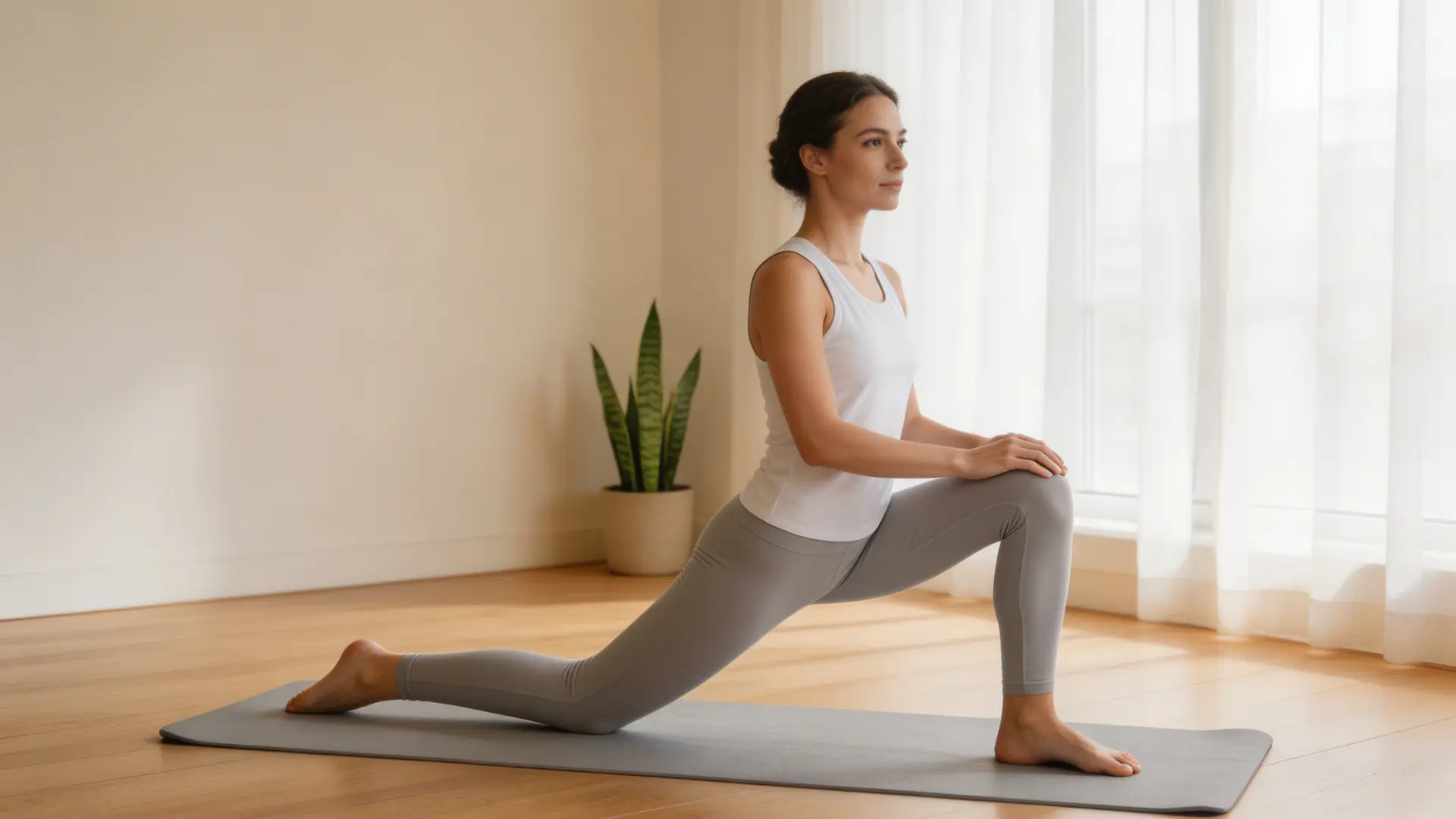
Before doing exercises, it helps to know where you actually stand. The wall dorsiflexion test is the simplest, most reliable at-home assessment available:
- Get into a half-kneeling lunge facing a wall with your front toes approximately 4 to 5 inches from the base.
- Keep your heel completely flat and drive your knee forward, attempting to touch the wall without the heel lifting.
- If your knee reaches the wall cleanly, your dorsiflexion range is generally considered functional for most movement demands.
- If your heel lifts before contact, restricted dorsiflexion is likely affecting your squats, stairs, and walking gait.
- Measure the distance from your toe to the wall when you first pass, and retest every two to three weeks.
I use this exact test as the opening assessment with new clients complaining of knee pain or squat limitations. The results consistently correlate with what I observe in their movement patterns under load.
One thing I tell clients: don’t compare your number to anyone else’s. Note your baseline and track your own improvement.
A client I worked with after a Grade II ankle sprain started at 2.5 inches from the wall. After six weeks of consistent daily work, she tested at 4.5 inches, and her knee pain had resolved entirely.
Essential Exercises to Improve Ankle Flexibility and Strength
The 15 movements below cover every key aspect of ankle health, from joint capsule mobility and dorsiflexion to calf strength and foot stability, giving you a complete, practical routine to follow.
1. Knee-to-Wall Lunge
The knee-to-wall lunge is one of the most reliable ways to assess and improve the dorsiflexion range of motion. Stand about 4 inches from a wall, place one foot forward, keep your heel flat, and drive your knee toward the wall.
The stretch should register in the lower leg, not the arch. In my practice, this is often the first movement used when evaluating squatting limitations.
- Target Muscle: Tibialis anterior, calf complex, ankle joint capsule
- Sets & Reps: 2–3 sets per side
- Hold/Duration: 20–30 seconds per hold
2. Banded Ankle Mobilization
Banded ankle mobilization differs from passive stretching: the band creates posterior distraction, directly opening the joint capsule.
Loop a resistance band around your ankle, anchor it low behind you, step into a lunge, and slowly rock your knee forward over your toes. This is especially effective for stiffness that lingers after old sprains and doesn’t respond to standard calf stretching.
I use this with virtually every post-sprain client before any other ankle work. The distraction it creates changes what you can access immediately, in a single session. People often gain a noticeable degree of forward knee travel that they couldn’t achieve without it.
- Target Muscle: Ankle joint capsule, posterior ankle structures
- Sets & Reps: 2–3 sets of 10–15 reps per side
- Hold/Duration: Continuous controlled rocking, no static hold
3. Alphabet Writing with Foot
Alphabet writing with the foot builds multi-directional ankle range of motion, a quality few single-plane exercises can match.
Sit with one leg extended, lift your foot slightly off the floor, and trace the entire alphabet using your big toe as the guide. Every letter demands a slightly different direction from the joint, covering the full arc of available motion.
- Target Muscle: Peroneals, tibialis anterior, intrinsic foot stabilizers
- Sets & Reps: 1 full alphabet per foot, per side
- Hold/Duration: No hold, slow, deliberate, continuous movement
4. Heel Walks
Heel walks directly target the tibialis anterior, the shin muscle responsible for pulling the foot upward and controlling the ankle during the landing phase of walking and running.
Raise your toes off the ground and walk forward with legs straight. Most people find this surprisingly fatiguing on the first attempt, which reflects just how underworked this muscle typically is.
- Target Muscle: Tibialis anterior, ankle dorsiflexors
- Sets & Reps: 3 sets
- Hold/Duration: 20–30 seconds of continuous walking per set
5. Toe Walks
Toe walks load the gastrocnemius and soleus, the two muscles that form the calf complex and generate the plantarflexion needed for walking, running, and jumping.
Rise onto the balls of your feet and walk forward without letting the heels drop mid-stride. Pairing this with heel walks in the same session gives you a complete approach to lower-leg conditioning.
- Target Muscle: Gastrocnemius, soleus, ankle plantarflexors
- Sets & Reps: 3 sets
- Hold/Duration: 20–30 seconds of continuous walking per set
6. Deep Bodyweight Squats
The deep bodyweight squat functions as both a mobility test and a training tool; the ability to hold the bottom position with heels flat is a direct measure of dorsiflexion capacity.
Stand shoulder-width apart, lower fully into the squat, and use your elbows to gently push your knees outward. In my assessment work, this position quickly reveals where ankle restriction is limiting movement.
- Target Muscle: Ankle dorsiflexors, hip flexors, lower body stabilizers
- Sets & Reps: 2–3 sets
- Hold/Duration: 30–60 seconds at the bottom position
7. Standing Calf Stretch
The standing calf stretch targets the gastrocnemius, the large, superficial calf muscle that limits dorsiflexion when tight. Face a wall, step one foot back, keep that back leg straight, and press the heel firmly into the ground.
A clear pull should run from mid-calf to the heel. This is one of the most accessible and consistently underused stretches in lower-body maintenance.
- Target Muscle: Gastrocnemius, Achilles tendon
- Sets & Reps: 2–3 sets per leg
- Hold/Duration: 20–30 seconds per hold
8. Kneeling Dorsiflexion Stretch
The kneeling dorsiflexion stretch works the ankle joint capsule directly, something passive calf stretching doesn’t reach.
From a half-kneeling position, place one foot flat ahead of you and slowly push your knee over your toes while keeping the heel grounded. The long hold here is intentional: joint capsule tissue and fascia respond to sustained, low-load pressure rather than brief force.
- Target Muscle: Ankle joint capsule, posterior talocrural structures
- Sets & Reps: 2 sets per side
- Hold/Duration: 45 seconds to 2 minutes, build this duration gradually
9. Towel Scrunches
Towel scrunches build the intrinsic foot muscles, the small, often-neglected muscles that support the arch and stabilize the ankle from the ground up.
Sit upright with a small towel flat on the floor. Place your bare foot on top and curl your toes to scrunch it toward you. Clients dealing with flat feet, plantar fasciitis, or chronic ankle instability tend to notice the most benefit from consistent practice.
- Target Muscle: Intrinsic foot muscles, toe flexors, plantar fascia
- Sets & Reps: 2–3 sets per foot
- Hold/Duration: 1–2 minutes of continuous scrunching per set
10. Plantarflexion Stretch
The plantarflexion stretch targets the tibialis anterior and the dorsal surface of the foot, areas that are rarely addressed in standard lower-body routines.
Sit back on your heels with toes pointed behind you and the tops of your feet pressing gently into the mat. The stretch runs across the shin and the top of the foot, complementing calf-focused work by addressing the opposite side of the ankle.
- Target Muscles: Tibialis anterior, extensor digitorum, dorsal foot muscles
- Sets & Reps: 2–3 sets
- Hold/Duration: 30 seconds to 1 minute per hold
11. Rolling the Foot with a Ball
Foot rolling is a form of myofascial release that softens the connective tissue running through the sole, tissue that directly influences how freely the ankle moves.
Place a tennis or lacrosse ball on the floor, stand on it with one foot, and roll slowly from heel to toe, pausing on areas that feel particularly dense or restricted. This works well as a pre-session ritual before squatting or running.
- Target Muscle: Plantar fascia, intrinsic foot muscles, heel pad
- Sets & Reps: 1 set per foot
- Hold/Duration: 2–3 minutes of slow, continuous rolling
12. Ankle Circles
Ankle circles move the joint through its full range of motion, covering dorsiflexion, plantarflexion, inversion, and eversion in a single continuous motion.
Sit with one leg extended, lift your foot slightly off the floor, and trace slow, deliberate circles. Push to the edges of your range in every direction, particularly the full point-down and pull-up extremes. Small, rushed circles return almost nothing.
- Target Muscle: All ankle stabilizers, peroneals, tibialis posterior
- Sets & Reps: 2 sets per foot, 10 circles clockwise, 10 counter-clockwise
- Hold/Duration: Continuous movement, no static hold
13. Heel Drops
Heel drops train the calf eccentrically, meaning the muscle lengthens under load, which simultaneously builds calf strength and increases the ankle’s available downward range of motion.
Stand on the edge of a step, lower your heels slowly below step level, hold briefly, then rise back up. Runners and anyone managing Achilles tightness tend to see significant results from this movement within a few weeks.
- Target Muscle: Gastrocnemius, soleus, Achilles tendon
- Sets & Reps: 3 sets of 10–15 reps
- Hold/Duration: 5–10 seconds at the lowest point
14. Squat Rocking
Dynamic squat rocking takes the ankle through dorsiflexion and plantarflexion during a loaded squat, making it one of the most functional warm-up movements available.
Drop into a full squat and slowly shift your weight forward toward the balls of your feet, then back onto your heels. The movement should be controlled and deliberate, with brief pauses at each end.
- Target Muscle: Ankle dorsiflexors, calf complex, lower body stabilizers
- Sets & Reps: 2–3 sets of 10–15 reps
- Hold/Duration: 2-second pause at each end of the rock
15. Forced Dorsiflexion on a Box
Forced dorsiflexion on a box is the most demanding movement here; the elevated foot and applied bodyweight produce a stronger dorsiflexion stimulus than any floor-based variation can match.
Place one foot flat on a low box, lean forward, and gently push your knee over your toes with the heel grounded. For clients with persistently stiff ankles, this is the exercise where the most consistent progress tends to show up.
I save this movement for clients who have been working consistently for three to four weeks and are no longer responding to floor-based variations.
The added height amplifies the demand on the joint capsule noticeably, so don’t rush into it.
- Target Muscle: Ankle joint capsule, tibialis anterior, calf complex
- Sets & Reps: 3 sets per side
- Hold/Duration: 10–20 seconds per hold
Work through these exercises at a pace that feels manageable. Even four to five movements done consistently will produce noticeable changes in ankle range, stability, and how your lower body feels under load.
Sample Weekly Ankle Mobility Routine
The table below is the structure I recommend for most clients starting out. You do not need to do all 15 exercises every day. Consistency across the week matters more than volume in a single session.
| Day | Focus | Exercises | Time |
|---|---|---|---|
| Monday | Dorsiflexion + Strength | Knee-to-Wall Lunge, Banded Ankle Mobilization, Heel Drops | 10–12 min |
| Tuesday | Active Recovery | Ankle Circles, Alphabet Writing, Foot Rolling | 8–10 min |
| Wednesday | Calf + Full Range | Standing Calf Stretch, Toe Walks, Heel Walks, Deep Squat Hold | 10–12 min |
| Thursday | Intrinsic Foot + Capsule | Towel Scrunches, Kneeling Dorsiflexion Stretch, Plantarflexion Stretch | 10 min |
| Friday | Full Routine (Short) | Any 5 favorites from the list above | 10 min |
| Saturday | Functional Movement | Squat Rocking, Forced Dorsiflexion on Box, Banded Mobilization | 10–12 min |
| Sunday | Rest or light Circles | Ankle Circles only, both feet | 5 min |
Retest with the wall dorsiflexion assessment every 2–3 weeks and adjust based on which movements are producing the most change for you.
Mistakes to Avoid When Training Ankle Flexibility
Most people don’t get results from ankle mobility work because of how they practice, not which exercises they pick. These are the most common errors that slow progress down:
- Practicing only once or twice a week, ten to fifteen minutes daily, produces far better results than one long session on the weekend; ankle tissue adapts gradually and needs frequent stimulus
- Cutting hold times short: less than 20 seconds at end range rarely produces lasting change; if you’re releasing before discomfort even registers, you’re not holding long enough
- Stretching without strength work: flexibility without muscular control is unstable; pair range-of-motion movements with strengthening exercises in the same session to make the new range usable
- Pushing through sharp pain: a stretching sensation is expected; sharp or localized pain is a different signal entirely, stop immediately and seek professional assessment before continuing
- Starting too advanced too soon: begin with accessible movements and build toward more demanding ones gradually; four to six exercises per session is enough without overloading
Avoid these consistently, and meaningful changes in range, stability, and daily comfort typically show up within three to four weeks.
When to Seek Professional Help
Ankle mobility exercises are generally safe for most people, but there are clear situations where professional input becomes necessary. If you experience persistent pain or swelling during or after any of these movements, stop and get it assessed rather than working through it.
The same applies if you have a previous ankle injury; an old sprain, fracture, or ligament issue can significantly affect which exercises are appropriate for your specific situation.
Doing the wrong movements on a compromised joint can set recovery back considerably. A physical therapist can evaluate your current range, identify any underlying restrictions, and build a plan around your actual needs rather than a general routine.
When in doubt, a single professional consultation is always worth more than weeks of guessing.
Final Thoughts
Building stronger, more mobile ankles is one of the highest-return investments in long-term physical health.
The ankle mobility exercises and ankle stretches covered here address flexibility, joint capsule health, and muscular strength, giving you a well-rounded foundation rather than a one-dimensional fix.
Start with two or three movements that feel accessible, stay consistent for three to four weeks, and let the results guide you forward.
In my work as a certified fitness trainer and rehabilitation specialist, the clients who see the most lasting improvement are the ones who approach this with patience and regularity.
Your ankles carry you through every movement of every day; give them the care they’ve earned. Drop a comment below and share any questions you might have.
Frequently Asked Questions
How long does it take to improve ankle mobility?
Most people notice small changes within two to three weeks of consistent practice. Lasting improvement usually takes six to eight weeks, depending on whether the limitation comes from muscle tightness or joint restriction.
Should I do ankle mobility exercises before or after a workout?
Do dynamic movements before workouts to prepare the joint for activity. Use slower, longer stretches after training when muscles are warm. A short daily session outside workouts can improve results further.
Can poor ankle mobility cause knee pain?
Limited ankle movement can shift stress to the knee. This often leads to poor alignment during movement, increasing strain on the joint. Improving ankle function may help reduce knee discomfort over time.
Are these exercises safe after an ankle sprain?
Light movements are usually safe after the initial swelling reduces, often after a few days. More intense exercises should wait until proper healing and medical clearance to avoid long-term instability issues.
How many ankle mobility exercises should I do per day?
Four to six exercises per session are enough for most people. Focus on a mix of mobility and strength work rather than doing too many movements, especially when starting out.
Can tight calves cause ankle stiffness?
Tight calf muscles can limit ankle movement since they cross the joint. Stretching helps, but combining it with joint-focused exercises gives better results when both muscle and joint limits are present.