









Stiff mornings can show up quietly, like needing extra effort to stand up from a chair or feeling a bit unsteady on stairs. I know how quickly that can make you second-guess simple movements.
That’s where core exercises for seniors come in: they focus on the muscles that support balance and everyday stability.
When the center of the body weakens, even small tasks can feel less steady, and posture may shift slowly without you noticing. It’s easy to feel unsure about where to begin or what actually helps.
You don’t need anything complicated to start feeling more stable. Simple seated, standing, and floor-based movements can slowly rebuild control and confidence in how you move each day.
Why Core Strength Matters as You Age?
A strong core quietly supports almost every movement you make. It helps you stay steady when standing, walking, or turning, and reduces the effort needed for daily tasks.
When these muscles weaken, balance becomes less reliable, increasing the risk of falls, especially during simple actions like getting up from a chair or climbing stairs. A weak core can also place extra strain on the lower back, leading to discomfort and stiffness over time.
Good core strength supports better posture, making it easier to achieve tension-free spinal alignment over time. It also helps movements feel more controlled and less shaky. Building these muscles step by step can restore a sense of physical fitness elements that support steadiness in everyday life.
Safe Core Exercises You Can Start With
The zse gentle movements are designed to build steady core strength without strain. Each exercise focuses on control, balance, and simple steps you can follow at home.
1. Seated Abdominal Contraction
This low-impact exercise activates the transversus abdominis, your deepest core muscle, to build stability, balance, and posture awareness.
By drawing your navel toward your spine while seated, you engage your center without strain, making it an ideal starting point for beginners building foundational core strength.
Steps to do it properly:
- Begin by sitting upright in a sturdy chair with your feet flat and your hands on your lower abdominals.
- Slowly draw your navel in towards your spine, bracing your deep abdominal muscles.
- Hold the contraction for 5-10 seconds, then relax.
- Repeat for 3 sets of 10 holds, sitting tall throughout, and avoid bending your trunk forward.
- Breathe normally; do not hold your breath.
Modification: Shorten each hold to just 3 seconds if a full 5–10-second contraction feels too challenging, gradually increasing the duration as your core strength improves.
2. Seated Marching
Your lower abs and hip flexors do more work than you’d think. Every time you walk, climb stairs, or shift your weight, they’re firing. This exercise wakes them up and gets them working together again.
Think of it as teaching your core to stay switched on while your legs move. It’s simple, but over time you’ll notice your walking feels less wobbly and more controlled.
Steps to do it properly:
- Sit halfway up from the chair, gripping the sides for support; keep your back neutral (not arched or rounded).
- Tighten stomach, push down hard through grounded leg.
- Lift opposite knee while keeping abs engaged.
- Lower leg slowly with stomach still tight; avoid relaxing core.
- Alternate legs, maintaining tight abs throughout.
Modification: Perform smaller knee lifts of just 2–3 inches if raising the knee to full height feels too challenging, gradually increasing the lift height as your hip and abdominal strength improve.
3. Seated Torso Twist
Most people don’t realize how stiff their mid-back gets until they try to turn and look over their shoulder. This move works the obliques and spinal rotators, the muscles responsible for that everyday twisting and turning.
Done slowly and with breath, it loosens up tension you probably didn’t know you were carrying, without putting any pressure on a vulnerable spine.
Steps to do it properly:
- Sit upright, holding the strap, belt, towel, or clasped hands at shoulder-width.
- Rotate torso as far as comfortable to one side, eyes on hands/strap, head turning with arms.
- Keep your bottom evenly in the chair; grab the armrests for a deeper twist if the chair is stable.
- Take slow breaths, feeling the stretch in the back/sides; hold for 5-10 seconds.
- Switch sides and repeat.
Modification: Clasp your hands together for support if no strap is available or if arm weakness makes holding one difficult, gradually introducing a strap after 1–2 weeks as your grip and arm strength improve.
4. Standing Side Bend
The side of your body, from your outer hip all the way up through your ribs, rarely gets direct attention. But the obliques and quadratus lumborum running along that line are key to keeping you upright and balanced.
Reaching one arm overhead while sliding the other down your leg creates a full lateral stretch that feels just as good as it is effective. Your posture will thank you.
Steps to do it properly:
- Stand tall, feet hip-width apart; squeeze thighs together (optional: place a block between thighs).
- Keep shoulders level (not forward/down), chest facing forward.
- Engage core; slide one hand down the leg while lifting the opposite arm overhead.
- Feel a stretch from the outer hip up through the side to the shoulder; hold for 20-30 seconds.
- Switch sides; maintain engaged core throughout.
Modification: Hold a chair or wall for balance if standing unsupported feels unsteady, gradually reducing your reliance on the support after 5–7 sessions as your balance and core stability improve.
5. Standing March
Walking is one of the most natural things a person do, but it depends on your lower abs and hip flexors being strong enough to lift and control each step. When those weaken, balance goes with them.
This exercise rebuilds that pattern in a safe, supported way. Holding a chair keeps you steady while your body relearns the rhythm it needs for confident, everyday movement.
Steps to do it properly:
- Stand behind a sturdy chair, holding the backrest for support.
- Lift one knee to chair-back height (or lower if challenging).
- Tap knee lightly if able; lower slowly with control.
- Complete 10 reps per leg before resting.
- Switch sides; maintain upright posture throughout.
Modification: Reduce the knee lift to just 2–3 inches if raising it to chair-back level feels too challenging, gradually increasing the height by a few inches every 3–5 sessions as your hip flexor strength and balance improve.
6. Wall Push Hold
A lot of upper-body exercises feel intimidating or hard on the joints; this one doesn’t. By using the wall instead of the floor, you get the shoulder- and tricep-strengthening benefits of a push-up at a level that actually feels manageable.
Your core has to work the whole time to keep your body in a straight line. It’s one of those moves that looks easy until you hold it for 30 seconds.
Steps to do it properly:
- Stand ~1 foot from the wall; place your hands at shoulder height, shoulder-width apart.
- Step feet back slightly; keep body straight from head to heels.
- Engage the core; slowly lower the chest toward the wall by bending the elbows.
- Push back to start; maintain a straight line throughout.
- Complete 10 reps with control.
Modification: Step closer to the wall and hold the position for just 10 seconds if the full push feels too difficult; gradually move your feet further back and increase to 20–30 seconds as your shoulder and core strength improve.
7. Glute Bridge
Weak glutes are behind a surprising number of glute-driven imbalances, including lower back pain, poor balance, and difficulty getting up from a chair. This exercise targets them directly, along with the hamstrings and core, all while lying down.
Pressing through your heels and lifting your hips might feel small, but it builds the kind of strength that makes standing and walking feel noticeably easier over time.
Steps:
- Lie on your back on the mattress/floor, knees bent, feet flat and firm (hip-width).
- Engage core; push through heels to lift hips toward the ceiling.
- Squeeze glutes and hamstrings at the top; keep knees, hips, and shoulders aligned.
- Lower hips slowly with control back to start.
- Repeat 10-15 times, breathing steadily.
Modification: Reduce the height of your hip lift and hold for just 3–5 seconds if raising fully feels too challenging, gradually increasing the lift height and hold duration as your glute and core strength improve.
8. Bird Dog Exercise
Balance and coordination don’t just live in your legs; they live in your deep core and your lower back control, too. The bird dog trains exactly that, asking your transversus abdominis, erector spinae, and glutes to work together to keep you stable.
What makes it so effective is that extending an arm and leg in opposite directions challenges your spine without loading it. It’s one of the safest ways to build real core control from the ground up.
Steps:
- Position on all fours (hands under shoulders, knees under hips); maintain good posture.
- Draw the tummy inward toward the ceiling to engage the core.
- Extend the right arm forward and the left leg backward, keeping the hips level.
- Hold 3-5 seconds with control; return to start.
- Switch sides (left arm, right leg); repeat.
Modification: Extend only the leg, and hold for just 2–3 seconds if performing both simultaneously feels too unstable. Gradually progress to the full movement with a 5-second hold as your balance and core control improve.
9. Seated Side Bend Stretch
The obliques are easy to overlook, but they wrap around your trunk and quietly hold everything together. When they’re tight or weak, your posture suffers, and your spine loses a layer of protection it relies on.
Seated stretch targets the whole side of the trunk, bending from the waist, not the neck, giving you a controlled way to build flexibility and strength without ever leaving your chair
Steps:
- Sit upright in a chair, feet hip-width apart and firmly planted.
- Stand tall (or stay seated), engage core, keep back straight.
- Arms at sides; slide one hand down the leg while lifting the opposite arm overhead.
- Bend sideways from the waist (not the neck); feel the side crunch/stretch.
- Return to the center; complete 10 reps, then switch sides.
Modification: Reduce the bend range to just a few inches and hold for 3–5 seconds if a full side bend feels too challenging; gradually increase both the range and the hold duration as your oblique strength and flexibility improve.
Consistency is key; even a few minutes each day adds up. Listen to your body, rest when needed, and celebrate every small step forward.
3-Day Weekly Core Routine for Stability & Strength
A routine works best when it feels easy to follow and is not overwhelming. This plan spreads core work throughout the week, giving the body time to recover while still building strength and stability.
| Day | Session Type | Focus | Exercises | Duration |
|---|---|---|---|---|
| Monday | Chair-Based (Seated Stability) | Deep core activation | Seated Abdominal Contractions, Seated Marching, Seated Torso Twists, Seated Side Bends | 15–20 min |
| Wednesday | Standing (Balance & Control) | Dynamic stability | Standing March, Countertop Plank, Standing Side Bends, Single-Leg Stands | 15–20 min |
| Friday | Floor-Based (Strength Building) | Full-core endurance | Glute Bridges, Bird-Dog, Dead Bug, Modified Superman | 15–20 min |
| Tue, Thu, Sat, Sun | Rest Days | Recovery | Light walking, gentle stretching, hydrate & monitor soreness | — |
Consistency with a weekly routine helps improve strength and stability over time. Small, regular sessions are more effective than intense workouts for long-term core health.
Progression Tips: Increase reps/holds weekly; add 1 set after 2 weeks. Breathe steadily; stop if pain occurs. Builds fall prevention and posture per PT guidelines.
When to Seek Professional Guidance
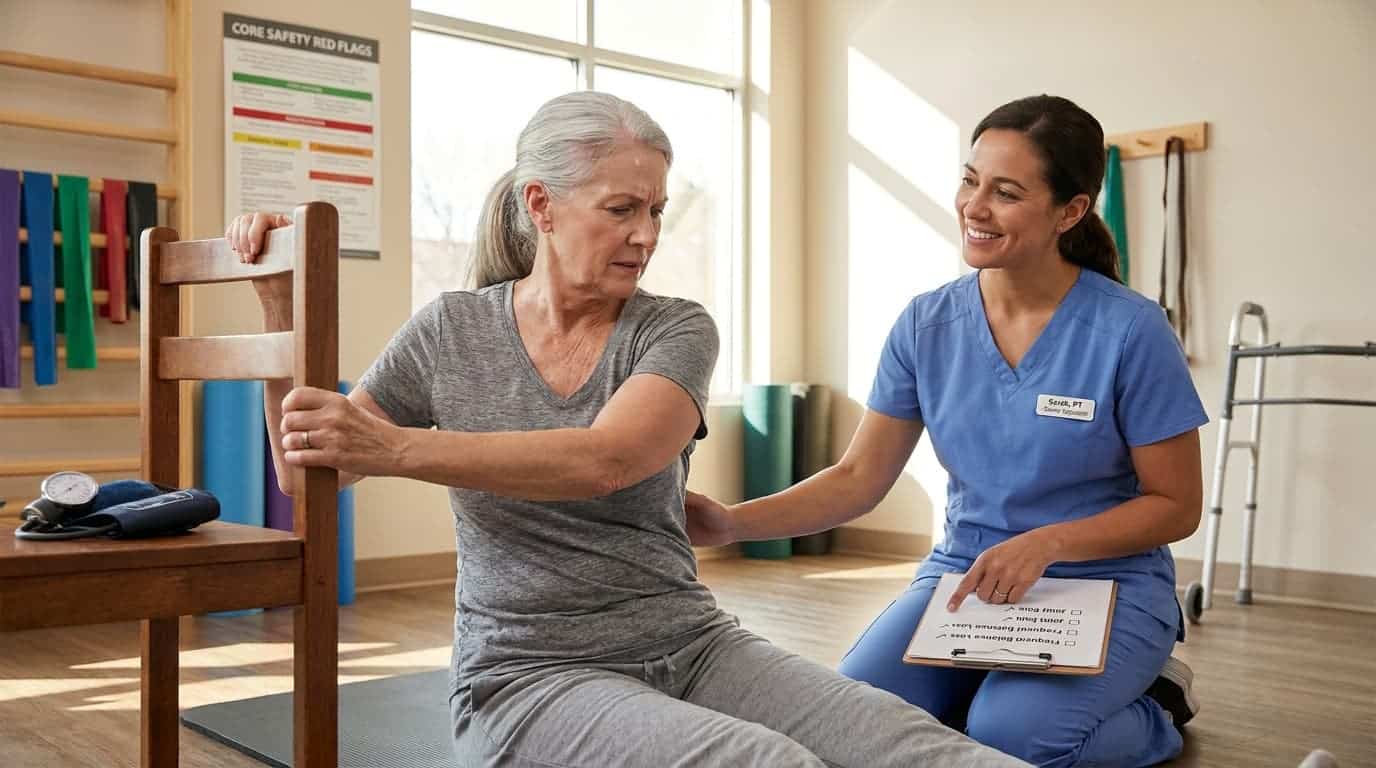
Some health conditions require extra care before starting core exercises. Knowing when to seek guidance helps ensure safe movement, better results, and reduced injury risk.
- Frequent loss of balance during daily movement: may indicate the need for supervised training support
- Uncontrolled blood pressure or heart conditions: requires exercise approval before starting core routines
- Severe joint pain during simple movements suggests the need for modified or low-impact exercise plans
- Recent falls or fear of falling: benefits from guided balance and stability training first
- Nerve-related symptoms or weakness should be evaluated before beginning exercises
- Limited mobility or difficulty standing unassisted: may require seated-only or assisted exercise programs
Professional guidance helps tailor exercises to individual needs and limitations. It supports safer progress, better confidence, and long-term consistency in building core strength and stability.
Habits That Support Stronger Core Muscles
Core strength is also shaped by daily habits, not just exercise routines. Small lifestyle changes can support better stability, posture, and overall muscle health over time.
| Habit | Impact | How To Do It |
|---|---|---|
| Stay Active Daily | Fights stiffness and builds lasting stamina. | Walk 10 min post-meal; stand hourly. |
| Good Sitting Posture | Protects your spine and activates your core at rest. | Feet flat; shoulders down every 30 min. |
| Balanced Nutrition | Fuels muscle recovery and sustains energy. | 25g protein/meal; 8 cups water daily. |
| Slow Movements | Reduces injury risk and builds confident movement. | Bend knees when lifting; pause before standing. |
| Gentle Stretching | Releases tension and maintains flexibility. | 5-min twists morning/evening. |
Consistent healthy habits, alongside exercise, help improve core strength. Simple daily actions can support better balance, flexibility, and long-term movement stability
Common Mistakes Seniors Should Avoid in Core Training
Core exercises are most effective when done with care and correct form. Avoiding a few simple mistakes can improve safety, comfort, and results during daily practice.
- Holding breath during exercises increases pressure and reduces control
- Moving too quickly limits core activation and raises injury risk
- Skipping warm-up makes muscles stiff and less prepared for movement
- Poor posture reduces effectiveness and increases strain on the back and neck
- Ignoring discomfort signals can lead to strain or delayed recovery
Small corrections in breathing, posture, and pace make a big difference. Safe habits help build stronger core muscles, reduce strain, and improve long-term movement quality.
Frequently Asked Questions
How often should core exercises be done?
Core exercises are best done about three times per week. This gives your muscles time to recover while still helping you build strength, better balance, and steady movement control. You can start gently and add more reps as you feel stronger.
Do core exercises require equipment?
Most senior-friendly core exercises do not need special equipment. A sturdy chair, wall, or exercise mat is often enough for safe practice at home. You can add light resistance later, but only when basic movements feel steady and comfortable.
What time of day is best for core exercises?
There is no strict best time for core exercises. Morning or early evening often works well because energy may be higher and stiffness may be lower. Pick a time you can follow often, so the habit feels easier to keep.
How soon can results be noticed?
You may notice better balance, strength, and control within 3 to 6 weeks. Results depend on steady practice, good form, and slow progress. Small changes count too, like standing taller, walking with more control, or rising from a chair more easily.
Final Thoughts
Staying steady and moving with confidence often starts from the center of the body. I’ve noticed how small, consistent changes in movement can make everyday tasks feel easier for you, from standing up to walking with better control.
I’ve shared safe routines, simple exercises, benefits for balance and posture, and common mistakes to avoid so you can build strength without confusion. You also saw when to seek guidance and how daily habits support progress.
Regularly practicing core exercises for seniors helps improve stability, reduce strain, and support independence in daily life. I encourage you to start small, stay consistent, and notice how your body responds over time. Share your experience in the comments or check my other helpful fitness guides next.