









| Disclaimer: This article is for informational and educational purposes only. It does not constitute medical advice and should not replace consultation with a qualified healthcare provider. Always consult a doctor or physical therapist before beginning any new exercise program, especially if you have a shoulder injury, recent surgery, or neck and upper-back pain. |
| Exercise | Wall Angels |
| Primary Goal | Posture correction, shoulder mobility, scapular control |
| Evidence Level | Moderate (postural exercise research, clinical rehabilitation use) |
| Who It’s For | Desk workers, people with rounded shoulders, upper-body athletes, and anyone working in the overhead range |
| Equipment Needed | None, flat wall only |
| Who Should Use Caution | Recent shoulder surgery, rotator cuff injury, cervical spine issues, or anyone with pain during the movement |
What the Wall Angels Exercise Actually Does to Your Posture and Shoulders
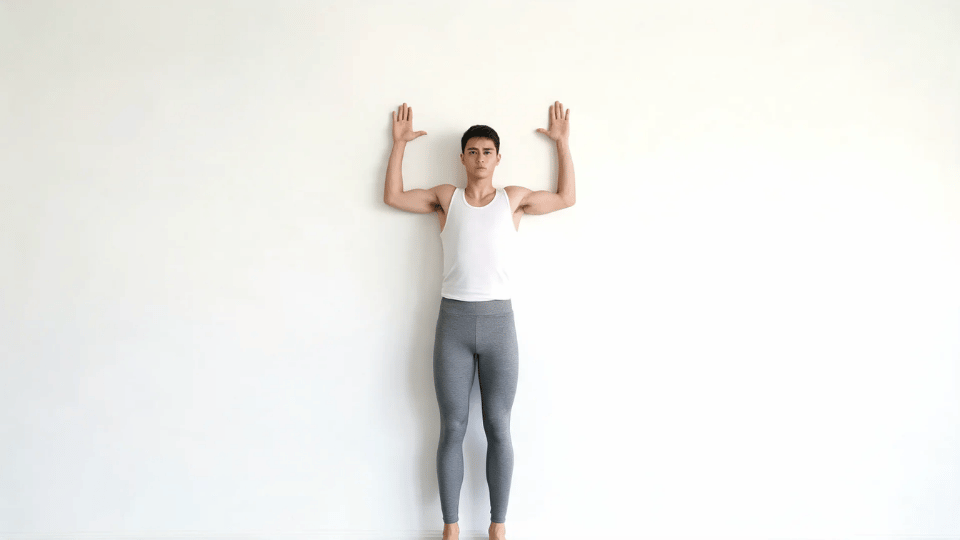
The wall angels exercise is a bodyweight posture and shoulder mobility drill that uses a flat wall as real-time feedback to correct alignment as you move. Stand with your back against a wall, slide your arms from a W shape up toward a V or overhead, and your body will immediately tell you where your mobility has a problem.
Your lower back lifts. Your head juts forward. Your elbows drift away from the surface. Most people who sit at a desk for hours have at least one of these, and wall angels reveal all three at once.
The Quick Facts above give you the basic parameters. The rest of this article covers what is happening in your body during wall angels, what the research says, how to perform the movement correctly, the most common mistakes, modifications, and when to see a professional.
What Happens in Your Body During the Wall Angels Exercise
This is not a strength exercise in the traditional sense. You are not loading a muscle to fatigue. What wall angels do is coordinate a chain of structures that tend to fall out of sync when people spend long hours in forward-flexed postures.
When your arms slide up the wall, your shoulder blades need to rotate upward and move outward across the rib cage. The serratus anterior, a muscle that runs from the ribs to the underside of the shoulder blade, drives that gliding motion.
Most people who sit a lot have a serratus that is underused and inhibited. Meanwhile, the rhomboids, which pull the shoulder blades together, have to work in coordination with the mid and lower trapezius to keep the blades stable and moving smoothly through the full arc.
At the same time, your pectorals and anterior deltoids are being lengthened at the front, which is the opposite of what they experience during bench pressing, rowing at a desk, or driving. The chin tuck cue that goes with wall angels also activates the deep cervical flexors, the small muscles at the front of your neck that tend to weaken in people with forward head posture.
The wall itself is doing something important too. It prevents the common compensations. When your lower back cannot maintain contact, that tells you your thoracic spine lacks the extension range needed to raise your arms cleanly. When your elbows lift off, that signals the chest and lat are too tight to allow full glenohumeral rotation. This is feedback you simply do not get from a free-standing exercise.
What the Research Says About Posture Exercises and Wall Angels
Wall angels as a standalone exercise have not been the subject of a dedicated randomized controlled trial, but the physiological mechanisms they target have meaningful research support.
A 2016 randomized controlled trial published in the Journal of Physical Therapy Science found that a four-week scapular stabilization exercise program significantly improved forward head posture and rounded shoulder alignment in office workers. Wall angels are a standard component of scapular stabilization protocols used in physical therapy settings for exactly this reason.
Research into postural exercise interventions more broadly supports the case. A 2015 study in Clinical Rehabilitation by Tunwattanapong and colleagues found that a structured neck and shoulder stretching and strengthening program reduced pain and improved function in office workers with neck pain over four weeks.
Wall angels fit within the category of exercises used in those kinds of protocols, combining shoulder mobility, scapular muscle activation, and thoracic extension in a single controlled movement.
The limitation worth noting is that no single exercise corrects posture in isolation. Wall angels are more useful as a consistent daily drill than as a once-weekly add-on.
Muscles Worked in the Wall Angels Exercise
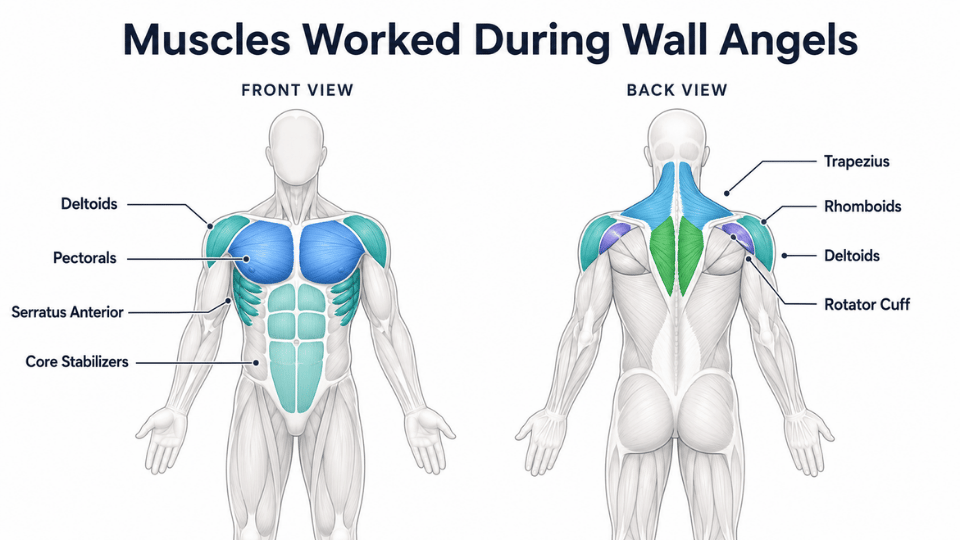
Wall angels are not a high-load strength exercise, but several muscle groups are still actively involved to make the movement work correctly. Here is a breakdown of what each area contributes.
| Muscle Area | Role During Wall Angels |
|---|---|
| Rhomboids | Help draw the shoulder blades together |
| Trapezius | Supports upper-back and shoulder movement |
| Deltoids | Help raise and control the arms |
| Serratus anterior | Supports smooth shoulder blade movement |
| Rotator cuff | Helps stabilize the shoulder joint |
| Pectorals | Stretch as the chest opens |
| Core stabilizers | Help control the ribs and lower back |
Wall angels are primarily a control and mobility exercise. The goal is not to fatigue these muscles but to coordinate them, improve their awareness, and restore the posture and range they support throughout the day.
Benefits of the Wall Angels Exercise
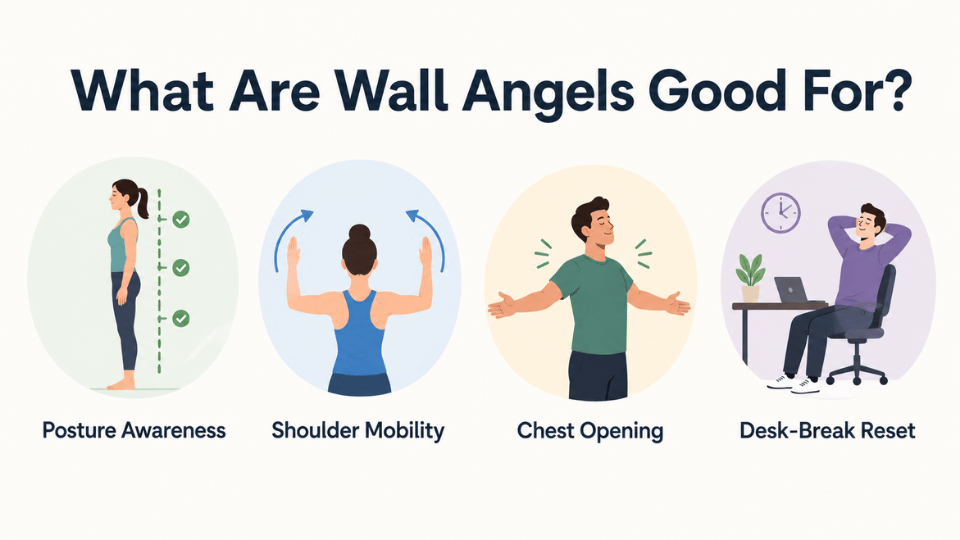
Wall angels are useful because they combine posture awareness, shoulder movement, and upper-back control in one simple exercise. The wall acts as feedback, helping you notice where your body loses alignment.
1. Helps Improve Posture
Wall angels encourage a taller, more upright posture by training your upper back, shoulders, and neck to stay aligned.
When you slide your arms against the wall, you learn to keep your chest open without over-arching your lower back. This can be helpful if you sit for long hours, work at a computer, or often notice your shoulders rounding forward during the day.
2. Supports Shoulder Mobility
Wall angels move the glenohumeral joint and scapulothoracic joint through a coordinated arc of motion without any external load.
This makes them appropriate for people returning from shoulder injuries, people beginning a mobility program, or anyone who wants overhead mobility work that does not stress the rotator cuff the way loaded pressing does.
For mobility training broadly, the principle holds: controlled movement through a full range is more sustainable than loaded movement through a limited range.
3. Reduces Rounded Shoulder Posture
Rounded shoulders often happen when the chest feels tight, and the upper back muscles are underused. Wall angels help by gently opening the front of the shoulders while encouraging the muscles between your shoulder blades to work.
This does not “fix” rounded shoulders alone, but it can be a helpful part of a routine that also includes stretching, strengthening, and regular movement breaks.
4. Upper Back Stiffness Relief
Thoracic stiffness is one of the most common physical complaints among office workers. The thoracic spine needs a certain degree of extension mobility for overhead arm movements to happen correctly. When it does not have it, the lower back and neck compensate.
Wall angels gently encourage thoracic extension and rotation as the arms move, which makes them a practical desk-break drill for people who sit for extended periods. For people managing tech neck, wall angels fit naturally into the same corrective routine.
5. Pre-Workout Shoulder Preparation
Before upper-body pressing or pulling movements, wall angels prime the scapular stabilizers and open the anterior shoulder without the fatigue risk of heavy stretching or the loading risk of warm-up sets.
Five to eight controlled reps before bench pressing or overhead pressing can improve scapular control during the working sets themselves.
How to Do the Wall Angels Exercise Properly
| Difficulty | Beginner to Intermediate |
| Reps | 5 to 10 per set, 1 to 3 sets |
| Props Needed | Flat wall only |
| Best Time | Before upper-body training, during desk breaks, or as part of a morning mobility routine |
| Avoid If | Active shoulder impingement, recent rotator cuff surgery, and pain during the movement |
The setup matters as much as the movement itself. Getting your position right from the start makes everything that follows easier to control.
Stand with your back against a flat wall. Find any smooth, flat wall with enough vertical space to raise your arms fully overhead without hitting anything.
Place your feet a few inches away from the wall. This small gap makes it easier to keep your lower back from over-arching while you move.
Bring your butt, upper back, shoulders, and head close to the wall. Full contact is the goal, but if some areas hover slightly at first, that is completely normal and will improve over time.
Lightly brace your core. Think about gently pulling your belly button inward, just enough to stop your lower back from lifting away from the wall as your arms rise.
Apply a gentle chin tuck. Slowly draw your chin back as if making a slight double chin. This helps keep your head aligned with your spine rather than jutting forward.
Bring your arms into a “W” position. Bend your elbows, raise your upper arms to roughly shoulder height, and rest your arms as close to the wall as your range allows.
Slowly slide your arms upward toward a “V” or overhead position. Move at a steady, controlled pace, keeping your arms as close to the wall as you comfortably can throughout the movement.
Stop before you feel pain or before your back begins to arch. Your usable range is wherever your form stays clean, not wherever your arms happen to reach.
Slowly return your arms to the starting “W” position. The return counts as much as the lift. Keep the movement smooth rather than letting your arms drop.
Repeat with steady, controlled breathing throughout. Exhale as you raise your arms, inhale as you lower them, or find a breathing rhythm that feels natural and consistent.
Tip: If you cannot get any part of your back to the wall without significant strain, do not force it. Start with the floor variation (arms moving along the floor while lying on your back) and work up to the standing version as your thoracic extension improves.
For more info, you can refer to the video:
How Many Wall Angels Should You Do?
There is no single perfect number of wall angels for everyone. It depends on your posture, shoulder mobility, and how you are using the exercise.
If you are new, start with 4 to 5 slow reps and focus on keeping your ribs down, back against the wall, and movement smooth.
For general mobility, 5 to 10 controlled reps per set usually works well. You can do 1 to 3 sets, depending on your routine and comfort level.
Wall angels are best used during desk breaks, before upper-body workouts, or in a posture-focused mobility routine. Four clean reps will help more than ten rushed ones, so keep the movement slow and deliberate.
Common Wall Angels Mistakes
Wall angles look simple, but small form errors can reduce their benefit. Watch for these common mistakes so the exercise supports posture and shoulder mobility safely.
- Arching the lower back: This often happens when shoulder mobility is limited. Keep your ribs down, bend your knees slightly, and reduce the range of motion.
- Forcing the arms against the wall: Your wrists and elbows do not need to touch the wall. Move only as far as you can without pain or compensation.
- Shrugging the shoulders: Lifting your shoulders toward your ears can create neck tension. Keep your shoulders relaxed and gently pulled down.
- Flaring the ribs: Rib flare makes the movement look bigger but reduces control. Keep your core lightly engaged and your ribs stacked over your hips.
- Moving too fast: Fast reps can turn wall angels into a loose arm swing. Move slowly so your upper back and shoulders stay controlled.
- Tilting the head forward: Letting your chin jut forward strains the neck. Keep your head gently against the wall with your chin slightly tucked.
Correcting these mistakes makes wall angels more useful and comfortable. Focus on smooth movement, steady breathing, and a smaller range before trying to lift your arms higher.
Wall Angels Exercise Modifications for Beginners
Wall angels can be modified to match your current mobility, comfort level, and control, so the movement stays useful whether you are starting gently or progressing gradually.
1. Floor Angels (Easier)
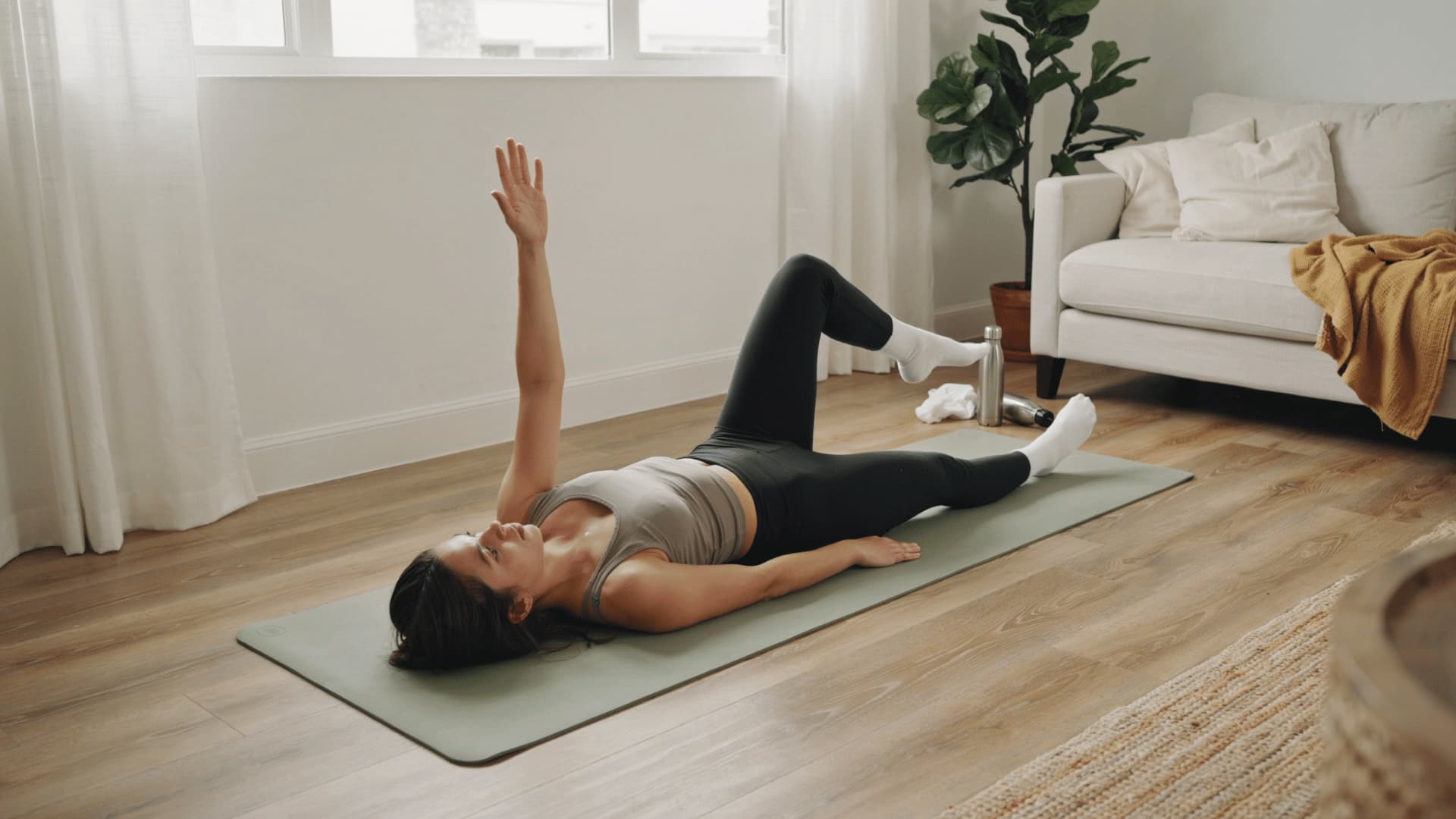
Lie on your back with your knees bent and your feet flat on the floor. Position your arms in a W shape on the floor beside you and slowly slide them overhead the same way you would against the wall. The floor provides the same feedback as the wall but removes the upright loading demand. This is the right starting point if standing wall angels produce pain or if you cannot get your head, back, and arms near the wall at the same time.
2. Feet Closer to the Wall (Easier)
Stepping your feet farther from the wall naturally increases the lumbar tilt required to maintain back contact. Conversely, stepping them slightly closer reduces that demand. If you are struggling to keep your lower back on the wall, experimenting with foot position first before reducing your arm range is worth trying.
3. Towel Behind the Head (Easier)
If your head hovers an inch or two from the wall due to thoracic kyphosis or forward head posture, place a small folded towel behind your head so the feedback loop is maintained without forcing an uncomfortable position.
4. Paused Wall Angels (Harder)
Add a two to three second pause at the top of the movement before returning. This increases the demand on the lower trapezius and serratus anterior to maintain the scapular position under sustained hold.
5. Resistance Band Wall Angels (Harder)
Hold a light resistance band taut between both hands as you perform the movement. The band adds a small but meaningful rotational demand on the shoulder and scapular stabilizers throughout the arc. Start with a band that provides minimal tension so you can maintain form quality.
6. Wall Angels With Wall Squat (Harder, Combined)
Perform a partial wall squat simultaneously with the arm movement. This adds a lower-body stability demand and is appropriate only once the upper-body movement is genuinely clean and controlled on its own. For people also working on hip stability, combining movements can be a time-efficient option
Wall Angels vs. Wall Slides
Wall angels and wall slides look nearly identical from the outside; both involve the back against a wall and the arms moving along the surface. Here is how they tend to differ in practice:
| Level | Wall Angels | Wall Slides |
|---|---|---|
| Primary focus | Posture awareness, chest opening, and shoulder mobility | Shoulder mechanics, scapular control, and overhead range |
| Common setting | Mobility routines, desk breaks, posture work | Rehab, clinical settings, strength training warm-ups |
| Key emphasis | Full-back contact and postural feedback | Precise scapular movement and shoulder blade mechanics |
| Names used interchangeably? | Yes, the terms overlap frequently in everyday use | Yes, context and goal matter more than the label |
Rather than getting caught up in the label, pay attention to the goal of the movement, the setup, and how it feels. That will tell you more than the name will.
Who Should Use Wall Angels and Who Should Use Caution
Wall angels are a broadly appropriate exercise, but they are not universal. Here is a clear framework for who benefits and who should proceed carefully.
Wall angels are a good fit for people who sit for long hours, have mild rounded shoulders or forward head posture, want a no-equipment posture drill, or need better overhead mobility for upper-body exercises. For older adults working on balance and posture, wall angels fit well within a low-load daily mobility routine.
Use caution or consult a professional first if you: have had shoulder surgery in the past six months; experience sharp, pinching, or catching pain during the movement; have active rotator cuff impingement; have cervical disc problems that worsen with head-back positions; or cannot get into the starting position without significant compensations at the lumbar spine or neck.
When to See a Professional About Shoulder and Posture Issues
Wall angels are gentle, but they are not a clinical treatment. There are situations where exercise alone is not the right first step.
See a physical therapist or sports medicine professional if: the exercise consistently produces pain rather than mild stretch sensation; you have shoulder clicking accompanied by pain or weakness; symptoms do not improve after 4 to 6 weeks of consistent practice; you have a history of shoulder dislocation, labral tear, or rotator cuff repair; or you notice numbness or tingling running down your arm or into your hand during or after the movement.
For people managing structural joint issues in other areas alongside shoulder work, a supervised program is nearly always more effective than self-directed mobility work alone
Frequently Asked Questions
Why do my shoulders click during wall angels?
Light clicking without pain can happen when the shoulder joint moves through a new range. If the clicking is accompanied by pain, pinching, weakness, or discomfort, stop the exercise and consider seeking guidance from a qualified professional.
Can wall angels help with rounded shoulders?
Wall angels may support better shoulder positioning by encouraging the chest to open and the upper back to engage. They work best when paired with consistent posture habits, strengthening exercises, and regular movement throughout the day.
Should I do wall angels before or after a workout?
You can do wall angels before a workout as a gentle mobility drill or after training as a posture reset. Keep the movement controlled, avoid forcing your range, and use them when your shoulders feel stiff.
Conclusion
The wall angels exercise is simple to set up and highly revealing. It provides valuable insights into your shoulder mobility, chest tightness, upper-back control, and posture, all from a single movement against a flat wall.
This combination of feedback and function makes it worth incorporating regularly, even just a few reps. Begin with a small range of motion and move slowly, adjusting as needed if something feels off.
The goal isn’t fatigue but coordination, which is a different and worthwhile challenge. If you notice tightness or restrictions during the movement, comment below.
For more, see my other posts on different exercises and comment down with any insights you have to help others.