











You go to buy salt. Thirty seconds later, you’re standing in the aisle holding a pink Himalayan rock, a grey French flake, and a quiet suspicion that your regular table salt has been doing you wrong.
The healthiest salt question sounds simple. The answer is actually layered, and most of what you’ve heard about it is either incomplete or quietly misleading.
This covers every major salt type and what makes each one different, what “natural” and “mineral-rich” on a label genuinely means, and the one health factor that separates all types of salt in a way that actually matters for your body.
Salt Is Mostly the Same Thing, MOSTLY
Every salt you will ever buy is primarily sodium chloride. That is the compound your body uses to balance fluids, fire nerve signals, and keep muscles working. You need it. Your body cannot make it on its own.
But not all salts behave the same way. The differences come down to three things: where it came from, how much it was processed, and the crystal size.
Those three things change how salt behaves in your kitchen and how much sodium ends up in your food per spoonful. There is one more difference that goes beyond cooking. Whether iodine was added or not.
That single factor is the only thing that genuinely separates one salt from another on a health level. Everything else is texture, flavor, and a very convincing marketing story.
The Main Types of Salt
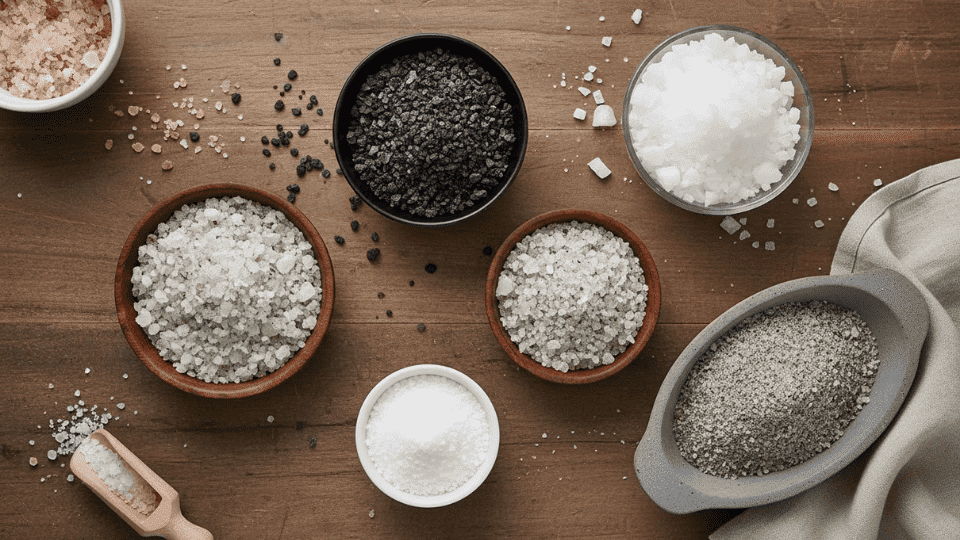
Not all salts behave the same way in your kitchen, even if they look almost identical on a nutrition label. Here is what each one actually is and where it genuinely belongs.
1. Table Salt
Table salt comes from underground deposits. Water is pumped in, salt dissolves into brine, and that brine is evaporated and refined into tiny, uniform white crystals. Refining takes it to about 97–99% pure sodium chloride.
Because the crystals are so fine and dense, they pack tightly into a spoon, making it the most consistent salt for baking.
- Sodium per ¼ tsp: ~590 mg
- Iodine: No
2. Iodized Salt
Iodized salt is table salt with one addition: iodine. That single thing makes it the only salt that does something nutritionally distinct from every other variety.
Iodine supports thyroid hormone production, metabolism, and fetal brain development during pregnancy. Most people only realize the gap after switching from iodized salts entirely.
- Sodium per ¼ tsp: ~590 mg
- Iodine: Yes, 45–77 mcg per serving
3. Kosher Salt
Kosher salt gets its name from its traditional use in drawing blood from meat during the koshering process. The crystals are large, irregular, and airy; they do not pack tightly into a spoon.
This means less sodium per teaspoon than table salt and more natural control when seasoning by feel. But brand matters enormously here.
- Sodium per ¼ tsp: ~480 mg (Morton) / ~280 mg (Diamond Crystal)
- Iodine: No
4. Sea Salt
Sea salt is made by evaporating seawater. Fine or coarse, white or grey, it depends on the origin and how it was processed. The label “sea salt” tells you the source, not a quality standard.
Worth knowing: multiple studies have detected microplastics in commercially available sea salt, since modern oceans contain them. The actual differences between Himalayan and sea salt are smaller than the price gap suggests.
- Sodium per ¼ tsp: ~560–580 mg
- Iodine: Trace only, not a reliable source
5. Himalayan Pink Salt
Himalayan pink salt is mined from ancient deposits in Pakistan’s Khewra Salt Mine. The pink color comes from trace iron oxide, the same compound as rust.
It is 95–98% sodium chloride, with trace minerals making up the rest. Those minerals are real but clinically meaningless at normal salt doses. It is dry, stable, and grinds well. There are practical ways cooking with Himalayan salt goes beyond just seasoning food.
- Sodium per ¼ tsp: ~560 mg
- Iodine: No
6. Celtic Grey Salt
Celtic sea salt is harvested from clay-lined evaporation ponds along France’s Atlantic coast. That clay contact gives it the grey color and, most distinctively, a moisture content of around 10–15%.
This makes it dissolve faster on warm food, which works brilliantly as a finishing salt. But that moisture also causes it to clump in storage and damage grinders. The real story behind the differences between Celtic and Himalayan salt is moisture, not minerals.
- Sodium per ¼ tsp: ~480 mg (moisture reduces effective sodium by weight)
- Iodine: No
7. Fleur de Sel and Finishing Salts
Fleur de sel is harvested from the water’s surface in those same French ponds using wooden rakes. Only about 1.5 kg is collected for every 40 kg of grey salt, which explains the price.
It has a soft, damp texture and a delicate, lingering flavor. Other finishing salts worth knowing: Maldon sea salt flakes from England and smoked salt for a subtle wood flavor.
- Sodium per ¼ tsp: ~400–480 mg
- Iodine: No
8. Black Salt (Kala Namak)
Kala namak is a volcanic rock salt from South Asia with a sulfurous, egg-like smell and flavor. That character comes from sulfur compounds formed during production.
Despite being called black salt, the ground form is actually pinkish-grey, part of why salt looks different from what its name suggests. It serves a very specific flavor purpose, particularly in plant-based cooking.
- Sodium per ¼ tsp: ~550 mg
- Iodine: No
9. Low-Sodium Salt Substitutes
Low-sodium substitutes replace some or all sodium chloride with potassium chloride. The result looks and tastes like salt but delivers significantly less sodium.
The 50/50 blends taste closest to regular salt. Pure potassium chloride has a slightly bitter metallic edge. Genuinely useful for people managing blood pressure, but not appropriate for everyone.
- Sodium per ¼ tsp: ~280–360 mg
- Potassium content: High, not suitable for kidney disease or certain medications
What the Label Is Actually Telling You
Salt packaging has its own language. These words sound meaningful; some of them technically are. Here is what they actually say and what they quietly leave out.
Most of what appears on a specialty salt label is built on real but heavily overstated facts.
| Label Claim | What It Actually Means | What It Doesn’t Mean |
|---|---|---|
| Natural | No regulated definition, signals minimal processing | Purity, safety, or superior nutrition |
| Unrefined | Fewer processing steps, more trace minerals retained | Fewer contaminants, less refining removes less of both |
| Mineral-rich | Trace minerals are genuinely present | Clinically meaningful amounts, you’d need 30g+ of salt daily to feel any difference |
| No anti-caking agents | Pure salt, nothing added | Healthier, these additives are safe in the tiny amounts used |
| Ancient / pre-pollution | Mined from old deposits, lower microplastic exposure | Zero contaminants, heavy metals can still be present in rock salt |
A label tells you where salt came from. It almost never tells you the two things that actually matter, sodium per serving and whether iodine is included.
The Only Salt Question That Actually Matters for Your Health
Most people assume switching to a “better” salt improves their health. Here is what the numbers actually show.
Around 70–75% of your daily sodium comes from processed foods, packaged snacks, and restaurant meals, before you have touched a salt shaker.
The salt you add while cooking is a small fraction of your total intake. Switching salt types changes almost nothing about your overall sodium picture.
So no, the type of salt you cook with does not meaningfully affect your health in most cases. There is one real exception, iodine.
When people switch to specialty salts, they quietly remove their most reliable dietary iodine source without realizing it. Iodine deficiency affects thyroid function, metabolism, and energy. It builds slowly. Most people never connect it back to their salt switch.
Salt Beyond the Kitchen
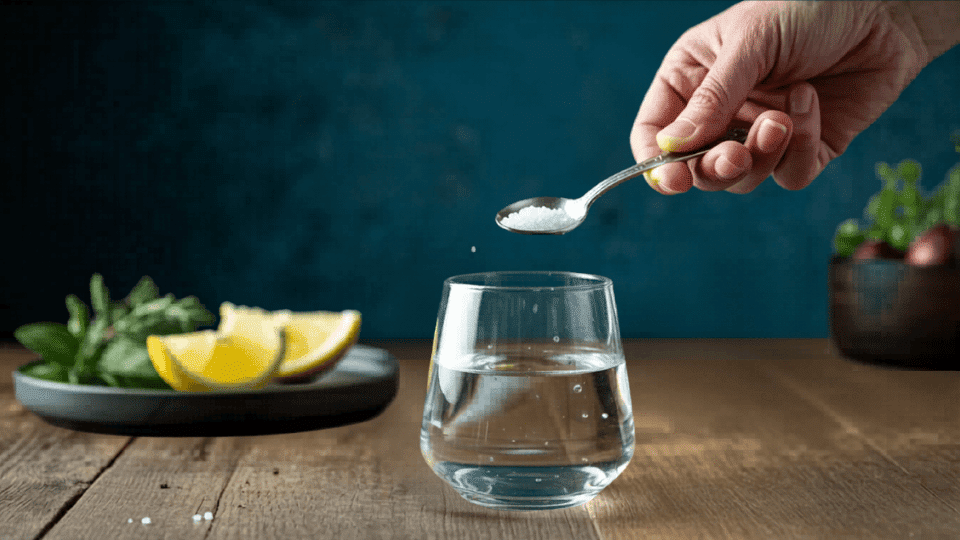
Salt has been used for skin, muscles, and throat health long before wellness culture gave it a rebrand. Here is what the evidence actually says across each use:
| Use | How It Works | Best Salt to Use |
|---|---|---|
| Gargling with warm salt water | Creates an osmotic effect that reduces throat inflammation and draws fluid from irritated tissue | Any salt works. The type does not change the outcome |
| Salt baths | Combines warmth, water pressure, and mineral contact for muscle recovery and stress relief | Epsom salt or sea salt are the most commonly used options |
| Sole water | Saturated salt solution diluted into drinking water, popular in wellness spaces | Himalayan pink salt is most commonly used in wellness recipes |
The actual benefits and risks of salt water across these different uses are worth knowing before making any of them a daily habit.
The Bottom Line
The salt aisle is designed to feel like a wellness decision, and understanding the different types of salt makes it easier to see through the marketing. Most of what you are looking at is sodium chloride in a different outfit.
Crystal size affects how much sodium ends up in your food. Moisture changes how a salt behaves in cooking. Iodine, present only in iodized salt, is the one nutritional difference that matters for most people.
Keep iodized salt as your everyday cooking salt. Use a finishing salt for food you care about. Check that your iodine is covered. Everything else is personal preference.
Found this useful? Share it and drop a comment below.