









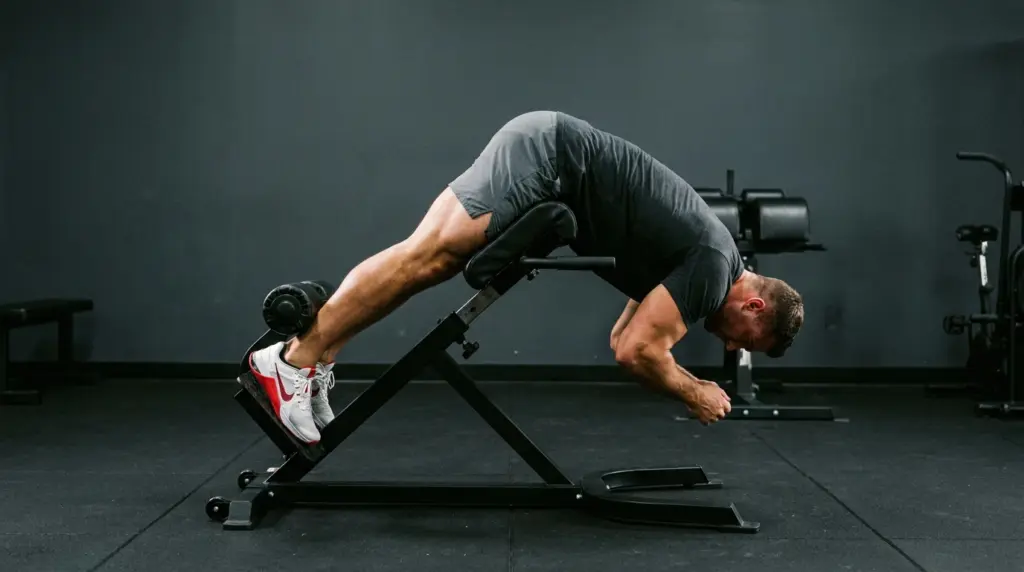

Ask five people how to do a hyperextension exercise correctly, and you’ll probably get five different answers.
In my coaching sessions, some people stress the lower back; others swear by a strict hip hinge for the glutes and hamstrings. Small form choices greatly influence which muscles do the work, more than most realize.
This blog covers proper setup, muscle-focused techniques, and how barbell loading affects the outcome.
It also breaks down bench-free options, covering limited equipment or gentler lower back exercises.
Disclaimer: This blog provides general exercise information and is not medical advice. Stop exercising and seek appropriate care if you experience sharp, radiating, or unusual pain.
What is the Hyperextension Exercise?
A hyperextension is a bodyweight or loaded accessory movement, not a competition lift.
Trainers use it to build hip-hinge patterning outside of squats and deadlifts.
It’s a compound, closed-chain exercise involving multiple joints and muscles. Physical therapists use it in posterior-chain rehab to isolate the hip hinge by removing lower-leg involvement.
Gyms label it under back or posterior chain instead of a specific muscle, as focus varies with technique.
Back extension form follows this same hip-hinge pattern, so cues for one carry over to the other.
| Term | Meaning |
|---|---|
| Back extension | Torso moves while the legs stay secured |
| Hip extension | Movement is produced primarily at the hips |
| Hyperextension | Common name for the exercise; may also mean moving beyond neutral |
| Roman-chair extension | Back extension on an angled station |
| GHD extension | Extension performed on a glute-ham developer |
| Reverse hyperextension | Legs move while the torso stays supported |
Who Should and Shouldn’t Do Hyperextensions?
This exercise suits some training goals and bodies better; match it to your situation before adding to a routine.
Good fit for:
- Desk workers seeking ways to reduce prolonged sitting.
- Athletes involved in running and field sports who require hip extension strength.
- Lifters using support for bench-press or squat lockout.
- Older adults engaging in activities focused on improving posture and preventing falls.
Best avoided or modified for:
- Active disc herniation or a recent flare of sciatica.
- Osteoporosis associated with increased risk of fractures.
- Later-trimester pregnancy.
- Unmanaged hypertension.
- Recently undergone spinal fusion or abdominal surgery.
How to Set Up a Hyperextension Bench
Bench angle matters before body position does.
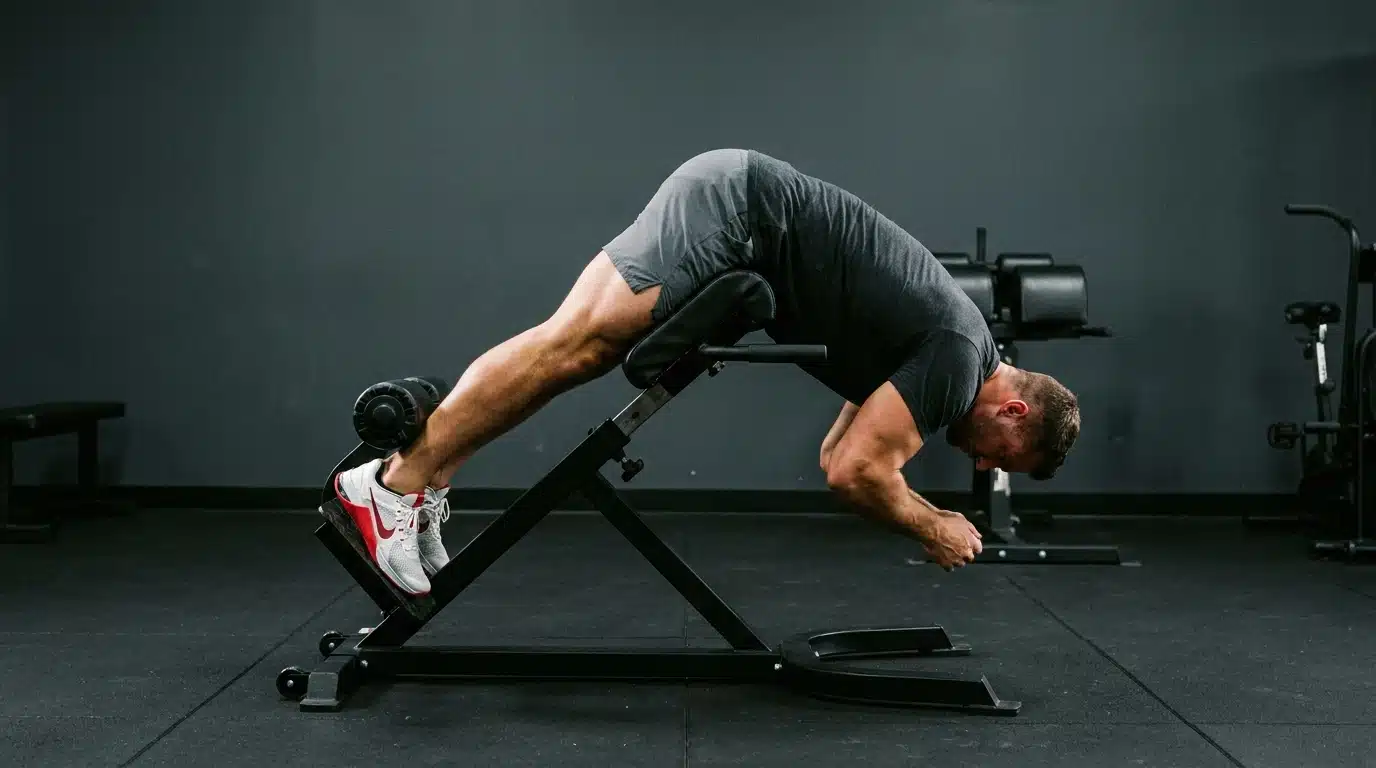
A 45-degree station suits beginners since it offers partial support and an easier exit if something feels wrong.
A 90-degree Roman chair demands more control since gravity pulls harder on the way down.
Check that the frame is bolted to the floor or weighted enough not to tip.
Leave clear space behind the bench for a controlled step-off. Confirm the pad padding hasn’t worn thin, since a compressed pad shifts hip position without you noticing.
Hyperextension Safety Tips
Follow these safety tips to perform hyperextensions with greater control and reduce avoidable strain.
- Inspect the bench before each session, checking the frame, pad, and foot supports so nothing shifts mid-set.
- Position the pad around the hip crease so your hips can hinge freely without restricting your range.
- Begin with bodyweight repetitions to build consistent form before adding any external resistance.
- Avoid bouncing at the bottom to prevent loss of control and lower back strain.
- Stop immediately if sharp, radiating, or unusual pain occurs; pushing through is too risky.
Note: People with injuries, surgery, neurological symptoms, or exercise restrictions should seek professional guidance before doing hyperextensions, especially weighted ones.
Equipment You’ll Need
Adding a few extras beyond the bench itself can make sessions safer and easier to monitor.
| Item | Why you need it |
|---|---|
| Non-slip shoes | Keeps feet locked against the platform |
| Chalk or lifting gloves | Improves grip when holding a plate |
| Resistance band | Adds light load without a plate or bar |
| Foam pad or towel | Extra cushioning if the bench pad feels thin |
| Weight collars | Keeps plates secure on a loaded barbell |
| Workout log or app | Tracks reps, load, and progression over time |
How to Perform the Hyperextension Exercise Correctly
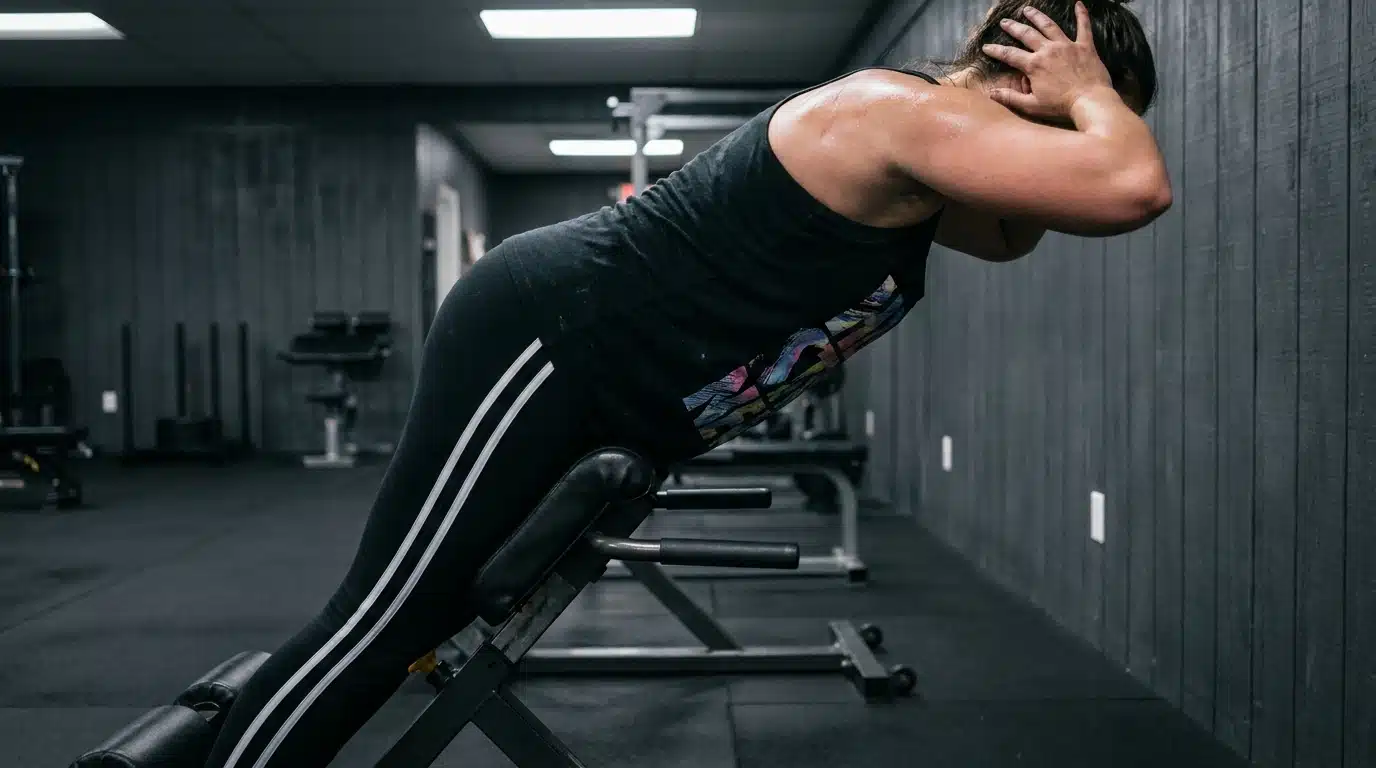
Once the bench is set and your position feels stable, follow these steps for a clean, controlled rep.
- Step 1: Take a breath in and brace your core before you move.
- Step 2: Unlock your hips and let your torso lower under control, not gravity.
- Step 3: Lower until you feel a stretch through the hamstrings or lower back, without rounding excessively.
- Step 4: Pause briefly at the bottom instead of bouncing out of the stretch.
- Step 5: Exhale as you drive back up through your hips.
- Step 6: Stop the ascent once your torso reaches the target alignment for your chosen technique.
- Step 7: Squeeze the glutes or lower back muscles for one second at the top.
- Step 8: Reset your breath before starting the next rep.
- Step 9: Complete your full set, then step off the bench slowly, keeping your hands on the frame for balance.
Muscles Worked During Hyperextensions: Primary vs Secondary
Primary movers do the lifting; secondary muscles just keep you steady.
The multifidus and quadratus lumborum, smaller stabilizers deep along the spine, count as primary here since they fire continuously through the hip hinge.
Secondary muscles include the adductor magnus, which assists hip extension from the inner thigh, and the latissimus dorsi, which helps keep the torso rigid if you’re holding a plate.
Rear deltoids and rhomboids engage lightly too, since crossed or extended arms need shoulder stability.
Knowing which muscles are primary versus secondary helps you know why a variation feels harder in one area than another.
Hyperextension Exercises You Can Try
Each variation uses the same bench but alters hip and spinal movement to change where you feel the work.
1. Lower-Back-Focused Hyperextension
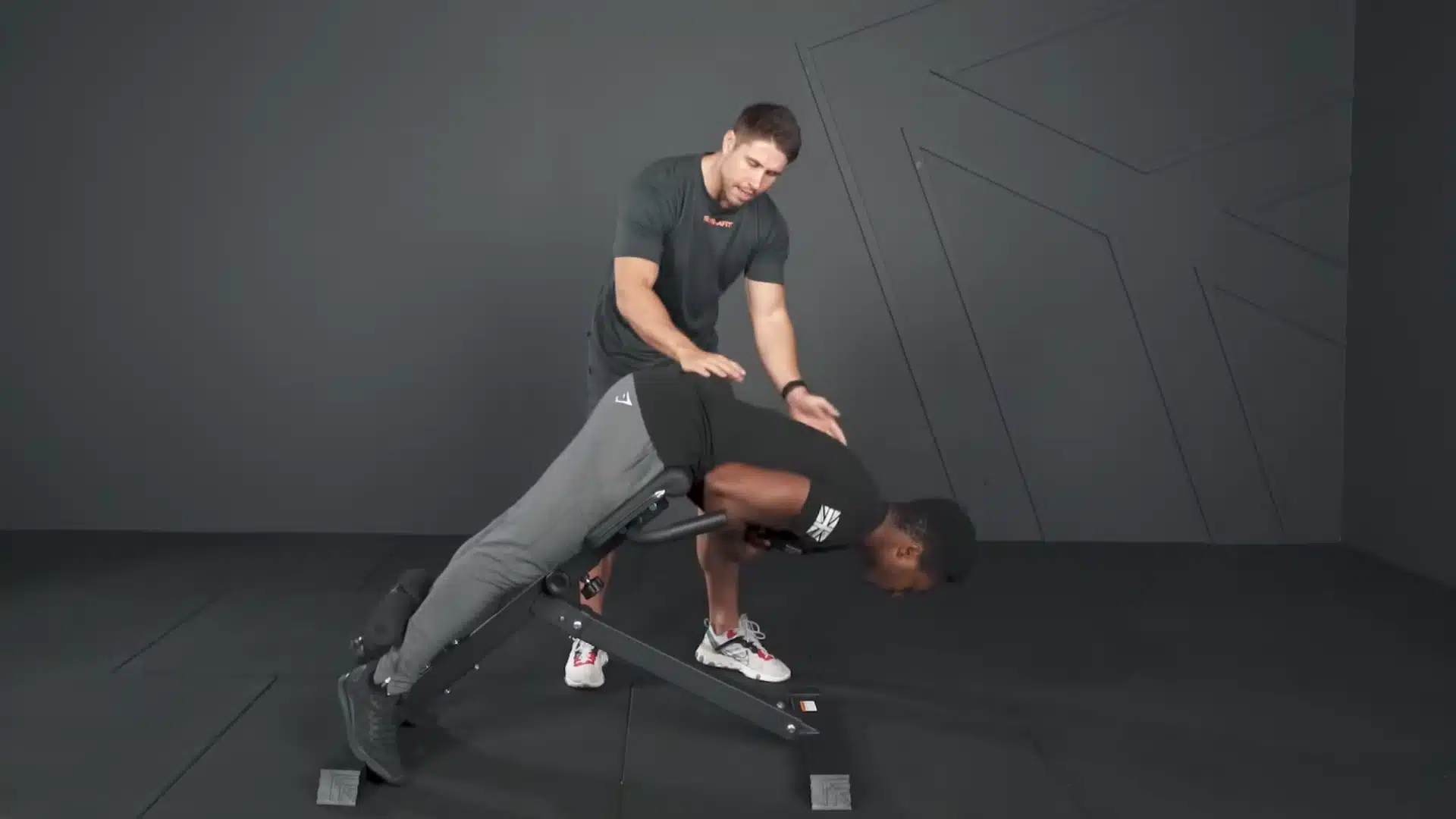
Brace the torso and hinge forward under control, keeping the movement smooth rather than rushed.
During the upward phase, use a small, deliberate amount of lumbar extension to emphasize the spinal erectors.
Avoid forcefully throwing the shoulders backward or moving beyond a comfortable range at the top, since that shifts the emphasis away from the lower back and adds unnecessary strain to the movement.
Safety Tip: Stop if you feel pinching or sharp sensations in the lower back, rather than pushing through.
2. Hamstring-Focused Hyperextension
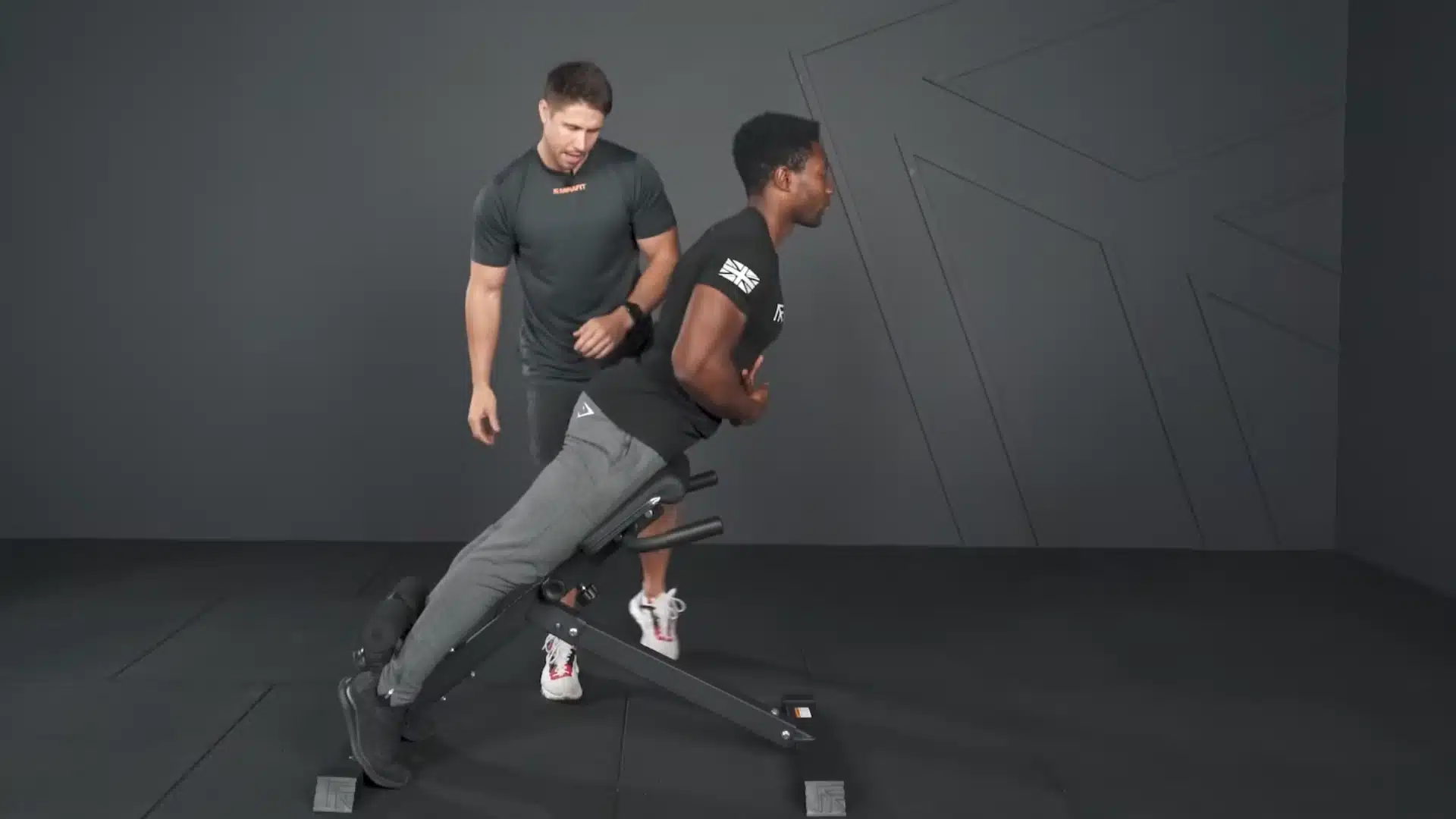
Use a strict hip hinge that resembles a Romanian deadlift, pushing the hips backward as you lower.
Initiate upward movement through the hamstrings, stopping at torso alignment instead of overextending the lower back to maintain tension where needed.
Maintain a controlled torso position throughout, rather than letting the spine do the work.
Safety Tip: Keep knees soft, not locked, to reduce strain on hamstrings and lower back.
3. Glute-Focused Hyperextension
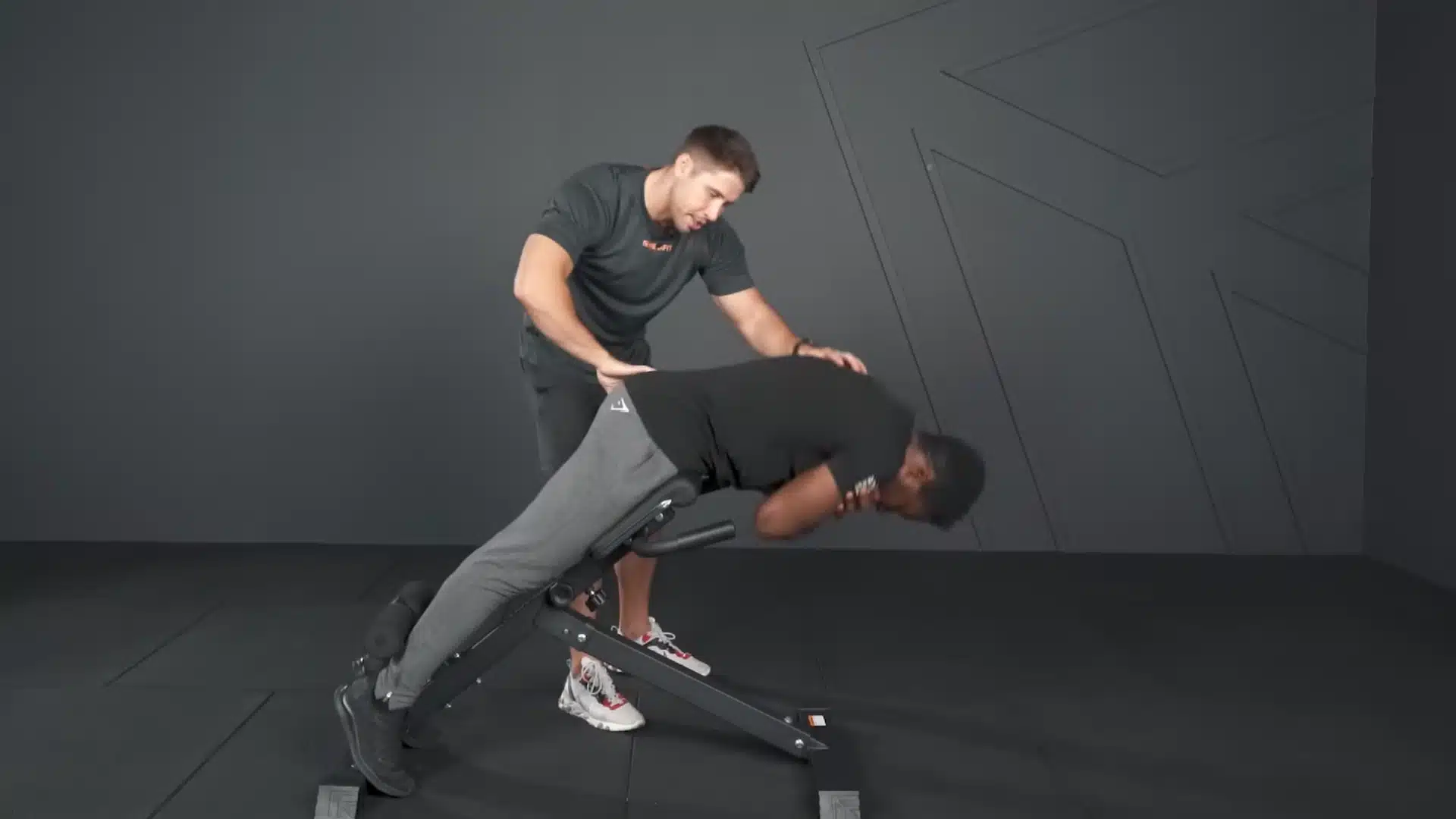
Use the rounded upper-body hug position shown in the video and keep that shape during the movement.
Press the hips into the pad and contract the glutes deliberately to raise the torso, finishing with a controlled squeeze rather than lifting the shoulders excessively high.
This is an intentional coaching variation and may not suit readers who experience discomfort with spinal flexion.
Skip if rounding your lower back causes discomfort; choose a neutral or lower-back-focused technique.
4. Weighted Hyperextension
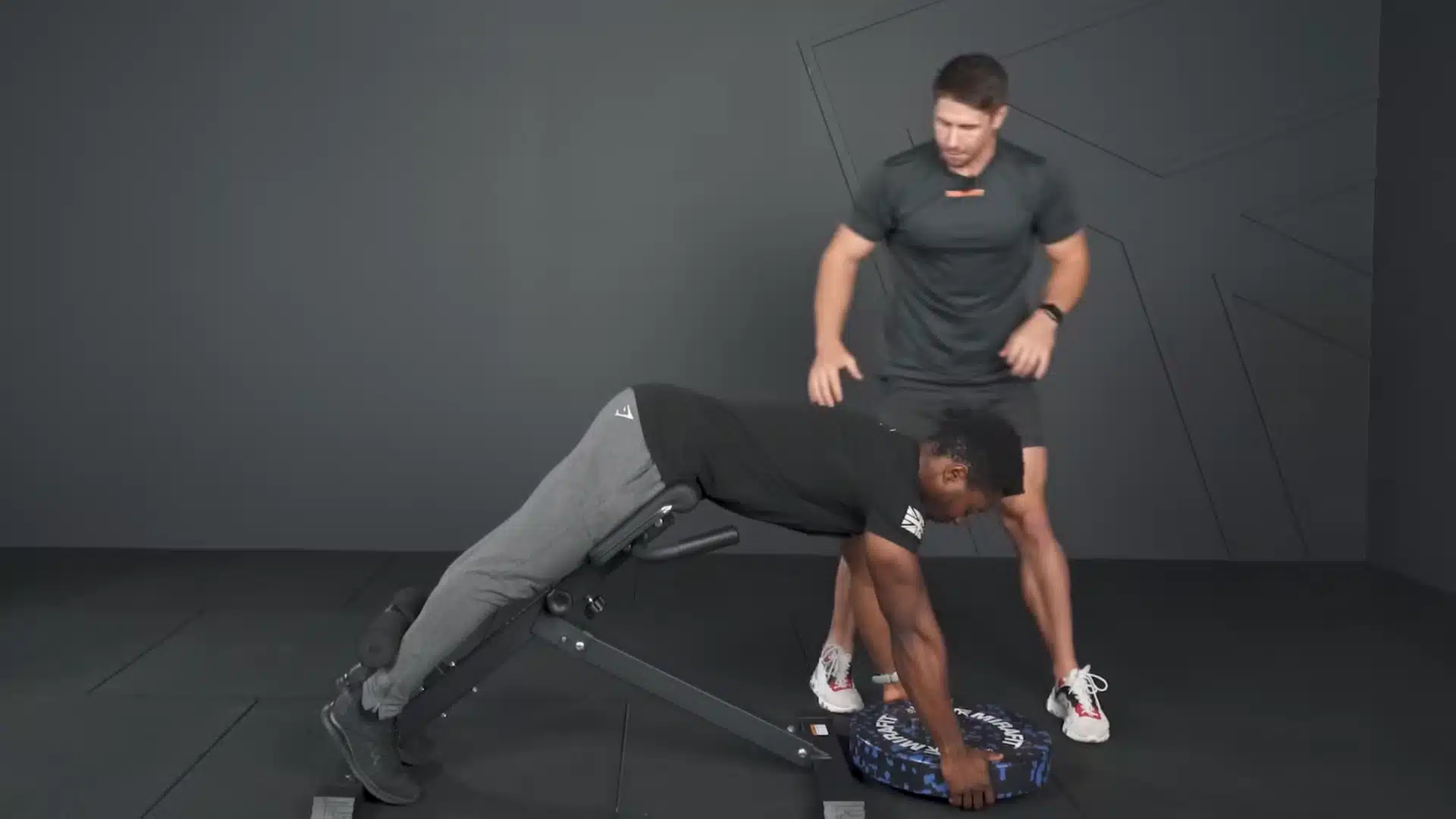
Hold a dumbbell or weight plate close to the chest to add resistance without overcomplicating the setup.
Extending the weight farther from the body increases the difficulty and technique demands significantly.
Try the demonstrated plate setup: place a smaller-diameter plate under the working plate so the load is easier to reach and grip from the bench, then return it carefully without twisting.
Safety Tip: Have a spotter or space nearby when handling weight on the bench, and never twist while holding a plate or dumbbell.
Follow along with this video to see the three muscle-focused techniques in action by @MirafitOfficial.
Hyperextension Alternatives that Train the Same Muscles
These options target similar muscles without a bench or a Roman chair.
| Exercise | Muscles targeted | How it’s done |
|---|---|---|
| Nordic hamstring curl | Hamstrings | Anchor ankles, lower forward, pull back up |
| Superman hold | Erector spinae | Lie face down, lift arms and legs, hold |
| Bird dog | Core, glutes, lower back | On all fours, extend opposite arm and leg, hold |
| Single-leg deadlift | Glutes, hamstrings | Hinge on one leg, other leg extends behind |
| Kettlebell swing | Glutes, hamstrings, erectors | Hinge hips, drive kettlebell forward with hip snap |
| Suitcase deadlift | Lower back, obliques | Deadlift one dumbbell from one side of the body |
How to Choose the Right Hyperextension Alternative
Choose the pick based on your actual needs that day, rather than just what is available.
- No bench needed: perform bird dog or Superman hold exercises.
- Hamstrings seem to be the weak point: Nordic curl or single-leg deadlift.
- Increase your posterior-chain strength with the kettlebell swing.
- Weak core rotation combined with back fatigue: suitcase deadlift.
Most Common Hyperextension Mistakes and How to Fix Them
Even experienced lifters pick up small habits that quietly limit results or add risk.
1. Holding your breath through the rep: Breath-holding increases internal and blood pressure.
Exhale when ascending and inhale when lowering to keep breathing steady and match movement.
2. Letting the neck crane forward: Craning the neck to look up strains the cervical spine and diverts attention from the hips. Keep your gaze fixed slightly ahead of the floor, letting your head follow your spine naturally.
3. Locking the knees completely: Fully locked knees shift stress onto the hamstrings and lower back unevenly.
Keep a soft bend throughout the set so the hips stay the primary hinge point.
4. Rushing the eccentric: Dropping too fast into the stretch skips the muscle control this exercise aims to develop.
Lower for a full two to three seconds before reversing direction.
5. Gripping the pad: Grabbing the sides of the pad for leverage masks weak hip and core control. Cross your arms or hold a plate, allowing your posterior chain to handle the weight.
Hyperextension vs Similar Exercises
Here’s how hyperextensions stack up against a few commonly confused movements.
- Deadlifts load the spine axially, while hyperextensions load it horizontally with less compression.
- GHR adds a knee-flexion component through the calves and hamstrings that hyperextensions don’t train.
- Planks build static core endurance; hyperextensions develop dynamic hip-hinge strength through full motion.
- Hip thrusts target the glutes at a fixed angle, while hyperextensions work the entire posterior chain.
Barbell Hyperextension: Is It Worth Doing?
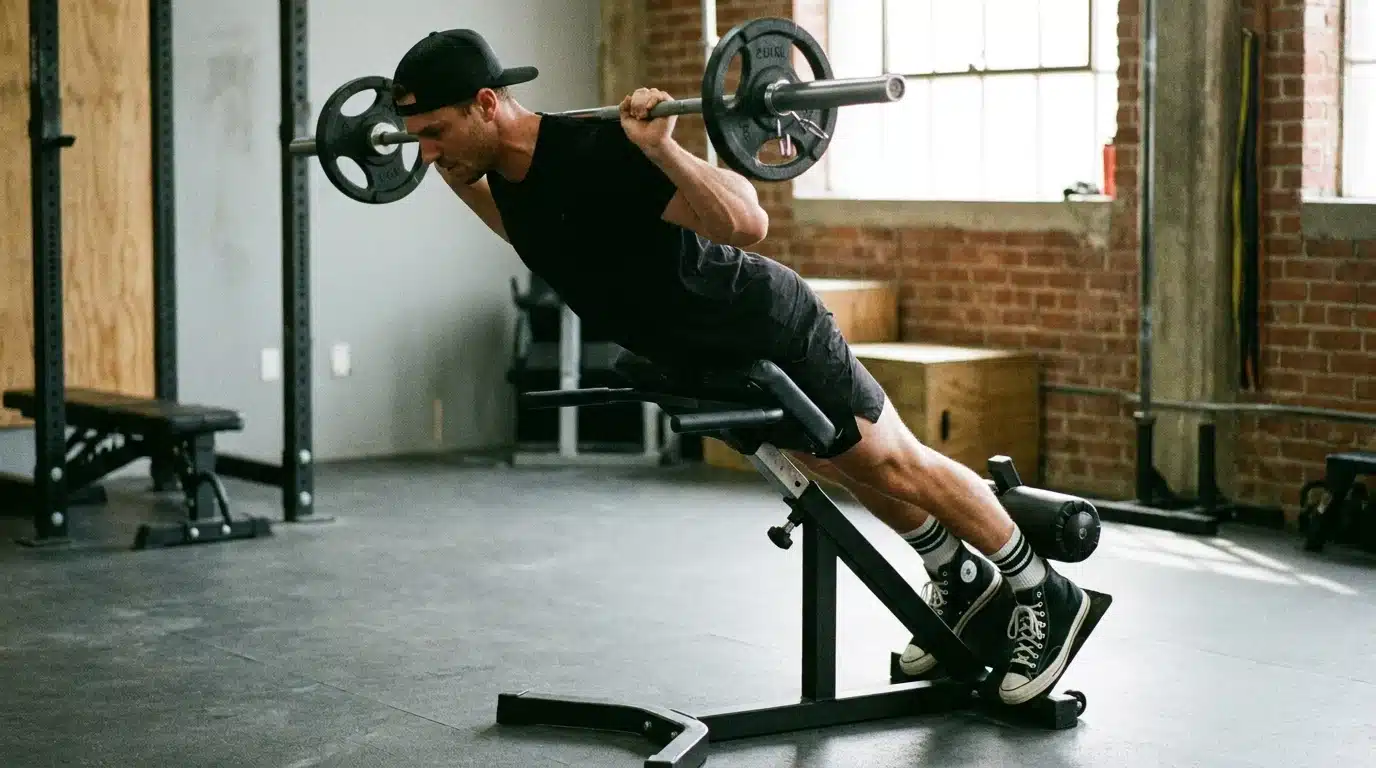
For most lifters, the answer is no.
The loading potential looks appealing on paper, but the exercise wasn’t designed to move heavy loads safely.
Balancing a bar across the upper back while hinging forward risks spine injury if control slips. Powerlifters use it for lockout carryover on deadlifts, but loads remain conservative.
A Romanian deadlift or good morning gives you the same barbell-loading benefit with a safer bar path.
Save the barbell version for advanced lifters with a flawless hip hinge who want an extra accessory variation.
How to Make Hyperextensions Target Different Muscles
Small tweaks to stance, tempo, and range shift the emphasis without changing the exercise itself.
- Turn toes slightly outward to bias the glutes over the hamstrings.
- Widen your stance to reduce hamstring involvement and stabilize the pelvis.
- Narrow your stance to increase hamstring recruitment through the movement.
- Add a two-second pause at the top to increase time under tension for the target muscle.
- Slow the descent to shift more load onto whichever muscle you’re emphasizing.
- Stop the range short of full extension to keep tension off the lower back.
- Loop a band around the pad anchor to add resistance right where your target muscle works hardest.
Hyperextension Progression: From Beginner to Advanced
Progression occurs through stages rather than simply increasing loads.
Beginners start with partial-range reps, stopping well short of full extension until control feels automatic.
Intermediate lifters move to full range with bodyweight only, then introduce a light plate. Advanced trainees add tempo variations, such as three-second holds at the top, before touching heavier external load.
Elite lifters sometimes progress toward single-leg or single-arm loaded versions for unilateral strength.
Skipping stages causes stalls or injuries. Each stage should feel boring and controlled before progressing.
Performing Hyperextensions for Different Fitness Goals
The right rep range and tempo shift depending on what you’re actually training for.
| Goal | Sets x Reps | Tempo/Load |
|---|---|---|
| Strength | 4 x 6-8 | Slow lower, added plate or barbell |
| Hypertrophy | 3 x 12-15 | Moderate pace, light-to-moderate load |
| Muscular endurance | 2 x 20-25 | Fast but controlled, bodyweight only |
| Rehab or injury recovery | 2 x 8-10 | Very slow, partial range, no added load |
| Fat loss/conditioning | 3 x 15 | Minimal rest between sets, bodyweight |
| Athletic power | 3 x 5 | Explosive up, controlled down, light band |
Quick note on the strength row: The barbell loading shown is intended for lifters who already possess the perfect hip hinge technique described earlier, not for beginners.
How to Add Hyperextensions to Your Workout Split
Placement varies depending on the split you choose.
In a push/pull/legs split, they fit best on pull or leg day, never both, to avoid overlapping fatigue.
If you train on an upper-lower split instead, lower-body day is the natural home for them.
In a bro split, pair them with a dedicated back or leg day rather than a separate posterior-chain day.
Full-body splits work best with a single set added at the end, kept light.
Whichever split you use, avoid stacking hyperextensions on consecutive training days, since the lower back needs at least one rest day between direct sessions to recover fully.
Frequently Asked Questions (FAQ’s)
1. Are Hyperextensions Bad for Your Lower Back?
Not inherently. Poor form and excess load cause strain; correct technique actually strengthens the lower back.
2. Can You Perform Hyperextensions Without a Bench?
Yes. Floor back extensions, bird dogs, and glute bridges train the same pattern without equipment.
3. Is a Barbell Hyperextension Better than a Plate Version?
Not better, just harder to control. Plates suit most lifters; barbells suit advanced, spotter-free setups.
4. Should Hyperextensions Target the Glutes or Lower Back?
Neither is correct universally. Your technique choice should match your specific training goal, not a fixed rule.
5. What is the Best Hyperextension Alternative?
It depends on the goal: deadlifts for loading, hip thrusts for glutes, and bird dogs for equipment-free training.
End Note!
Hyperextensions train the posterior chain when the bench and technique align with your goal.
Beginners should master controlled bodyweight form before attempting weighted or barbell hyperextensions.
Rushing into loaded versions often causes issues.
In my coaching, pad height and hip position matter more than bar weight. The best choice depends on whether you’re targeting the lower back, glutes, hamstrings, home training, or heavier resistance.
Leave a comment with your favorite, and let us know how it went.