




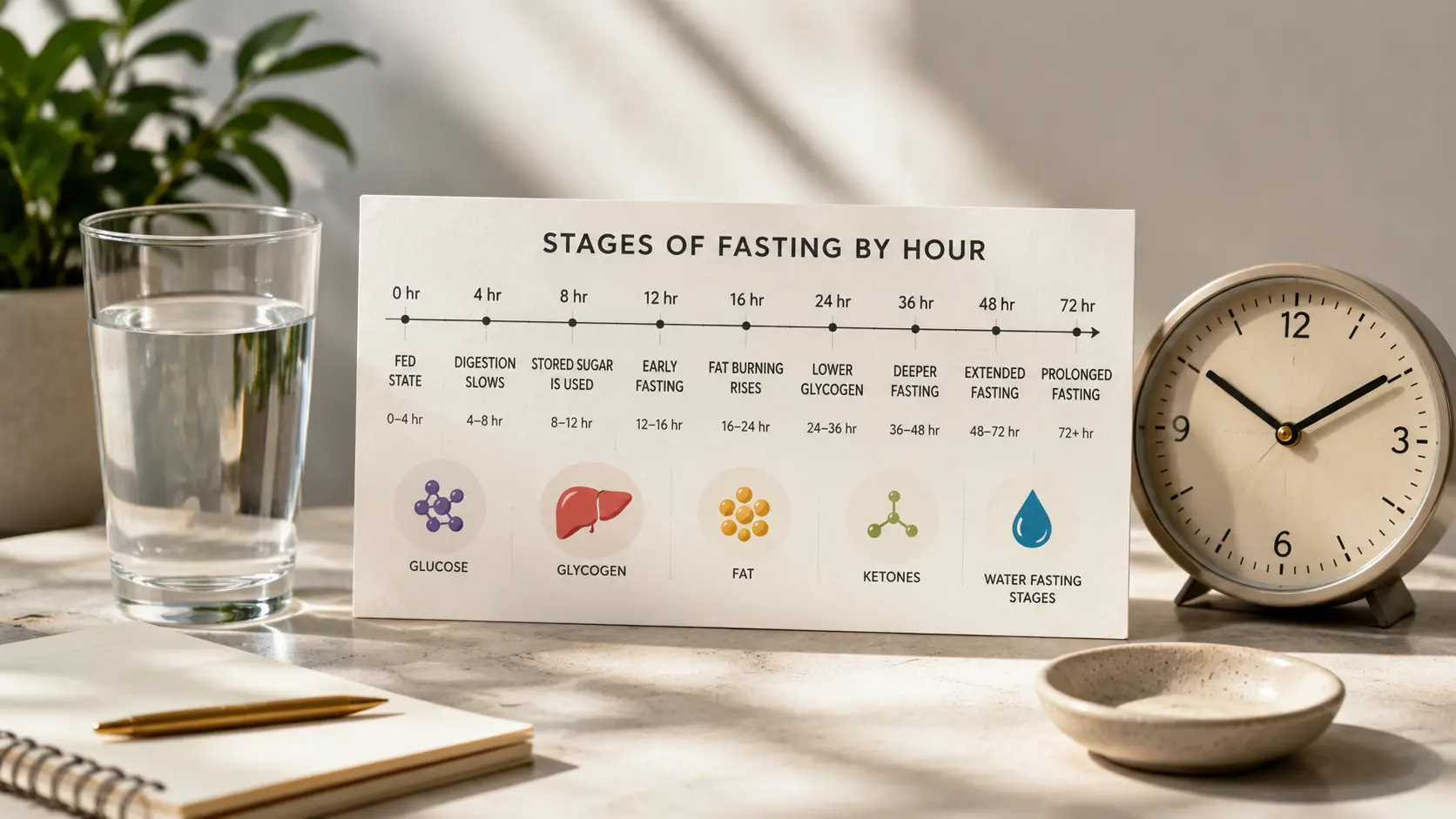









Most people expect fasting to feel steady, but it rarely does. Hour 4 feels nothing like hour 16, and understanding why changes everything.
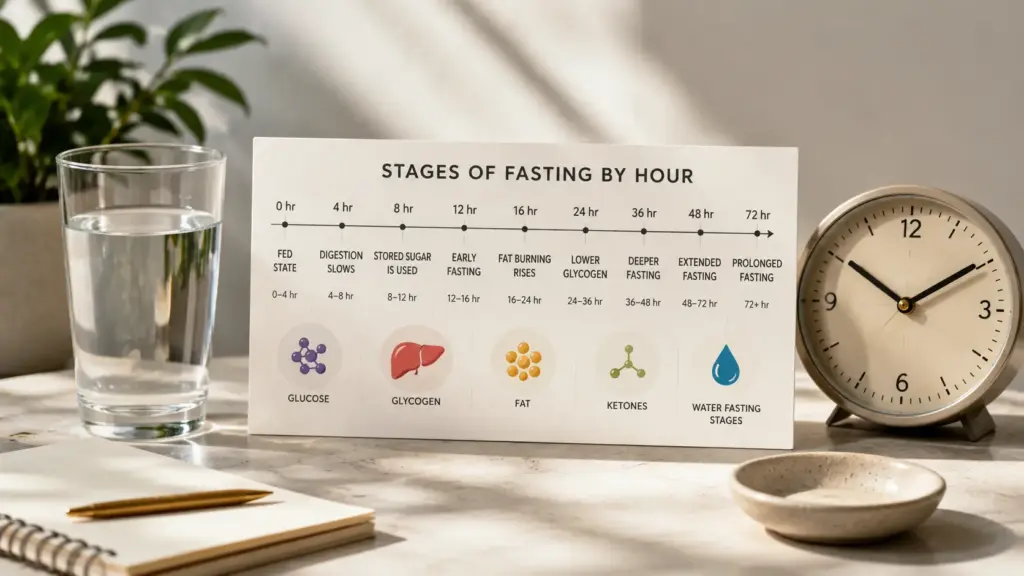
The stages of fasting by hour map exactly what shifts inside the body, from the first fuel handoff to deep fat metabolism and ketone production.
This blog covers the complete 0-to-72+ hour timeline, water-fasting stages, the body changes behind each phase, safety signals to watch for, and how to break a fast without undoing the work.
If fasting has ever felt confusing or harder than expected, what follows will make it far clearer.
| Disclaimer: Do not attempt prolonged fasting without medical supervision if you are pregnant or breastfeeding, underweight, diabetic, taking insulin or blood sugar medication, managing heart, kidney, or liver disease, recovering from an eating disorder, or taking any medication that requires food. |
What Happens Inside Your Body When You Stop Eating
Fasting isn’t a single state but occurs in phases driven by changes in fuel sources, hormones, and cell signals. After eating, energy from food is used first, then stored sugars, then fat, and finally ketones.
This process overlaps and varies based on individual factors. Rafael de Cabo and Mark P. Mattson describe this as metabolic switching from glucose to fatty acids and ketones, which occurs gradually and is influenced by meal timing, activity, sleep, stress, body composition, and health.
The timeline below reflects a standard no-calorie fast, though your chosen eating pattern shapes how quickly these shifts unfold.
| Fasting Window | Primary Fuel Source |
|---|---|
| 0 to 4 hours | Glucose from food |
| 4 to 8 hours | Glucose and stored fuel |
| 8 to 12 hours | Liver glycogen |
| 12 to 16 hours | Glycogen and early fat use |
| 16 to 24 hours | Fat and early ketones |
| 24 to 36 hours | Fat and rising ketones |
| 36 to 48 hours | Ketones and fat |
| 48 to 72 hours | Fat, ketones, and gluconeogenic glucose |
| 72+ hours | Fat, ketones, and gluconeogenic glucose |
This table is a map, not a promise. Ketosis does not begin at the same hour for everyone. Autophagy does not work like a light switch. The longer the fasting window, the more safety matters over milestones.
The Complete 0 to 72+ Hour Breakdown

Each stage below covers what is happening in the body, what it tends to feel like, and where caution becomes important. The format shifts across stages; earlier phases are straightforward; later ones need more context.
1. 0 to 4 Hours: The Fed State
In the hours after eating, your body processes food, carbohydrates become glucose, while protein and fat digest at different rates. Blood sugar rises, and insulin helps move glucose into cells, with excess stored as glycogen in the liver and muscles.
| What Happens | What It Means |
|---|---|
| Food is still being digested | Your body is using energy from your last meal |
| Blood sugar may rise | Glucose is entering the bloodstream |
| Insulin increases | Cells are being helped to take in glucose |
| Glycogen storage may begin | Extra glucose can be saved for later |
| Fat storage may happen | Extra energy can be stored if the meal is larger than needed |
2. 4 to 8 Hours: The Transition
By this stage, digestion is slowing. Your body may still be absorbing parts of your last meal, but insulin usually starts to fall.
Meal energy is still available, so this stage is mild for many people. Hunger may show up because of habit, boredom, or a usual meal pattern rather than a real need for food.
| What Happens | What It Means |
|---|---|
| Digestion slows | Less food energy is entering the bloodstream |
| Insulin starts falling | The body is moving away from the fed state |
| Stored fuel begins to matter more | The body starts preparing to use saved energy |
| Hunger may appear | Your body may expect food at its usual time |
| Small bites restart digestion | Snacks can interrupt a no-calorie fasting window |
3. 8 to 12 Hours: Overnight Territory
At 8 to 12 hours, less energy from your last meal is entering the bloodstream. Your body starts leaning more on stored fuel.
The liver helps keep blood sugar steady by releasing glycogen, which is stored sugar. Many people reach this stage overnight without thinking much about it, which raises a question worth settling early, whether nighttime hours count toward your window affects how you set your eating schedule.
| What Happens | What It Means |
|---|---|
| Meal energy drops | The body relies less on fresh calories |
| Liver glycogen is used | Stored sugar helps keep blood sugar steady |
| Hunger may rise | The body may respond to its normal eating schedule |
| Overnight fasting often reaches this stage | Many people enter this window while asleep |
| Energy may still feel stable | The body still has stored sugar available |
4. 12 to 16 Hours: Time-Restricted Eating Territory
This is where many time-restricted eating plans land. The 16:8 method, for example, uses a 16-hour fasting window and an 8-hour eating window.
During this stage, insulin levels are lower than after eating. Your body still uses glycogen, but fat use may start rising.
| What Happens | What It Means |
|---|---|
| Insulin stays lower | The body is moving further from the fed state |
| Glycogen is still used | Stored sugar continues to support energy |
| Fat use may rise | The body starts leaning more on stored fuel |
| Hunger may come in waves | Appetite may not stay steady the whole time |
| Ketosis is not guaranteed | Deep ketosis does not begin at the same hour for everyone |
5. 16 to 24 Hours: Fat Becomes the Dominant Fuel
After 16 hours, stored sugar becomes less available for many people. The body may rely more on fat for fuel.
Ketones may start rising before this stage for some people, but they often become more noticeable as fasting continues. The timing depends on carb intake, activity, sleep, and metabolic health.
| What Happens | What It Means |
|---|---|
| Glycogen may be lower | Stored sugar may not be as available |
| Fat use rises | The body leans more on stored fat for energy |
| Ketones may increase | Some people begin making more ketones |
| Energy may feel uneven | Focus, mood, and stamina can change |
| Physical effort may feel harder | Exercise may feel different without food |
6. 24 to 36 Hours: Extended Fasting Begins
A full-day fast moves beyond casual time restriction. By 24 to 36 hours, liver glycogen is often lower, especially if you were active or ate fewer carbs before the fast.
Before pushing into this range, it helps to understand what extended windows actually demand from the body and where the thresholds for risk begin.
Fat use becomes more important. Ketones may play a larger role, but the response still varies from person to person.
| What Happens | What It Means |
|---|---|
| Liver glycogen is often lower | The body has less stored sugar available |
| Fat use becomes more important | Stored fat helps support energy needs |
| Ketones may rise further | The body may make more ketones from fat |
| Headaches can appear | Fluid, sodium, sleep, or caffeine changes may play a role |
| Energy may vary | One person may feel calm while another feels slow or cold |
7. 36 to 48 Hours: Deep Ketosis Territory
At 36 to 48 hours, digestion is quiet because no food is coming in. Ketones may be higher, and appetite may drop after earlier hunger waves.
This stage can feel very different from the first day. Some people feel calm and focused, while others feel weak, cold, or drained.
| What Happens | What It Means |
|---|---|
| Digestion is quiet | The body is not processing new food |
| Ketones may be higher | Fat-based fuel may play a bigger role |
| Appetite may drop | Hunger waves may feel less intense for some people |
| Workout strength may fall | Hard activity can feel more difficult |
| Sleep may change | Some people wake early or feel alert at night |
8. 48 to 72 Hours: Autophagy, Gluconeogenesis, and the Limits of Popular Claims
At 48 to 72 hours, the body runs primarily on fat and ketones. Two topics recur at this stage, autophagy and the continued presence of glucose in the fuel mix. Both deserve a clearer explanation than most fasting content provides.
| Common Claim | Better Way to Understand It |
|---|---|
| 48 hours guarantee autophagy | Autophagy may increase, but timing is not exact |
| 72 hours reset the body | No fast fully resets the body |
| Longer fasting is always better | Longer fasts can raise safety risks |
| A long fast burns only fat | The body uses mixed fuel sources |
| Extended fasting is safe for everyone | Some people should avoid it without medical advice |
On autophagy: This is the body’s cellular cleanup process in which damaged cellular components are broken down and recycled. Fasting encourages this, but the exact timing in humans is unknown, and autophagy increases gradually during prolonged fasting.
On gluconeogenesis: The fuel table shows “gluconeogenic glucose” at 48 hours and beyond, which is produced in the liver from non-carbohydrate sources such as amino acids and glycerol. The body makes this to maintain blood sugar during fasting, preventing a collapse. It’s a normal, ongoing process, not a sign of a problem.
9. 72+ Hours: Medical Territory
A fast beyond 72 hours is not a wellness experiment. This stage carries real clinical risk and should not be replicated from online challenges or social media trends.
The U.S. National Library of Medicine notes that refeeding after prolonged starvation can cause dangerous fluid and electrolyte shifts, a condition known as refeeding syndrome. The risks at this stage include low blood sugar, dehydration, electrolyte imbalance, fainting, severe weakness, and complications when food is reintroduced.
| Risk | Why It Matters |
|---|---|
| Low blood sugar | Can cause shaking, confusion, weakness, or fainting |
| Dehydration | Worsens dizziness, headache, and fatigue |
| Electrolyte imbalance | Affects energy, muscle function, and heart rhythm |
| Refeeding complications | Eating too quickly after a long fast can cause dangerous internal shifts |
| Medication interactions | Some medications require food or stable blood sugar to work safely |
Water Fasting Stages: The Same Biology, Higher Stakes
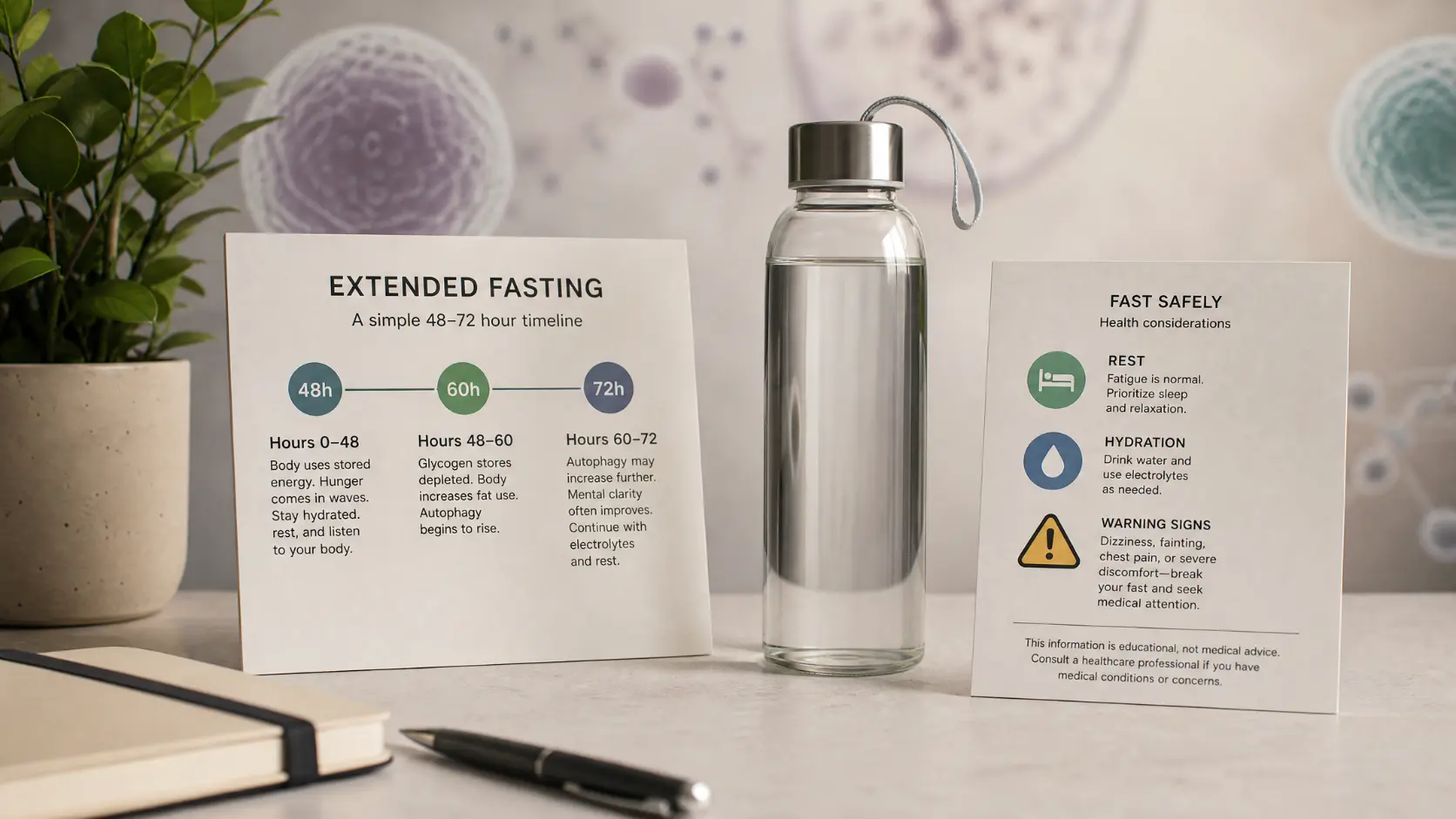
Water fasting follows the same biological timeline described above. The body uses the same fuel sequence, moves through the same hormonal shifts, and experiences metabolic switching in the same general pattern.
What differs is not the sequence, but the intensity and the risk. Because strict water fasting means water only, there is no buffer from broth, electrolytes, or any caloric intake at all.
- The first 24 hours tend to feel similar to any no-calorie fast. Most people manage this without major difficulty if they are reasonably healthy and well-rested going in.
- After 24 hours, the margin narrows. Hydration status, sodium balance, blood sugar stability, and sleep quality need active monitoring, not passive optimism. Lightheadedness, weakness, and sodium loss become more pronounced in the absence of a buffer.
- After 48 hours, the risks become clinically meaningful. Dehydration, electrolyte imbalance, and low blood sugar are not theoretical at this point. Anyone continuing beyond 48 hours on water alone should have medical oversight.
A strict water fast is broken by anything other than water, broth, juice, milk, cream, electrolyte drinks with calories, or any food, and the fast ends entirely.
Normal Signs vs. Warning Signs During a Fast

Mild discomfort is a common side effect of longer fasting windows. Severe symptoms are different and should not be pushed through.
The Centers for Disease Control and Prevention (CDC) identifies shaking, sweating, confusion, dizziness, and sudden hunger as signs of low blood sugar. Anyone managing diabetes or taking blood sugar medication needs to be especially cautious throughout any fasting window.
| Commonly Normal | Stop the Fast Immediately |
|---|---|
| Mild hunger waves | Fainting or near-fainting |
| Empty stomach feeling | Confusion or disorientation |
| Slight headache | Severe or escalating weakness |
| Mild bad breath | Chest pain or palpitations |
| Reduced exercise energy | Repeated or worsening dizziness |
| Mood shifts | Shaking accompanied by sweating |
If a symptom is on the right side of that table, stopping is not optional.
How to Break a Fast Without Causing More Harm
The digestive system has been at rest. Reintroducing food too aggressively, especially after a longer fast, stresses a system that needs a gradual reawakening.
The quality of how you break a fast matters as much as the fast itself. In my practice, this is the step I spend the most time on with people, because it is the step most often rushed.
| Fast Length | Recommended Approach |
|---|---|
| 12 to 16 hours | A normal, balanced meal works fine |
| 24 hours | Eat slowly, keep the first meal smaller than usual |
| 48 to 72 hours | Small portions of gentle foods, spaced out over several hours |
| 72+ hours | Get medical guidance before eating anything substantial |
Easier refeeding options include soft-cooked vegetables, plain rice, eggs, yogurt, and lean protein. Avoid alcohol, heavily fried food, very spicy dishes, and oversized portions immediately after any extended fast.
If symptoms appeared during the fast or it lasted beyond 48 hours, speak with a healthcare provider before the first meal.
Frequently Asked Questions
Does the order of macronutrients in your last meal affect how quickly you enter fat-burning?
Yes. A pre-fast meal higher in refined carbohydrates leaves more glycogen to be depleted before the body shifts to fat. A meal higher in fat and protein starts with lower glycogen levels, meaning the transition may occur earlier. Two people fasting the same hours can feel completely different by hour 14 for exactly this reason.
Can poor sleep during a fast affect which fuel stage you’re in?
It can. Poor sleep raises cortisol, which slows fat oxidation and keeps blood sugar elevated for longer. People who fast through poor sleep consistently report greater hunger, greater irritability, and a slower transition into fat-burning phases than those who sleep well during the same fasting window.
Is it normal for fasting to feel easier the more you practice it?
For many people, yes. The body becomes more efficient at switching between fuel sources with repeated exposure. The hunger waves that once felt sharp at hours 13 to 15 often become more manageable over time. That said, easier does not mean risk-free; longer windows still carry the same clinical caution regardless of experience level.
What does bad breath during fasting actually mean?
It is usually a sign of ketone production. Acetone, a ketone the body exhales, produces a metallic or faintly fruity smell, sometimes described as nail polish remover. A dry or metallic taste in the mouth and shifts in urine odor are also common. None of these confirm ketosis the way a blood meter would, but they are useful informal signals.
How does stress affect fasting stages?
Stress raises cortisol, which signals the body to maintain higher blood sugar and can slow the shift away from glucose. A fasting window under significant psychological stress may feel harder, hunger may persist longer, and the transition to fat metabolism may be delayed. Managing stress during a fast is not optional; it is part of the protocol.
Conclusion
Thestages of fasting by hour follow a reliable sequence: glucose, glycogen, fat, ketones, but they do not follow a shared clock.
What shapes your experience is your biology, your last meal, your sleep, and your stress, not someone else’s timeline. Water fasting stages follow the same pattern but require greater caution as the hours increase.
From my experience working with people through structured fasting, the ones who listen to their body rather than chase a milestone almost always do better.
If this gave you a clearer picture of what is happening inside, share it or drop your question in the comments below.