












Order a tomato juice at a café, and nobody blinks. Order one at High Altitude, and the person next to you might order one too. Tomato juice is one of the most requested drinks on flights, yet on the ground, it rarely crosses most people’s minds.
The question of why tomato juice tastes better on a plane is not a travel myth or a collective coincidence. There is documented scientific evidence behind it, and once you understand it, every flight starts making a lot more sense.
What follows is the full view, the research, the biology, the noise, and the reason your taste buds at cruising altitude are a completely different instrument than the ones you walked onto the plane with.
The Research That Made Tomato Juice a Flight Staple
Most airlines accepted tomato juice’s in-flight popularity as a quirk and moved on. Lufthansa, Germany’s flagship carrier, did not. Rooted in German engineering culture, where data matters more than assumptions.
Lufthansa commissioned the Fraunhofer IBP research, one of Europe’s most respected applied research organizations, to find out exactly why passenger drink preferences in the air looked so different from the ground.
What they found was striking: tomato juice was being ordered almost as frequently as beer. On the ground, those numbers would be reversed dramatically.
That single data point prompted a broader structured investigation into how the aircraft environment changes what people actually want to eat and drink, and the findings reshaped how airlines think about in-flight catering entirely.
What Happens to Your Taste Buds at Altitude
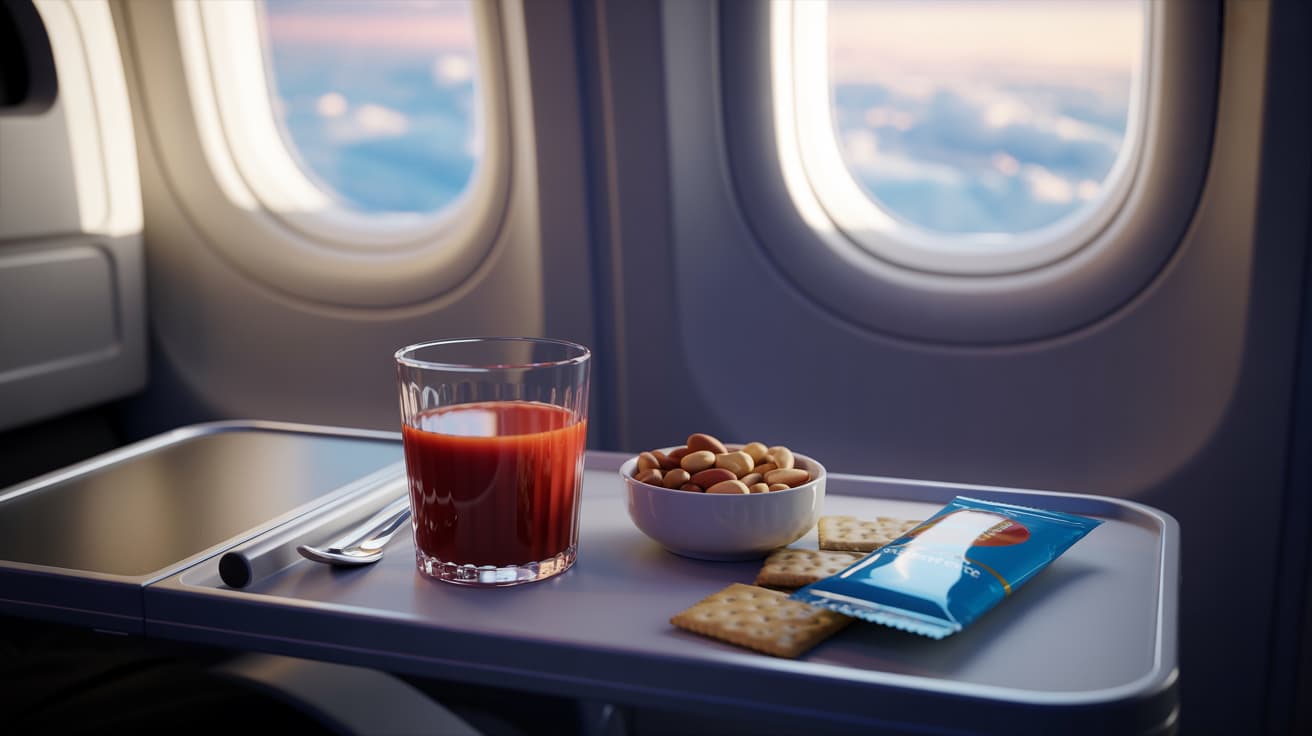
The aircraft cabin alters the way everything tastes more than most passengers realize, and what lands in your glass matters even more for those managing Chronic Kidney Disease (CKD).
- Humidity drops to 10–15%: drying out nasal passages and dulling smell almost immediately
- Smell drives 80% of taste: so any drop in smell perception has an outsized effect on flavor
- Cabin pressure mimics 6,000–8,000 feet: affecting how the olfactory system processes scent
- Sweet and salty perception drops 20–30%: both flavors become significantly harder to detect
- Umami stays intact, and may actually intensify as sweet and salty signals weaken around it
Two of your five taste signals are effectively turned down at altitude, and that changes everything about what tastes good up there.
Why Tomato Juice Benefits Specifically
With the sweet-and-salty perception suppressed, the flavor landscape at altitude shifts entirely, and tomato juice sits in exactly the right place to benefit.
Tomato juice naturally contains high levels of glutamates, a drink low in carbohydrates yet extraordinarily rich in the exact compounds that altitude amplifies. Unlike sweetness and saltiness, umami perception is not dulled at altitude. If anything, the contrast effect amplifies it; when two dominant taste signals are suppressed.
What tastes flat, earthy, or overpowering on the ground becomes balanced, mineral, and genuinely refreshing at cruising altitude. Tomato juice is not a different drink at 35,000 feet; it is the same drink finally being tasted in the conditions it was always best suited for. Nothing about the juice changes. Everything about the environment does.
Three Forces Quietly Reshaping Every Sip
Three forces converge at cruising altitude to reshape how everything tastes, and none work in isolation.
- Cabin humidity drops to 10 to 15 percent, drying nasal passages and dulling smell, which accounts for eighty percent of how taste is actually perceived.
- Cabin pressure mimics conditions at 6,000 to 8,000 feet, suppressing the olfactory system and measurably reducing how clearly the brain registers flavor.
- Aircraft cabin noise sits at eighty to eighty-five decibels, reducing sweetness perception while amplifying umami sensitivity, according to Cornell University researchers.
Humidity dulls smell. Pressure suppresses scent. Noise amplifies umami. Together, they do not just change what tastes good. They actively decide what tastes good.
Other Popular In-Flight Beverages for Pilots and Crew
Crew spends more time at altitude than anyone, and the drinks they reach for reflect both hydration awareness and the practical realities of working a long shift at 35,000 feet. Here is what they actually drink and why:
| Drink | Why Crew Choose It | Best For |
|---|---|---|
| Water | Dry cabin air accelerates fluid loss fast | All-round hydration |
| Electrolyte drinks | Replaces minerals lost through dehydration | Long-haul flights |
| Warm broth | Sodium supports fluid retention | Cold cabin conditions |
| Green tea | Gentle caffeine without altitude bitterness | Mental alertness |
| Coconut water | Natural electrolytes, no artificial additives | Short-haul hydration |
For crew managing cognitive performance across long shifts, what goes in the glass is not a preference; it is a calculated operational decision.
Other Tastes That Change on a Plane
Tomato juice is the most talked-about example, but altitude reshapes the taste of almost everything consumed in the cabin. Here is what else changes and why:
- Coffee: tastes harsher and more bitter, a result of dulled taste perception and water quality used for brewing
- Wine: tastes flatter in the air, meaning bold wines on the ground often work better at altitude
- Spicy food: perceived with similar intensity, which is why airlines season food far more aggressively than restaurants do
- Sweet drinks: noticeably less sweet in the air, making them easy to overconsume without realizing
The altitude that makes tomato juice taste better is the same altitude that makes everything else taste worse.
How to Eat and Drink Smarter on a Plane
Knowing how altitude changes taste perception opens up a genuinely different way to eat and drink on a plane. Here is how to put it to use:
- Try something normally too sweet: it will taste noticeably milder and more balanced in the air
- Order umami-rich foods: tomato dishes, broths, and aged cheeses taste more satisfying at altitude
- Go easy on sweet drinks: significantly muted sweetness makes them easy to overconsume without noticing
- Give tomato juice a fair try: a flight is genuinely the ideal condition to revisit it
- Choose bold wine over light: fuller wines on the ground taste more balanced once airborne
- Skip the extra salt packet: the drink and the food are already seasoned for normal conditions; your altitude-dulled taste buds are the ones lying to you, not the recipe.
The cabin is working on your senses; if you realize it or not, you may as well use it to your advantage.
Final Thoughts
Most people board a plane without realizing their taste buds are about to undergo a complete conversion. Now you know exactly why that happens, and why tomato juice tastes better on a plane is a question with a genuinely intriguing answer.
Low humidity, reduced cabin pressure, background noise, and umami science all converge at 35,000 feet to create a sensory environment unlike anything on the ground.
What I find most interesting is how simple the takeaway actually is: your environment shapes what tastes good, and a plane is one of the most extreme examples of that.
Next time you fly, order the tomato juice. Pay attention to what else tastes different. Then come back and tell me what you noticed.